

Monthly Recurring Revenue (MRR) is a metric used to gauge how much money the organization brings in from subscriptions or recurring payments. This metric sheds light on how well the organization is growing through both new customer acquisitions and ongoing customer retention.
Organizations are dedicated to tracking MRR to have more predictable revenue each month while also building a more risk averse growth trajectory. Investors often look at MRR as a way to gauge the stability and health of the companies they invest in. If your company is looking for this predictability and stability too, here’s what you need to know about MRR.

How to Calculate Monthly Recurring Revenue
On the surface, the formula to calculate Monthly Recurring Revenue (MRR) looks relatively simple:
MRR = (total customers) x (average monthly revenue per customer)
While that calculation might be simple enough for a middle school student to do, there’s quite a bit more depth baked into this one metric. Similarly, you can use this metric in a variety of ways to get more insights around what your customers are doing, what they’re buying, and who’s behind the purchase.
Types of Monthly Recurring Revenue
The MRR formula isn’t isolated to all customers and the average revenue per customer across all products or segments. Organizations can dig deeper using MRR by breaking out various areas of the business.
Here are some of the top used types of MRR:
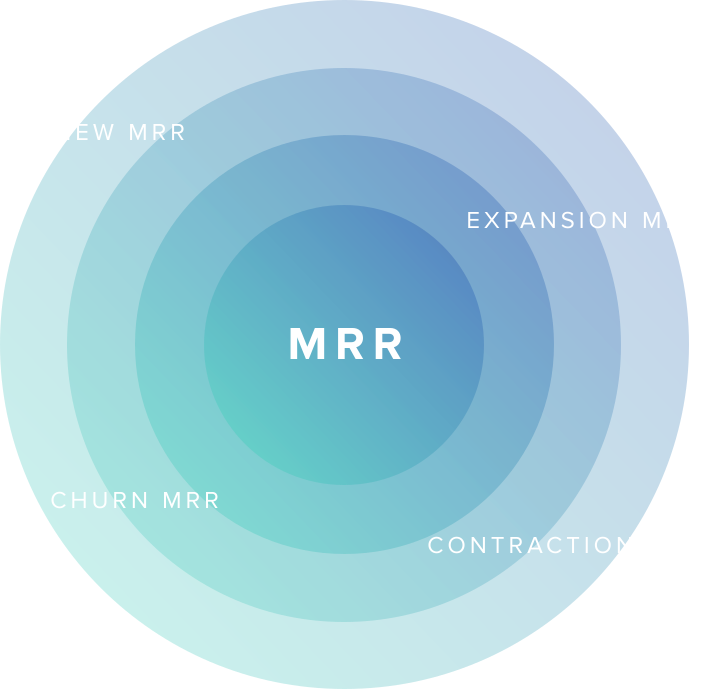
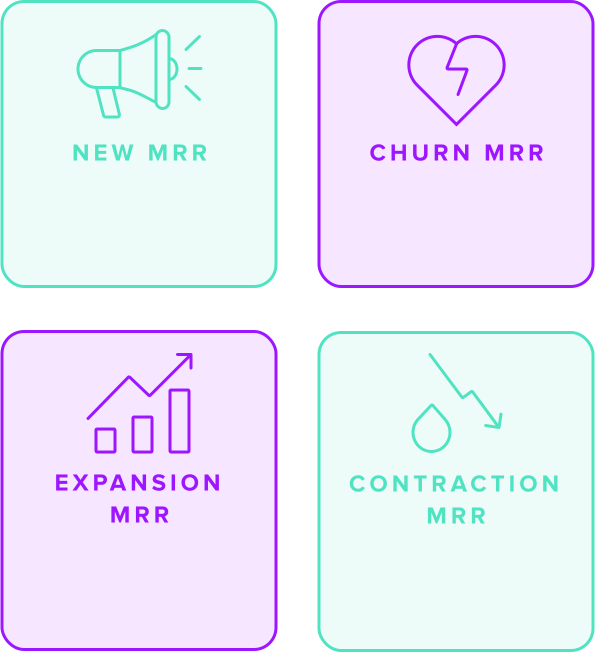
- New MRR: Monthly recurring revenue for customers who signed up in the last month or quarter.
- Churn MRR: Monthly recurring revenue lost due to customers churning out of the subscription.
- Expansion MRR: Additional monthly recurring revenue from customers who upgraded.
- Contraction MRR: Reduced monthly recurring revenue from customers who downgraded.
By understanding the various types of MRR, your team can take this one metric and peel back the proverbial layers to look closer at what’s happening, where changes are occurring, and what can be done to continue moving MRR upward.

Increasing MRR to Grow More Strategically
When it comes to MRR, it’s clear that the higher the number the better for your organization. With that in mind, many people wonder how they can increase MRR beyond the obvious of acquiring more new customers.
At RocketSource, we leverage the StoryVesting framework to bring the customer experience closer in alignment with the business’s why, business model, the 3 Ps, and, of course, the products or services offered. In doing so, retention increases and customers continue to advocate for the brand to their audience building word of mouth marketing and creating a stickier experience.
Another approach many organizations take is to optimize the pricing strategy by offering tiered levels for customers to subscribe to, upselling customers, or increasing rates. Many businesses also work to get subscribers onto an annual plan, reducing monthly churn and lowering risk.
By using StoryVesting to maintain a clear and consistent focus on what customers want and how to deliver it most effectively, organizations can increase MRR.
Key Benefits of Analyzing Monthly Recurring Revenue
Monthly Recurring Revenue (MRR) goes well beyond how much money organizations bring in each month. This single metric is rich with insights about how well the product aligns with a fast-paced market.

Get Closer to Product-Market Fit
Monthly Recurring Revenue (MRR) isn’t a standalone metric. It’s a signal that things are going well and a key component of Product-Market Fit mapping. By monitoring MRR, you can gauge the health of your customer acquisition costs, retention costs, and the lifetime value of each customer.

Gain Key Customer Insights
MRR is determined by how engaged customers are with your brand and how many people stay with your subscription month after month. When you segment these customers down, you can get more insights around who’s using your product each month and where to target your efforts.

Take an Innovative Stance
Slow growth or declining MRR is a clear signal that something inside the customer experience isn’t in alignment with expectations. By using MRR to monitor behavioral trends, your team can move quickly to improve, innovate, or invent new ideas to become stickier in the market.

Improve Employee Experiences
By calculating and monitoring MRR, teams can see how their work influences the bottom line and makes an impact on the customer’s lives. This impact is critical for helping employees see the value of their work and building a better employee experience overall.

Customer Experience (CX) Terms
- 360° Degree View of the Customer
- Agentic AI
- AI Ops
- Annual Recurring Revenue
- Behavioral Economics
- Behavioral Insights Matrix
- Behavioral Triggers
- Bow Tie Funnel
- Brick-to-Click
- Business Impact Analysis (BIA)
- Cognitive Computing
- Cohort Analytics
- Content Mapping
- Convergence / Divergence Bands
- Conversational User Guidance
- Customer Data Profile
- Customer Experience (CX)
- Customer Friction
- Customer Insights Map
- Customer Journey
- Customer Journey Mapping
- Customer Satisfaction (CSAT)
- Customized Ratios
- CX Intelligence
- CX Led Growth
- CX Metrics
- Data as a Product (DaaP)
- Data as a Service (DaaS)
- Data Culture
- Data Driven
- Data Engineering
- Data Fabric
- Data Governance
- Data Humanization
- Data Hygiene
- Data Looping
- Data Mapping
- Data Mining
- Data Modeling
- Data Monetization
- Data Swamp
- Data Visualization
- Data Warehouse
- Data-Centric
- Descriptive Analytics
- Diagnostic Analytics
- Digital Asset Management (DAM)
- Digital Transformation
- Dirty Data In Dirty Data Out
- Domain Specific Models
- Embedded Intelligence
- Empathy Mapping
- Employee Data Profile
- Employee Experience (EX)
- EPS
- EX to CX Data Mapping
- EX to CX Mapping
- Experience Management (XM)
- Foundation Models
- Gap Analysis
- Generative Adversarial Network
- Generative AI
- GEO
- Hallucinations
- Human-Centered Design (HCD)
- IRR
- Journey Analytics
- Large Language Model
- Machine Learning (ML)
- Managed Agile Services on Demand
- Model Training
- Modified Hoshin
- MRR
- Neural Network
- North Star Metric
- Party Data
- Pathway to Purchase
- Predictive Analytics
- Product-Market Fit Mapping
- Real Time Design Looping
- Revenue Acceleration
- RevOps
- ROAS vs. ROI
- S Curve of Growth
- Stack Impact Analysis
- StoryVesting
- Table Stakes Testing
- The 3 P’s
- Transformers
- User Experience (UX)
- User Insights Map
- User Interface (UI)
- Vector Database
- Vector Database Copy
- Voice of the Customer (VoC)
- Voice of the Employee (VoE)
- X Analytics