

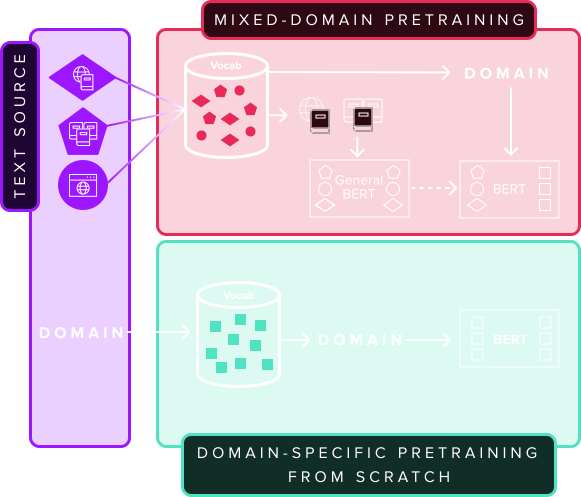
Domain Specific Models are large language models (LLMs) trained specifically for well-defined tasks. In putting up the guardrails for the output generated by an LLM, domain-specific models are able to tap into industry-specific data to deliver real-world applications for specific departmental needs. Domain specific models are best suited for industries that require clearly-specified outputs to answer niche challenges.


Why Enterprises Need Domain Specific Models
Right now, ChatGPT and Midjourney are dominating headlines as the generative artificial intelligence (AI) tools of choice. However, as enterprises refine their approach to generative AI, domain-specific models will be able to step in to offer clearer and more accurate outputs for the enterprise itself.
While LLMs are able to wrangle large amounts of data, domain-specific models can take those same large datasets and whittle the outputs down using fewer parameters and a more targeted approach. This means that teams at the enterprise level can work more precisely in real-time.
How to Domain Specific Models Work?
Domain specific models work a little differently than large-scale generative AI tools. To wield them correctly, teams must identify the specific problem they’re seeking to solve with a specific data set. Likewise, teams must be aware of the model’s requirements and constraints. With the domain defined, teams can them implement domain-specific modeling to clarify goals, unearth solutions, and identify challenges.
This software is designed by creating and manipulating models to validate, test, generate, and deploy specific outputs. When deployed correctly, these models are implemented via the current platforms and processes you have in place.
Challenges of Domain Specific Models
While it can seem like domain specific models are a good way to go deep with generative AI and LLMs, there are inherent challenges that go along with this type of model. Namely, its limitations. Because the model requires the user to define and maintain the modeling language, users must be well trained and educated on creating this type of model. This approach can be complex and time-consuming for teams.
Similarly, because it’s up to the human counterpart to integrate and interoperate with the model correctly, teams must approach domain-specific models through a framework rooted in behavioral psychology, like the StoryVesting framework. This approach is critical so that humanity can be infused into the strategic approach for generative AI, so that teams receive quality results.
The Importance of Domain Specific Models
Domain specific models may be harder to set up and manage, but their importance at the enterprise level cannot be underestimated.

Improve Employee Productivity
Domain specific models allow teams to get hyper specific results rooted in data that corresponds to their challenges and hurdles faster. In this timelier and more accurate result, teams can improve productivity and operate more efficiently.

Speed Innovation
By allowing users to experiment with various alternatives in an artificial setting, teams can speed the time it takes to innovate on current products, services or offerings. This allows teams the flexibility to modify models with less risk.

Architect New Experiences
Gathering insights alone won’t give you the silver bullet to success. Leveraging a framework rooted in behavioral economics, like our StoryVesting™ framework will help you architect the kind of experiences that create household names and build brand euphoria.

Improve Path to Loyalty
The law of exposure states that what people expose themselves to, they become. For marketers, being able to tap into behavioral economics to better shape experiences that’ll align with their underlying emotions and needs will help you build trust over time and deliver experiences that will drive loyalty.

Customer Experience (CX) Terms
- 360° Degree View of the Customer
- Agentic AI
- AI Ops
- Annual Recurring Revenue
- Behavioral Economics
- Behavioral Insights Matrix
- Behavioral Triggers
- Bow Tie Funnel
- Brick-to-Click
- Business Impact Analysis (BIA)
- Cognitive Computing
- Cohort Analytics
- Content Mapping
- Convergence / Divergence Bands
- Conversational User Guidance
- Customer Data Profile
- Customer Experience (CX)
- Customer Friction
- Customer Insights Map
- Customer Journey
- Customer Journey Mapping
- Customer Satisfaction (CSAT)
- Customized Ratios
- CX Intelligence
- CX Led Growth
- CX Metrics
- Data as a Product (DaaP)
- Data as a Service (DaaS)
- Data Culture
- Data Driven
- Data Engineering
- Data Fabric
- Data Governance
- Data Humanization
- Data Hygiene
- Data Looping
- Data Mapping
- Data Mining
- Data Modeling
- Data Monetization
- Data Swamp
- Data Visualization
- Data Warehouse
- Data-Centric
- Descriptive Analytics
- Diagnostic Analytics
- Digital Asset Management (DAM)
- Digital Transformation
- Dirty Data In Dirty Data Out
- Domain Specific Models
- Embedded Intelligence
- Empathy Mapping
- Employee Data Profile
- Employee Experience (EX)
- EPS
- EX to CX Data Mapping
- EX to CX Mapping
- Experience Management (XM)
- Foundation Models
- Gap Analysis
- Generative Adversarial Network
- Generative AI
- GEO
- Hallucinations
- Human-Centered Design (HCD)
- IRR
- Journey Analytics
- Large Language Model
- Machine Learning (ML)
- Managed Agile Services on Demand
- Model Training
- Modified Hoshin
- MRR
- Neural Network
- North Star Metric
- Party Data
- Pathway to Purchase
- Predictive Analytics
- Product-Market Fit Mapping
- Real Time Design Looping
- Revenue Acceleration
- RevOps
- ROAS vs. ROI
- S Curve of Growth
- Stack Impact Analysis
- StoryVesting
- Table Stakes Testing
- The 3 P’s
- Transformers
- User Experience (UX)
- User Insights Map
- User Interface (UI)
- Vector Database
- Vector Database Copy
- Voice of the Customer (VoC)
- Voice of the Employee (VoE)
- X Analytics