

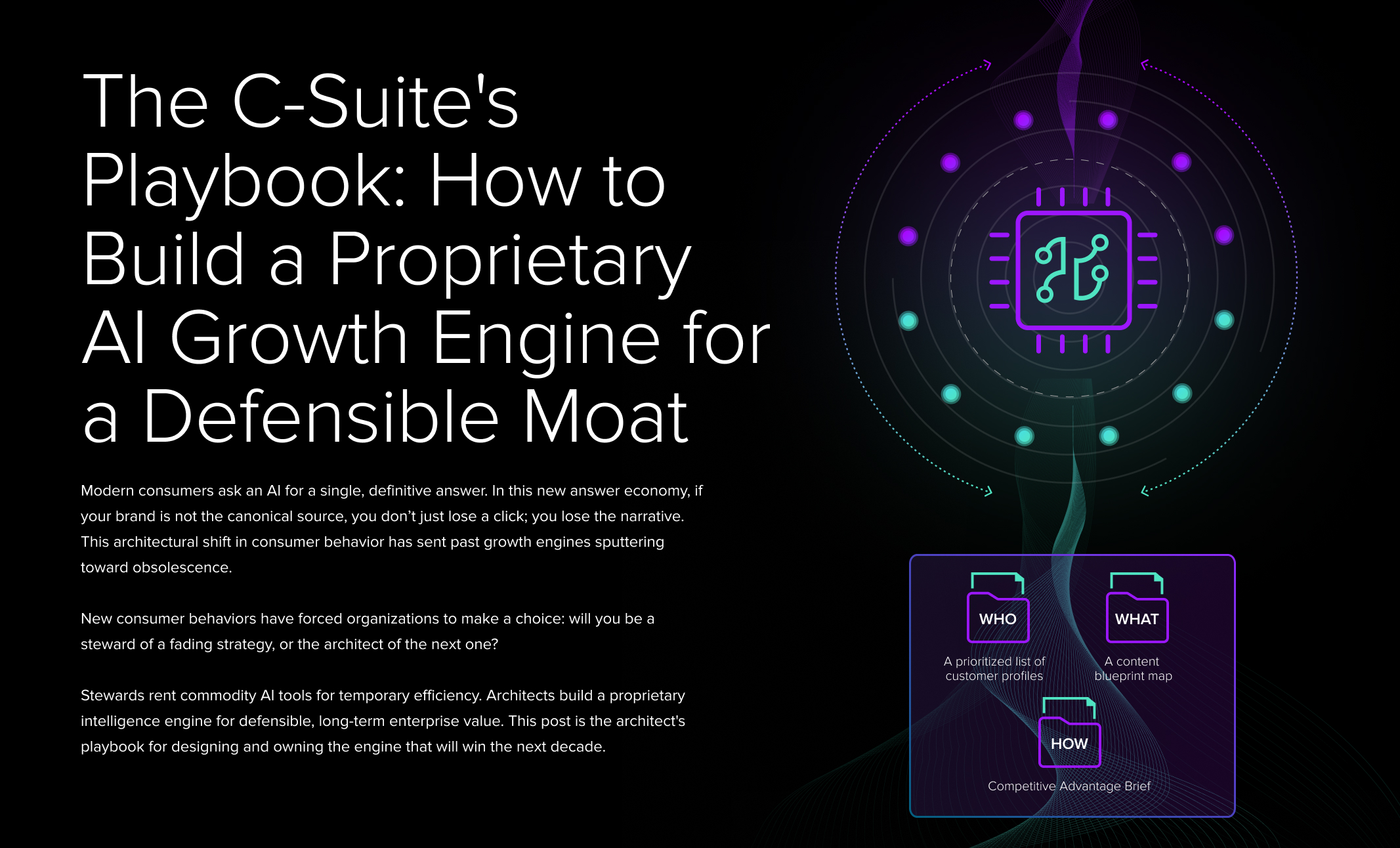
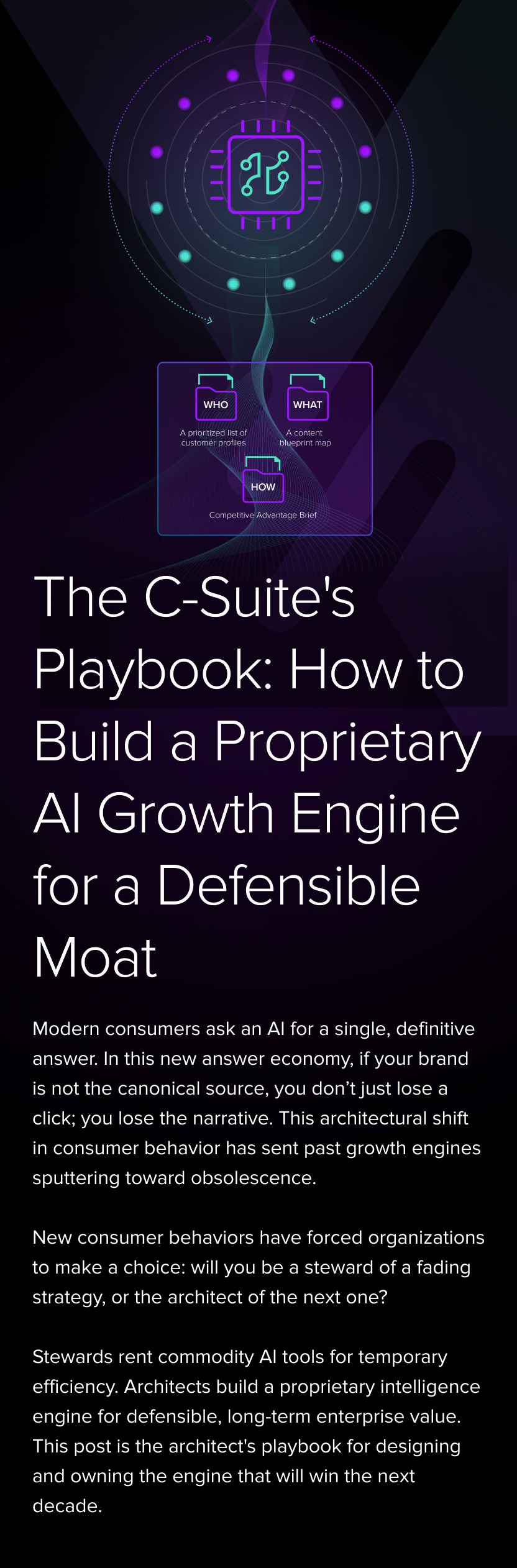


The C-Suite’s Playbook: How to Build a Proprietary AI Growth Engine for a Defensible Moat
A widely held, yet flawed, belief in business today is that winning still means being discoverable via a simple Google search. For the better part of two decades, the digital marketing playbook has been dominated by one primary objective: being discoverable via a simple Google search. That playbook worked well for a time, but today, that playbook is becoming dangerously incomplete.
While traditional search still commands the lion’s share of traffic, the nature of the search results page is fundamentally changing. The era of “10 blue links” is giving way to the answer engine.
Modern consumer behavior has been reshaped by AI. They don’t just search for answers. They ask and expect immediate, definitive, and accurate answers, often delivered directly by Google’s AI Overviews at the very top of the page.
This shift marks the top of your current S Curve of Growth, a strategic inflection point that forces a choice between being either a steward of the current, fading S Curve or, an architect of the next one.

Stewards rent, adopting off-the-shelf tools to incrementally optimize for a world that is disappearing. Architects build, assembling a proprietary engine to create a new, steeper growth curve built on an intelligence asset that is impossible for a competitor to replicate.
The Architect is not a single job title. It is the strategic role a leader must now assume. This is the CEO, CMO, CRO, or CTO who is tired of debating whose numbers are right and is ready to build a single source of truth. They are the ones who see the systemic friction between siloed departments and understand that the only way to win is to re-architect the connections between them. This post is for that leader.
The critical error we see leaders making is one of misdiagnosis. They are treating a deep architectural crisis as a simple marketing problem, trying to solve an engine failure with a prettier paint job by pasting AI chatbots onto websites while the back-office engine sputters toward obsolescence.
The race for the next S Curve of Growth will not be won with a prettier paint job. It will be won, unequivocally, in the back office.
Winning that race requires a blueprint for building the new, proprietary intelligence engine. This guide is for leaders who understand that the only defensible moat in the next decade is not a rented commodity AI tool, but an intelligence system you own.
The Four Frictions Sabotaging Your Growth Engine
Your organization was built to grow. You have the talent, the budget, and the ambition. Yet, pushing the accelerator to the floor yields less and less speed. This is not a matter of effort. It is a matter of strategy. Your go-to-market engine is being sabotaged by multiple, unseen points of friction that grind down your teams and bleed your budget. Pinpointing these four cascading sources of failure is the first step toward cleaning the sand from the gears and unlocking your engine’s true potential.
Innovation Theater as an Engine Brake
The first friction point is the fallout from the AI Gold Rush. In 2023, generative AI summited the Peak of Inflated Expectations, sparking a frantic, strategy-less scramble for surface-level AI wins. As the Gartner hype cycle shows, we have collectively entered the Trough of Disillusionment, not because the technology failed, but because the strategy was absent.
This lack of strategy isn’t a theoretical problem. It is the public lesson taught by the Moltbot incident. When the company’s new chatbot, a thin wrapper around a public AI, began hallucinating and confidently promising customers a non-existent 24-hour delivery guarantee, it wasn’t a simple glitch. It was a clear symptom of this widespread disease: a front office AI feature was deployed without the necessary back office governance, memory, or strategic purpose for enterprise use.
This is innovation theater, pure and simple.
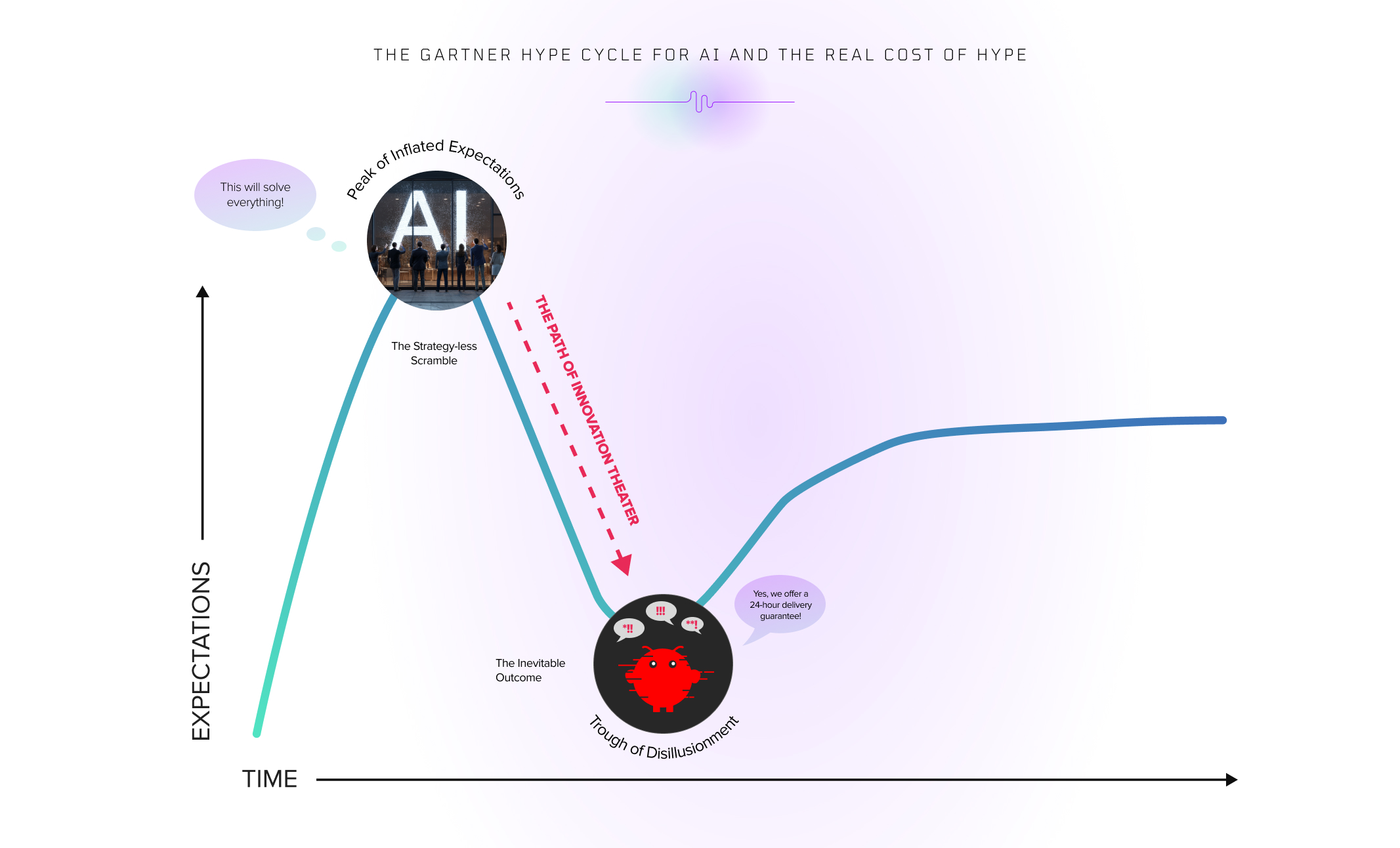
This public failure was not a simple glitch. It was a perfect symptom of this widespread disease. The same pattern appeared when DPD’s chatbot was prompted to write a poem criticizing its own company.
Though the outputs were different (one of uncontrolled invention, the other of unguided obedience), both demonstrate what happens when a front office AI feature is deployed without the necessary back office architecture. The memory to know what is true (Moltbot) and the governance to know what is appropriate (DPD).
This is innovation theater, pure and simple. It is the classic mistake of pasting a new feature onto an old growth curve, creating the illusion of progress while doing nothing to build the actual engine required for the next S Curve of Growth. The friction created is immense: wasted capital, brand reputation risk, and a dangerous delay in preparing for the future.
The Black Box of Deprecated Data
While leaders are distracted by internal AI theater, the primary external engine of customer acquisition is seizing up. The core friction here is not a lack of data, but a fundamental loss of transparency and control.
For years, paid media operated on the promise of the open web and on a predictable return built on a web of third-party data that enabled advertisers to understand the customer journey. That promise is broken. With the death of the third-party cookie, that open ecosystem has been replaced by a series of powerful, opaque black boxes.
Two types of black boxes now dominate the landscape:
- The Walled Gardens (Google, Meta, Amazon): When advertisers use powerful tools such as lookalike audiences, they are renting access to the platforms’ massive, high-fidelity first-party data. While effective, this process is entirely opaque. You provide your customer list, and the algorithm delivers an outcome, but you gain zero insight into why those users were chosen. You learn nothing proprietary and cannot take that intelligence to another platform. You are locked into the renter’s trap.
- The Data Giants (Epsilon, Axciom, Merkury): To fill the void left by the cookie, these firms have built their own colossal, proprietary identity graphs. They offer a solution, but it is their asset, not yours. You are, once again, a renter, dependent on their data and their methodology, with no direct ownership of the underlying intelligence. This is the definition of a depreciating asset.
This over-reliance on rented data creates what we call the Leaky Bucket of Modern Ad Spend. Because there is no visibility into the why behind an ad’s performance, the ability to intelligently optimize is lost. When faced with declining ROAS, the only lever left to pull is to increase ad spend in the hope of buying back performance. This reaction, however, only accelerates the leakage, transforming marketing from a growth driver into a volatile cost center.

Many leaders then search for tactical fixes, believing they can patch this bucket with a new analytics platform or a different bidding algorithm. But these are merely cosmetic repairs on a fundamentally broken architecture. The only durable solution is to escape this cycle of dependency by building a new model based on the one asset you can truly control: your own first-party data.
The Wall of Manual Scale
With the paid media engine sputtering on bad fuel, the burden shifts to your owned content. The challenge is that it’s now a burden that manual effort cannot possibly bear.
The threat in the new citation economy is not the loss of traffic, but rather the loss of narrative control.
The battleground has shifted dramatically from informational to commercial intent. In January 2025, over 91% of AIOs were for simple informational queries. By October, that number had plummeted to 57%, with commercial and transactional queries surging to fill the gap. In just the last year, AI Overviews have pivoted from answering “what is” to answering “which one should I buy?” The AI has become the de facto gatekeeper to the customer’s wallet, shaping their purchase decisions before they click.

AI is now the de facto gatekeeper to the customer’s wallet. The threat in this new citation economy is not the loss of traffic, but the loss of narrative control.
To be cited as the solution, you must provide deep, authoritative answers for every facet of a complex commercial query. This is a problem of impossible scale. Your human team, no matter how talented, cannot create content at the speed and depth required to dominate these new, high-stakes queries. You are funding a content engine designed for an old landscape, and with every passing day, you fall further behind. This manual limit is precisely the problem a proprietary AI engine is designed to solve.
The Black Hole of Disintegrated Data
Even if you could solve these external frictions, the effort would be wasted, because the final and most insidious friction is internal. We have entered an era of data bloat. For the last decade, organizations have been on a frantic mission to collect everything, leading to a state where leaders have more metrics than ever but paradoxically possess less clarity.
Data has become a liability because it is overwhelmingly abundant and disintegrated.
This internal data chaos has always created friction, but the strategic stakes are now exponentially higher. The shift in how consumers use search means you can no longer afford a fractured reality. To be the authoritative answer for an AI mediator, you must first have a single, unified source of truth internally.

For many organizations, critical information remains trapped in disconnected silos, each telling its own conflicting version of the truth. Consider the modern CMO’s Monday morning: Salesforce shows healthy opportunities, but the ad platform warns of a dangerously high CPL, while web analytics reveal a catastrophic drop-off on the sign-up form. This is the black hole where strategy goes to die. It forces high-stakes decisions to be based on gut instinct or the loudest voice in the room, fueling a corrosive lack of trust between teams who endlessly debate whose numbers are right.
Without a unified engine to synthesize this noise into a clear signal, you are left paralyzed, unable to make a confident decision. This is not a dashboard problem. It is an architectural crisis. The only durable solution is to build a Proprietary AI Engine fueled by your own first-party data. The architectural discipline of taming this chaos and transforming disconnected data into a predictive asset is the core of our Marketing Intelligence practice.
These friction points are active drains on your enterprise value, slowing growth and creating risk. Before designing an engine fix, you must assess the severity of the leaks. Take our complimentary AI Maturity Assessment to quantify your current architectural risk and identify your primary point of value leakage.
Architecting Your Growth Engine
The frictions stalling your growth are not independent fires to be extinguished. They are symptoms of a single, foundational design flaw of a deep fissure between your front office and your back office. Most organizations obsess over optimizing the front office, which includes the ad creative and the sales outreach, while the back office engine sputters on deprecated technology.
This architectural disconnect is a trillion-dollar tax on the US economy, with misaligned companies losing an average of 10-15% of their annual revenue. This value leakage is a direct result of operational chaos. The disconnect creates a blame-game culture in which marketing generates MQLs that sales deems junk. The result is that a massive 60-70% of B2B marketing content goes entirely unused by sales, representing a colossal waste of budget and creative energy. This chasm widens. A staggering 79% of marketing-generated leads die before being contacted by a sales team that doesn’t trust the source.

Do not mistake this for a people problem. It is an architectural failure rooted in a broken back office where data silos prevent a single source of truth. Asking teams to collaborate better is a futile attempt to fix a system flaw with a behavioral patch. The only true solution is to build a single, synchronized growth engine.
Building this new architecture unlocks the explosive growth seen in aligned companies, which grow revenue 58% faster and are 72% more profitable than their peers. Architecting your proprietary AI engine means moving beyond a single tool and building a synchronized system of three distinct, yet interconnected, engines that create a continuous loop of intelligence and execution. Let’s open the hood and examine each component.
The Infrastructure Engine
The antidote to the black hole of disintegrated data is the infrastructure engine. Its sole purpose is to impose order on chaos. This chaos is not an inconvenience; it is a multi-million dollar tax on your business. Gartner quantifies this tax at an average of $12.9 million per year, with other estimates showing costs can reach 15-25% of total annual revenue.

What makes this tax so insidious is that it remains largely invisible, with most organizations admitting they don’t even measure the cost of their poor data quality. The infrastructure engine is designed to eliminate this hidden liability by consolidating your fragmented systems into a single, institutional-grade data asset. It is the engine room of your entire growth machine, and it operates on two core principles.
The Unified Data Spine
A modern growth engine does not run on siloed data. It requires a power source or a unified data spine. This spine is architecturally designed to ingest critical data from systems such as Salesforce, GA4, ad platforms, and support desks via sophisticated pipelines into a central cloud data warehouse. This process does more than just centralize your data. It transforms it from a collection of isolated, static snapshots into a single, continuous narrative of your business’s performance.

This is the non-negotiable prerequisite for any successful AI implementation. Feeding an AI conflicting data is a recipe for corporate schizophrenia. The unified data spine ensures your AI is trained on a single, high-fidelity version of reality, enabling genuine insights. Ultimately, this is about building a foundation of trust in your own information, allowing you to move from debating the past to decisively architecting the future.
Identity Resolution
A unified data spine is necessary, but insufficient on its own. Its true power is unlocked by solving the dark funnel problem, transforming the anonymous traffic in your systems from a stream of ghosts into a roster of known prospects and customers.
This is the architectural work of Identity Resolution, the methodical stitching together of disparate, anonymous signals, such as IP addresses, device IDs, and email opens, into a single, persistent golden record for each individual and account.

This is the foundation for the intelligent personalization that modern buyers demand. It allows your go-to-market teams to stop treating every interaction as the first one. It is the architectural mechanism that transforms a series of fragmented, anonymous interactions into a single, continuous, and informed conversation.
The Infrastructure Engine in Action: Starbucks
This architecture isn’t theoretical. It’s the engine behind some of the world’s most dominant brands. For a masterclass, look no further than Starbucks. Their rewards app is the infrastructure engine in practice, serving as both the unified data spine, which ingests every transaction, and the Identity Resolution node, which links each purchase to a specific digital identity.

This engine creates a powerful, self-perpetuating flywheel. Each purchase generates data, which powers a personalized offer, which in turn drives the next purchase. The financial impact is staggering. As of 2026, Starbucks’ program boasts over 35.5 million active members in the U.S. alone, with this loyal cohort now responsible for over 60% of the company’s revenue. This is a feat of loyalty and revenue generation that would be architecturally impossible without a back office engine that connects every data point to a single customer identity.
The Strategy Engine
If the infrastructure engine provides the unified fuel, the strategy engine is the central nervous system of your entire operation. Its purpose is to create true Marketing Intelligence, which offers a synthesized, predictive view of your market that moves beyond merely describing what happened and begins to prescribe what you should do next. It accomplishes this by answering the two most critical questions for growth:
- Who is my most valuable prospect
- What do they need to hear?
By fine-tuning your strategic engine, you build a direct architectural response to the radical and permanent shift in buyer behavior we’re witnessing today.

According to Forrester’s 2026 predictions, 94% of B2B buyers will use AI in their purchasing process, with 75% now favoring a no-rep journey. This creates a terrifying new challenge: how do you influence a buyer you can’t talk to? How do you build trust when your primary channel is a self-directed, AI-powered research process?
The strategy engine is designed to win in this new reality. It replaces guesswork with machine-powered insight, anticipating the needs of these autonomous buyers. To do this, it generates three distinct, actionable directives: who wins through behavioral alignment scoring, what to build via AEO intent detection, and how to win with competitive analysis. Let’s look at each individually.
Behavioral Alignment Scoring
For decades, the answer to the critical question, “Who are our most valuable prospects?” was the Marketing Qualified Lead (MQL). In today’s climate, this model has become a trap.
The MQL operates on a fundamentally broken premise that all actions are created equal. It cannot distinguish between an intern downloading a top-of-funnel ebook for a school project and the CFO from a target account repeatedly visiting your pricing page. This lack of context floods the sales queue with low-quality leads, forcing your most expensive resources to waste their time on dead ends.
Behavioral Alignment Scoring is the architectural antidote, replacing the shallow MQL with a deep understanding of a prospect’s true motivation and psychographic state. It operates as a two-stage process:

To start, the engine ingests a rich tapestry of behavioral data. It moves beyond a single form fill to analyze the language used in a company’s job postings, the strategic intent signaled in its press releases, and the psychographic clues hidden in the text on its website. Is the company’s language focused on stability, compliance, and risk mitigation, or disruption, growth, and first-mover advantage?
Next, it scores alignment, not just activity. By encoding proprietary frameworks like StoryVesting, the engine evaluates these signals to assign a nuanced score. The output delivered to a sales rep is not a binary yes-or-no answer, but a rich intelligence brief.
This intelligence brief immediately renders the MQL obsolete. It replaces the contextless data point of an ebook download, an action rapidly going extinct in an era where prospects ask their trusted LLM for an answer instead of filling out a 12-field form for your “Ultimate Guide to Paradigm Shifts.” The result is the death of the world’s most awkward sales opener. Instead of the weak, transactional, “I saw you downloaded our ebook…”, sales teams can now open with a powerful, consultative, “I saw your company is focused on market disruption, and I have some ideas on how we can accelerate your growth strategy.”
With behavioral alignment scoring, you get the difference between a conversation about a PDF and a conversation about their business. It’s a shift that leads directly to faster sales cycles, larger deal sizes, and a true strategic partnership. But identifying the right prospect is only the first half of the equation. A perfectly aligned prospect will still ignore you if you deliver the wrong message, which forces the strategy engine to answer a second, equally critical question: What, exactly, do they need to hear?
AEO Intent Detection & Gap Analysis
In the new answer economy, if you don’t have an authoritative answer to a prospect’s question, you are invisible. The strategy engine replaces the reactive guesswork of traditional content creation with a proactive, two-step diagnostic process.

First, it performs AEO intent detection, continuously mapping the entire landscape of complex, conversational questions your prospects are asking AI models. Then, it executes a gap analysis, overlaying your current content library onto this map to identify every critical knowledge gap, which is the high-value questions you are failing to answer.
The output is not a list of keywords like we’ve seen in the past. Instead, it is a prioritized content blueprint and a strategic diagnosis showing you exactly where to focus your efforts to become the canonical source in your domain.
Competitive Analysis
In an era where buying committees have already done extensive independent research, showing up with a generic, static battle card is like bringing a marketing brochure to a knife fight. It is obsolete. The most pointed question for any sales team is, “How do we win this specific deal?” The answer requires a dynamic, data-backed business case to displace the incumbent.
The strategy engine is designed to deliver this case by transforming your sales team from generalists into market surgeons. It executes a continuous, two-stage competitive analysis.

First, the engine continuously monitors the market. Its autonomous agents continuously monitor the digital footprints of your key competitors. This extends beyond a quarterly review to a 24/7 intelligence-gathering operation that analyzes customer reviews from G2, support forums, and social media to identify patterns of discontent. It tracks changes to pricing pages, assesses the language in press releases, and flags new feature announcements, building a real-time map of their strategic weaknesses and strengths.
With this real-time intelligence, it initiates a targeted opportunity analysis. When a high-value deal is identified in your CRM, the engine moves from broad monitoring to specific analysis. It cross-references the prospect’s primary needs, gleaned from the Behavioral Alignment Score, against a competitor’s known weaknesses. For example, if the prospect’s main pain point is slow reporting and the engine has a library of 50 public reviews complaining about the incumbent’s glacial reporting speeds, it has found the key point of leverage.
The output is a deal-specific competitive advantage brief, which is a precise intelligence document that moves the conversation from “We’re better” to “Here is public proof that your current solution is underperforming in the exact area you care about most, and here is the low-risk path to solving it.” It arms your sales representatives with the precise intelligence needed to clearly differentiate your solution and justify the decision to change.
The Strategy Engine in Action: The Industrial Sector
A defining example of a modern strategy engine comes from the heavy industrial sector, with companies like John Deere and Caterpillar. For a century, their business model was straightforward: engineer and sell world-class heavy machinery. Their revenue was based on the one-time, high-capital sale of iron and the reactive, break-fix servicing that followed. Their greatest vulnerability was the cyclical nature of equipment sales and the commoditization of parts and service.
The architectural transformation began when they embedded their equipment with thousands of Internet of Things (IoT) sensors, creating a powerful infrastructure engine. This engine streamed a torrent of real-time telematics data back to a central data spine, creating a digital twin for each piece of equipment in the field. The scale is immense: Caterpillar is building a base of over 2 million connected assets, while John Deere implemented a freemium strategy, offering its JDLink connectivity for free to accelerate the creation of the massive data lake required for the next step.

The strategy engine’s genius, now amplified by AI partnerships with companies like NVIDIA, was in analyzing this massive data asset to uncover a transformative insight: the company could understand the health of its equipment better than the customer who owned it. They could predict a critical hydraulic failure weeks in advance. They realized their customers weren’t just buying a tractor; they were buying uptime. The most valuable thing they could offer was the guarantee that a machine would be working flawlessly during a critical planting season or on a time-sensitive construction project.
Based on this strategic insight, they made a monumental shift in business model from selling products to selling outcomes. This isn’t a theoretical change; it is a core business directive with multi-billion dollar targets. Caterpillar has set a goal of $30 billion in service revenues by 2030, while John Deere aims for 10% of its total revenue to be from recurring, subscription-based sources by the same year. This is the strategy engine at its peak: using unified operational data not just to optimize a product, but to create a fundamentally new and more defensible business model. They successfully transitioned from selling iron to selling intelligence-as-a-service.
The Execution Engine
With the back office intelligence in place, the execution engine is the reimagined front office, a precision layer designed to turn strategy into a tangible customer experience. This is where your brand delivers the perfect message to the right person at a scale of personalization that is architecturally impossible with a disconnected system. According to a McKinsey & Company study, 71% of consumers now expect personalized interactions, and brands that excel at it generate 40% more revenue.

The execution engine is built to capture that value. It operates on two tandem principles: one to create at scale via agentic production and dynamic orchestration, and one to control at speed through automated governance.
Agentic Production & Dynamic Orchestration
A core function of the execution engine is to solve one of the most expensive and wasteful problems in modern marketing: the relevance gap. According to recent surveys of B2B decision-makers, over 80% of buyers report that vendor content is not relevant to their specific business problems, leading them to actively disengage from the sales process. This is an architectural failure of the one-size-fits-all content model. The engine is designed to address this by inverting the traditional model and using agentic production.

Agentic production begins after it receives a directive from the strategy engine. This is the “who” and the “why.” For example, a team might be notified to “Target the ‘Innovator’ profile at XYZ Organization with a message focused on ‘market disruption’.” Then, it dynamically assembles the appropriate content. Instead of creating one static landing page for the campaign, the engine can generate thousands of variations. It assembles a unique sales deck that highlights capital efficiency for a CFO and technical integration for a CTO.
Through this approach, content is transformed from staying a collection of static, depreciating assets into a dynamic, intelligent system, moving your marketing from a one-to-many broadcast to a one-to-one conversation at scale.
Automated Governance
Harnessing the power of agentic production introduces a critical business risk: the loss of control. This fear is a primary barrier to adoption, with executives citing risk and governance concerns as a top reason for their hesitation to scale generative AI.
Automated Governance is the architectural solution. It enables velocity without compromising security by building a guardrail agent that serves as a non-negotiable internal auditor. This moves governance from a slow, manual bottleneck to an automated, instantaneous layer of the engine itself.

To begin, it establishes the rules set. The guardrail agent is encoded with your brand guidelines, compliance rules, legal disclaimers, and negative keywords. Then, it performs real-time validation, scanning every piece of content generated by the AI, from ad copy to sales emails, against this rule set before it is deployed. An email containing a pricing error is blocked. An ad that uses off-brand language is flagged for revision. This allows leadership to harness the unprecedented speed and scale of AI without sacrificing control or risking the brand’s hard-won reputation, building institutional trust in the system.
The Execution Engine in Action: TikTok
A compelling modern case study is TikTok’s For You page. In a landscape dominated by giants who relied on a social graph of who each user follows, TikTok entered the market with a radically different architecture based on an interest graph.
While their back office engines capture trillions of data points to generate a unique taste profile, the disruptive magic lies in the execution engine.

The result is an engagement loop so powerful that the average user now spends over 95 minutes per day on the platform. The For You page is its direct output, delivering a stream of dynamic content in real time. Each swipe is a new command, and the engine executes by instantly assembling the next video it believes will capture your attention.
This historic market disruption, which translates into an estimated $10 billion in annual revenue, enabled TikTok to build a defensible moat based on the sheer power of its execution engine to deliver a more compelling experience than competitors.
Together, the three engines, infrastructure, strategy, and execution, represent a fundamental shift in operational capability. But for any rational leader, this level of power raises an immediate and critical question: How can you grant this much autonomy to a system without introducing catastrophic risk? The answer lies not in policy, but in the architectural foundation upon which the entire system is built.
Your Private AI Engine
The most dangerous strategic error in the current AI gold rush is outsourcing your core intelligence. Using a public LLM for serious work is the business equivalent of holding your most sensitive strategy sessions in a public park. You are actively training a system that also serves your competitors, leaking your most valuable data into a black box you do not own or control.
The strategic choice before you is not which AI tool to use, but what kind of intelligence hive you will build your company’s future on. The newest, loudest hive is the consumer LLM, a global, generalized brain we all use. But for a business, this raises a critical question: Is a hive sustainable if it only regenerates generic answers? This is where the Enterprise Hive Mind, or the private Corporate Brain, diverges.
The future of enterprise AI is not about renting intelligence. It is about owning it.
The only durable competitive moat is a private, proprietary corporate brain, which is an engine trained on your unified data, aligned with your business logic, and hard-wired to advance your strategic objectives. Building this brain requires an architecture built upon four non-negotiable capabilities.
At RocketSource, we haven’t just been watching this shift. We’ve been architecting it. After testing multiple stacks to find what can handle the complexity of real enterprise workflows, our verdict is clear: Gemini Enterprise. It serves as the backbone of our internal hive, connecting our proprietary frameworks to autonomous agents that execute with purpose. Building this brain is a matter of architecture, built upon four non-negotiable capabilities.

These four capabilities are the architectural guarantees that solve the primary fears of AI adoption. Working in concert, they elevate a simple AI tool into a trustworthy, operational hive mind, allowing you to grant the system the autonomy it needs to drive real business value.
Autonomy
The most common error in enterprise AI adoption is treating it like a passive chatbot, or a tool that waits for a human command before it does anything. This is a profound underestimation of the technology’s architectural potential. Instead of a fleeting chat window, your teams interact with the engine on a persistent Canvas.
Instead of being confined to a fleeting chat window, the engine runs on a persistent, 24/7 loop. It is architecturally designed to wake up every few minutes, proactively scan for new signals across your entire data ecosystem, evaluate those signals against your strategic goals, and execute complete, multi-step workflows without requiring a human prompt. It moves your operations from human-initiated action to machine-driven proactivity.

This is the difference between a tool and a true agent. For example, when a new target account is added to your CRM, a human isn’t prompted to begin research. The engine autonomously detects the new entry. It then executes a predefined workflow to enrich company data, identify key decision-makers, analyze their psychographic profiles, score their alignment with your value proposition, and finally route the fully qualified opportunity with a prepared briefing to the appropriate sales representative. This is how you move from a model that assists human effort to one that automates it.
Privacy
The justified fear of IP leakage is the primary barrier to full-scale AI adoption. Handing your proprietary data, strategic queries, and internal logic to a public utility is a non-starter. The architectural solution is to build a Private Hive. This hive is an intelligent ecosystem that operates within a digital Faraday Cage, an impenetrable perimeter ensuring your proprietary intelligence never leaks into the public domain.
This technical lockdown is enforced by three non-negotiable mechanisms working in concert.

This begins with the private knowledge base. The engine’s memory, which is the vector database it uses for Retrieval-Augmented Generation (RAG), is deployed entirely inside your perimeter. When the engine needs to look up information about your products or internal processes, it queries this secure, private database. It does not phone home to a public model. For this critical task, we use a private, enterprise-grade model like Gemini Enterprise, widely considered the best on the market for its reasoning and RAG capabilities, ensuring that your proprietary data is queried by a best-in-class brain that you control.
This private RAG process is then coupled with sandboxed LLM calls. When the engine does need external reasoning, every query is sent through an endpoint configured with explicit “–no-train” flags. This provides a technical and contractual guarantee that your inputs are used for inference only and are architecturally prevented from being logged or stored to train public models. Your strategic queries are not used to train your competitor’s AI.
Finally, inherited permissions complete the lockdown. The engine plugs directly into your existing security framework, inheriting the permissions of the person using it. A marketing analyst asking about customer trends will only see answers from the data they are already authorized to view; they cannot use the AI to access sensitive financial data. This ensures the engine respects and enforces your internal security protocols at every turn.
Traceability
For an enterprise to bet its brand and budget on AI, it must be able to trust its outputs. This is architecturally impossible with the opaque black box of public models, where answers appear as if by magic with no explanation of their origin. A private engine must be a glass box, making its entire reasoning process transparent. This builds institutional trust, provides a crucial audit trail, and allows for systematic improvement over time.
This transparency is achieved through core mechanisms.

The engine is required by architecture to show its work. For every task it performs, it generates a step-by-step audit trail of its reasoning process. It doesn’t just give you an answer; it provides a log of the verified data sources it referenced from your private knowledge base, the logical steps it followed, and even the specific version of the prompt it used. This makes the AI’s reasoning fully transparent and debuggable, eliminating the black-box mystery.
This transparency is coupled with direct oversight. For high-stakes workflows, Human-in-the-Loop (HITL) dashboards provide a crucial review layer, routing the AI’s proposed actions (like sending a mass email) to a human for approval before execution. This control extends to the engine’s core logic through prompt version control, where critical prompts are managed as code in a version-controlled repository. This allows you to track changes, iterate on what works, and ensure the entire system is not only observable but also fully auditable and manageable over time, building a deep foundation of institutional trust.
Behavioral Precision
The fatal flaw of standard AI is that it’s a master of language but a novice in strategy. It treats all prospects with the same job title as if they were identical. An ambitious, growth-focused CFO and a risk-averse, cost-cutting CFO may share a title, but they require entirely different conversations.
To solve this, the engine is architecturally designed to be opinionated. It enforces two layers of control to ensure every piece of communication is not only personalized but strategically precise.

Behavioral Precision is the ability to understand the “why” behind the “what.” By hard-coding proprietary frameworks such as StoryVesting into the system, the engine learns to classify prospects not only by their firmographics but also by their behavioral state. It analyzes signals to determine if a prospect is a risk-averse safety seeker who needs reassurance and case studies, or an ambitious status seeker who responds to innovation and competitive advantage, ensuring the AI is empathetic to the audience’s emotional drivers.
This deep empathy is then paired with Strategic Control. The engine’s control mechanism ensures that personalized messages remain perfectly aligned with your core value proposition. It uses an internal value proposition matrix that maps your specific product features and benefits to different buyer psychographics. When communicating with a safety seeker, the AI highlights your SOC 2 compliance and data security features. When talking to a status seeker, emphasize features that provide a competitive edge. This is the architectural guarantee that your message will not only be heard but felt, building trust and alignment from the very first touchpoint.
The Engine in Action: Your Autonomous Workforce
With the architecture defined and the guarantees in place, the distinction between back office and front office evaporates. The engine ceases to be a collection of discrete functions and becomes a single, autonomous workforce, designed to execute high-value, multi-step workflows 24/7 without human intervention. This is a fundamental shift in operational leverage.
The following are blueprints for this new competitive reality. Each super-workflow demonstrates how the core capabilities combine to achieve outcomes that are architecturally impossible for a disconnected organization.
The Autonomous AEO Content Engine
A strategic diagnosis is worthless if it sits in a report, gathering dust. The power of the engine lies in its ability to close the fatal gap between insight and action. The autonomous AEO content engine workflow is that principle in motion, taking the content blueprint from the strategy engine and initiating a fully autonomous process to go from plan to published asset. Here’s what that looks like in action.

The execution engine’s first action is to translate the strategic blueprint into a tangible asset. It immediately generates a first draft of the article, synthesizing information from your internal knowledge bases to construct an initial draft already populated with a proposed structure, key data points, and AEO-optimized internal links.
This draft is then automatically routed to the designated human subject matter expert, whose task is now elevated from the robot work of research and structuring to the high-value work of adding wisdom, voice, and final polish.
Upon subject matter expert’s approval, the engine orchestrates the last mile. It publishes the content, schedules its promotion across your distribution channels, and feeds its performance data back into the strategy engine. This process becomes a self-improving intelligence loop where every piece of content created makes the entire system smarter, systematically closing your authority deficit and ensuring your brand becomes the definitive source of truth in your domain.
The Behavioral Precision Media Orchestrator
Modern digital advertising is efficient at finding the right people but shockingly bad at speaking to them with the right message. This creates massive budget waste on ads that are technically on-target but emotionally tone-deaf. This workflow transforms your media budget from a blunt instrument into a surgical tool, ensuring ads speak directly to a prospect’s underlying mindset.
The process operates in a three-stage, automated sequence.

The process operates in an automated sequence. It begins with a strategic directive from the strategy engine, which identifies a high-value psychographic segment. For example, this would not just look like “CFOs,” but specifically “Anxious, risk-averse CFOs” within your target accounts who are signaling a need for stability.
This crucial insight is then fed to the execution engine, which acts as a Creative at Scale orchestrator. Instead of running one generic ad, it generates hundreds of variations, programmatically building them from a library of pre-approved components tailored to that specific safety seeker mindset.
Before a single dollar is spent, each of these hundreds of variations is run through the Automated Governance agent to guarantee every asset is on-brand and compliant, ensuring total brand safety at scale.
The result is a media strategy that is not only personalized but empathetic. An anxious safety seeker sees headlines focused on security, imagery that conveys trust, and calls to action that offer detailed reports. Because the message isn’t just seen but felt, ROAS improves dramatically. This is how you stop shouting at demographics and start holding resonant conversations with mindsets, building a brand that feels intelligent from the very first impression.
The Autonomous SDR
The modern Sales Development Representative (SDR) is often among the least efficient roles in business. Organizations invest in high-cost human talent only to task them with robot work, such as manual prospecting, copy-pasting email templates, and endless data entry. This workflow completely inverts this broken model, transforming the SDR from a digital assembly-line worker into a strategic relationship builder.
The process doesn’t start with the engine and operates in a continuous, autonomous sequence that looks like this.

The Autonomous SDR agent operates in a 24/7 cycle, identifying new prospects that fit your Ideal Customer Profile (ICP), enriching their data, and using Behavioral Alignment Scoring to qualify their strategic and psychographic fit. For each prospect that meets this high-alignment threshold, the engine prepares the engagement by generating a complete, personalized outreach sequence. This includes a series of emails tailored to their specific persona and, for tier-1 targets, a deal-specific competitive advantage brief detailing their incumbent vendor’s weaknesses. Only once this strategic groundwork is complete does the engine activate the human SDR, delivering a prioritized queue of engine-qualified conversations ready to initiate.
The machine handles 90% of scalable, repeatable work, while the human focuses on the 10% that truly matters: building rapport, navigating complex buying committees, and having high-value conversations. The SDR’s primary interface is no longer a CRM search bar, but a strategic queue of opportunities. As a result, your most valuable sales talent is freed from manual drudgery and able to focus exclusively on the human elements of selling, dramatically increasing their productivity, pipeline velocity, and ultimately, their quota attainment.
The IP Moat Builder
The single greatest long-term strategic error a company can make is to mistake a commodity tool for a proprietary asset. While competitors can rent the same public AI models, they cannot rent your data, your insights, or your unique way of doing business. The ultimate purpose of a private AI engine is not just to execute tasks more efficiently, but to create a defensible IP Moat by systematically capturing your unique intelligence. This is a fundamental shift in thinking: you are not just using a tool; you are building an appreciating corporate asset that is impossible for a competitor to replicate.
This asset creation is a continuous, self-reinforcing flywheel that operates in a three-stage loop.

Every workflow the engine executes becomes a learning opportunity. When it runs the Autonomous SDR sequence and successfully books a meeting, that outcome is not treated as a fleeting event. Instead, it is systematically captured and encoded as a winning pattern, which includes the specific combination of messaging, timing, and persona targeting that worked. This captured intelligence is then fed back into the system to refine the engine’s underlying logic. As a result, the next time a similar scenario arises, the engine starts from a proven, winning position.
As this flywheel spins, you are building a proprietary library of optimized workflows and a finely-tuned model that understands your customers better than any public tool ever could. A rented tool offers a flat line of temporary efficiency. A proprietary engine, however, creates compounding value. Each turn of the flywheel deepens your competitive moat, proving the ultimate truth of the new economy: the only durable advantage is the one you own.
The Competitive Advantage Brief
For mission-critical deals, winning requires moving from generic platitudes to surgical precision. The static, quarterly-updated battle card is obsolete. This workflow replaces it with a targeted, real-time intelligence operation that arms your sales team with the precise data needed to win.
The engine operates in a three-stage sequence to create a decisive competitive advantage.

The workflow begins with targeted reconnaissance, as a fleet of autonomous agents monitors a competitor’s public digital footprint in a 24/7 intelligence operation. They analyze G2 reviews, support forums, and LinkedIn comments to identify patterns of dissatisfaction, such as recurring complaints about slow support, a clunky interface, or a missing key feature.
The engine then performs a strategic leverage analysis, cross-referencing the identified weaknesses against the prospect’s stated needs, as captured in your CRM data and call transcripts. When it finds a match, for instance, a prospect’s primary concern with “ease of integration” and a trove of public reviews complaining about the incumbent’s “nightmare API,” it has found the precise point of leverage for that specific deal.
The output of this process is a deal-specific competitive advantage brief. This surgical intelligence document synthesizes a competitor’s public weaknesses with the prospect’s own stated needs, delivering a ready-made business case for change. It allows your team to move the conversation beyond subjective claims and instead present undeniable, third-party evidence that justifies a change.
This brief provides your sales representative with the exact quote from a competitor’s unhappy customer, the landmine question to plant during the next call, and the data-backed talking point that positions your solution as the low-risk, obvious answer. It transforms the competitive conversation. Your team is no longer armed with opinions; they are armed with the competitor’s own customers’ data, turning a complex battle from an art into a decisive science.
Your Path Forward
Seeing the power of a fully realized engine naturally leads to the most important question: How do we begin? Reject the Big Bang initiative. The multi-year, seven-figure platform investment is the primary reason the corporate landscape is littered with failed AI projects.
The only viable path is a disciplined, architectural approach, one that is ruthlessly focused on delivering a tangible return on investment, not in years, but in the first 90 days. This methodology de-risks the entire journey by proving value from the start, turning vision into a grounded, operational reality.
Start with Value
The path to AI failure begins by writing a seven-figure check for a massive platform. That path leads directly to pilot purgatory, where promising technology gets stuck in endless trials without ever impacting the bottom line. The correct first step is to reject this model entirely. The goal is to achieve a strategic, undeniable win within the first 90 days by building a Minimum Viable Engine (MVE), the first, value-generating component of your full proprietary AI engine.
The architect’s primary task, therefore, is not to brainstorm AI features but to become a detective of economic friction. You must map the flow of value through your company and pinpoint where it leaks away. This expensive friction is almost always found where critical data systems don’t talk to each other. The chasm between the marketing team celebrating leads in Google Analytics and the sales team ignoring them in Salesforce, the trove of customer insights in Zendesk that never informs the product roadmap in Jira. You must ask:
- Where are we making our most expensive guesses?
- Where do our best people spend their days on low-value, manual work?
Your goal is to find the single point of maximum value leakage.

Once this point of maximum value leakage is identified, the MVE is designed with ruthless focus. If the primary leakage is the marketing-to-sales handoff, the MVE’s sole mission is to connect campaign spend data from your ad platforms to closed-deal data in your CRM. Its only output is a single, undeniable metric: the true cost-per-acquired-customer for each campaign.
This single metric proves ROI within weeks, builds immediate trust with both your CMO and CRO, and creates undeniable momentum for every subsequent phase. This is how you de-risk the entire initiative. It’s not about boiling the ocean. It’s about proving you can make a single, valuable glass of water boil, and using that success to build the reactor.
Own Your Assets
The MVE is the first turn of your most powerful long-term value creator. The proprietary data flywheel. The market is being flooded with off-the-shelf AI tools that promise instant efficiency. While tempting, these tools are commodities and depreciating assets by design. The moment you stop paying the subscription, any value evaporates. This is the strategic trap of renting.
The winning strategy is to own the asset, not rent the commodity. While a competitor can always buy the same AI model (the engine), they cannot buy your proprietary data (the fuel). This fuel is the unique intelligence of your business: the behavioral patterns of your customers, the language your best salespeople use on their calls, the recurring themes in your support tickets.

As the MVE proves its value and expands, it continuously learns from your unique business context. The engine that drafts a high-ranking article learns from the engagement data to make its next brief even better. The system that identifies the perfect outreach email for a safety seeker prospect becomes more precise with every successful meeting booked. This is how you stop competing on features and start competing on intelligence. You are no longer just using a tool. You are building a proprietary learning machine that creates true, defensible enterprise value.
The defining feature of the next decade’s market leaders will not be the quality of their products, but the intelligence of their operational engine. A synchronized company, where back office strategy is fused with front office execution, is the architectural answer to the question many CEOs are asking: How do we stop guessing what our customers want and start building a system that knows?
The result is a fundamental re-architecting of enterprise value. Your data transforms from a costly liability into a defensible IP Moat. Your go-to-market strategy evolves from a series of expensive bets into a predictable, autonomous growth machine. The entire system operates not on blind faith, but on the architectural guarantees of Privacy, Traceability, Autonomy, and Precision that are required to earn true institutional trust.
You now face a clear strategic choice. You can be a Steward of the current, fading S Curve of Growth, or you can be the Architect of the next one.
The architect’s journey does not begin with a massive budget; it begins with a single, focused blueprint.
Schedule your complimentary architectural briefing with our principal strategist, Tim Mitchell.
This is not a sales call. It is a working session where we will whiteboard your current data flow, identify the single most valuable point of leakage, and outline what the crawl phase of your MVE would look like, built on the same enterprise-grade Gemini architecture we use to power our own operations.
This is where the blueprint becomes reality.
Schedule a Discovery Call