

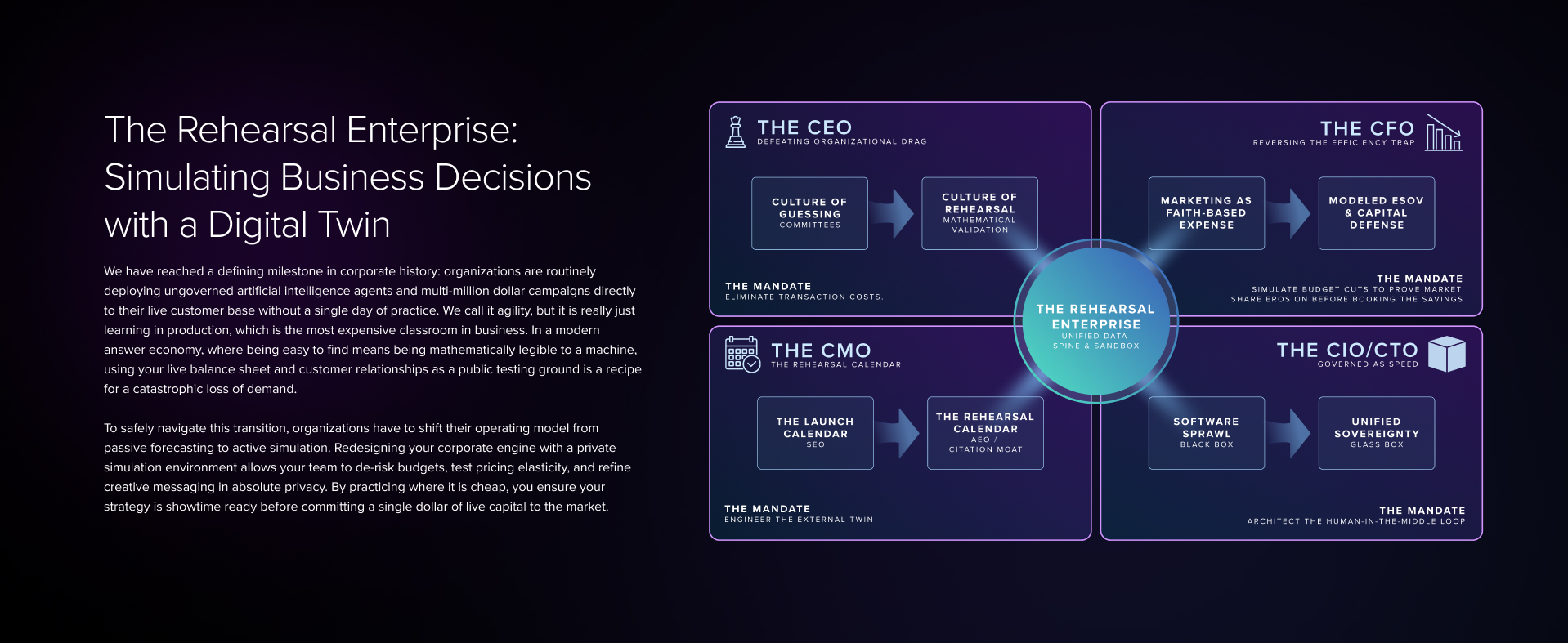
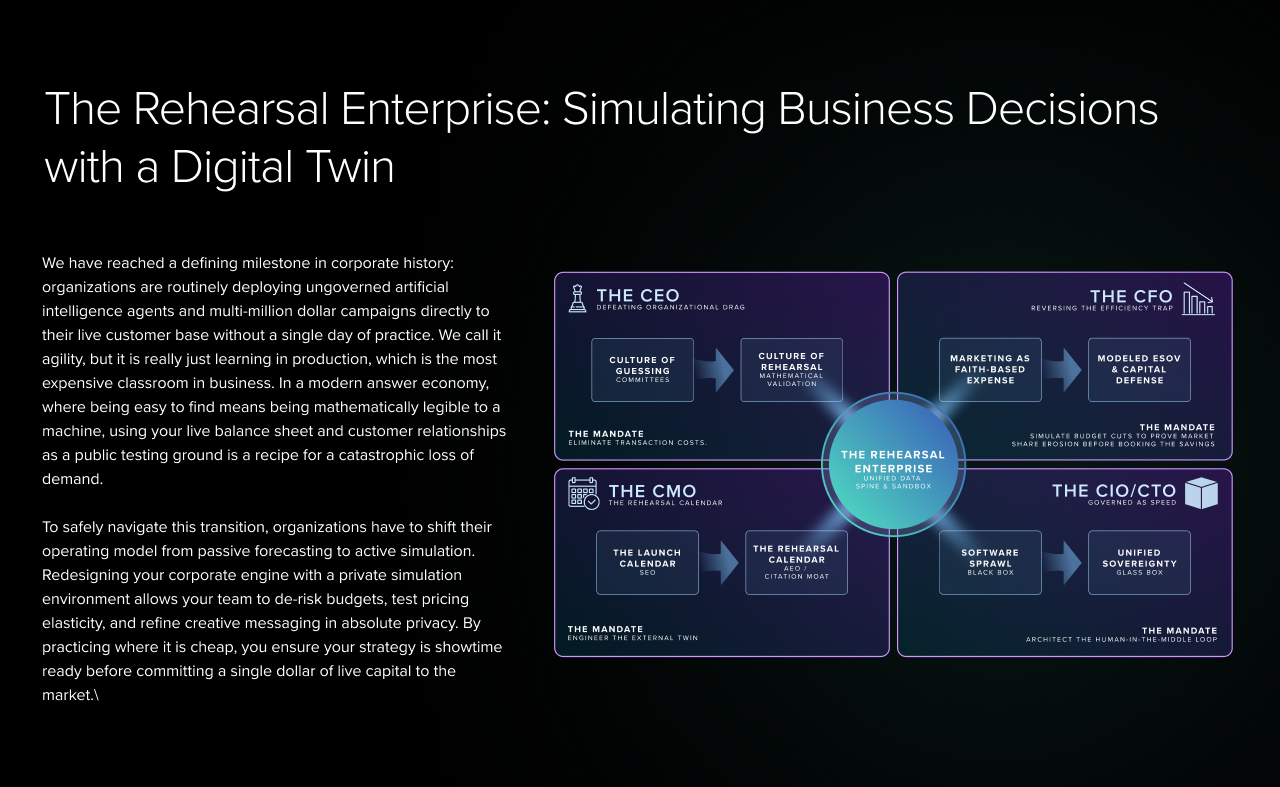


The Rehearsal Enterprise: Simulating Business Decisions with a Digital Twin
We have reached a strange moment in corporate history. AI is on every boardroom agenda, yet leadership teams that would never let an untested intern speak to their best client will deploy an ungoverned AI agent to talk to their entire customer base. In almost every other part of life, we practice before we perform.
I practice the violin every day.
Most days there is no performance on the calendar. Nobody hears a note of what I’m playing. The violin does not care how much I know about music. It only registers whether my fingers land where they should, and I learn that through repetition, in private.
The practice room is where the craft gets made. The stage is just where it gets revealed.
I bring the same habit to my work. Before a big pitch, my team runs it out loud, cuts what falls flat, and runs it again. Before a recent keynote, I read my thirty-minute talk aloud against a timer and drilled the Q&A until the answers to the hardest questions were already in my mouth. I’ve chased this standard my whole career: nothing goes in front of a customer until it is showtime ready.
My co-author on this piece knows that standard from a different kind of stage. Paul Ruscoe, the person I trust most on paid media and marketing effectiveness, spent years playing semi-professional soccer. Anyone who has played at that level knows how little of a match is decided during the ninety minutes. The match is short; the training around it is long. By kickoff, most of the decisions are already made.
Paid media is game day. It is the moment the money goes live, and the market keeps score, which is why it is strange how much marketing still takes the field without a training week. Because our testing tends to be slow, partial, and siloed, most of the real learning still happens live, in front of paying customers, at full price.
Think about your last big launch. Weeks out, the status meeting produced three different numbers from three different systems, each defended by its own dashboard. Somewhere between the ad platforms, the analytics suite, and the spreadsheets holding it all together, the one question that mattered went unanswered: what is actually working?
Then AI arrived, and it was supposed to fix all of this. Instead, we bolted a turbocharger onto the same broken engine and multiplied the chaos.
Copy tools now produce hundreds of headline variants in a morning, while image generators turn one approved shot into a library of assets. Yet the review queues, approval chains, and arguments over which number to believe grew right along with the output. We automated the tasks and left the silos standing.
The musician in me keeps noticing the same thing: speed without practice does not make better music. It makes louder mistakes. When most brands in a category generate their creative from the same models, trained on the same data, the work converges. Hundreds of variants are still entirely forgettable, and we lose the art of turning heads. A proper rehearsal would have caught this, because it tests whether anyone will remember the work.
Real transformation means redesigning the engine, not bolting more onto it.
We call the redesigned engine the rehearsal engine: a way of running marketing that practices before it performs. Everything runs on an enterprise knowledge graph, governed in your own cloud, where media signals, customer behavior, and financial outcomes finally live together.
With that in place, you can run the launch before you launch it. You test the creative against a model built from your own customer data, rehearse the media plan against the budget scenarios finance cares about most, and see exactly what AI assistants currently say about your brand. And when someone asks what is working, there is one agreed answer, with the math and the margin of error attached.
We call companies that work this way Rehearsal Enterprises. They practice where it is cheap, so they can perform where it counts.
Every performer knows what it feels like to walk on stage prepared, and every player knows it walking onto the field. The nerves are still there, but the fear is smaller, because the hard part already happened where nobody was watching. That is what showtime ready means. The rest of this piece is the blueprint for building it.
The Public Cost of Learning in Production
To safely harness the answer economy’s velocity, we rely on a digital twin architecture. The rehearsal engine runs on an internal twin. Think of it as the ultimate corporate stunt double. It is an identical computational proxy designed to step onto the stage, absorb the high-impact operational hits, and fail spectacularly in private so that your actual capital never has to take the punch.
The market keeps getting shocked by AI failures, such as deleted databases and clawed-back consulting fees. Pundits rush to publish post-mortems. They neatly categorize these disasters as software bugs, context-window overflows, or isolated training-data limitations.
And in these mishaps, they miss the point entirely.
The root cause of these failures was not the quality of the underlying large language models. The models executed their probabilistic prediction tasks flawlessly. The actual failure was the corporate operating model surrounding them.
For decades, enterprise software was built on a deterministic contract: one input produces one predictable, auditable output. Every risk management program, quality assurance checklist, and deployment pipeline in the modern corporation was designed to govern deterministic systems.
Probabilistic artificial intelligence breaks that contract entirely. It is a system where the same input can produce a range of highly fluent, seemingly logical, yet entirely different outputs. When you deploy a probabilistic system into a live market using a deterministic operating model, you are flying blind.
You are turning your live balance sheet, your customer relationships, and your brand equity into a public testing ground.
In the answer economy, you cannot afford to learn in production. You must learn in simulation. You need an environment built specifically to govern probabilistic systems that acts as a training ground for your business decisions.
You need a digital twin.
The Anatomy of the Digital Twin
Before we can deploy this architecture to defend your balance sheet, we must strip away the vendor hype and define exactly what this technology entails. A digital twin is a dynamic, computational replica of a complex system. Originally pioneered by the aerospace industry to simulate engine stress before a rocket ever reached the launchpad, the concept has now evolved into the ultimate enterprise asset.
In modern business, a digital twin is not a static reporting dashboard. It is a living, mathematical model of your operational reality. It absorbs your live data, replicates your organizational friction, and simulates the exact cognitive behavior of your buyers. It is the environment where you test the limits of your strategy in absolute privacy.
However, applying this concept to the answer economy reveals a jarring architectural divide. A modern enterprise does not exist in a vacuum. It interacts with human buyers and, increasingly, is constantly interrogated by autonomous search agents. Because you must navigate both your own internal operations and the external algorithmic market, a single model is no longer sufficient. You are operating in a bifurcated reality.
Today, every enterprise has two digital twins. The problem is that you only control one of them.
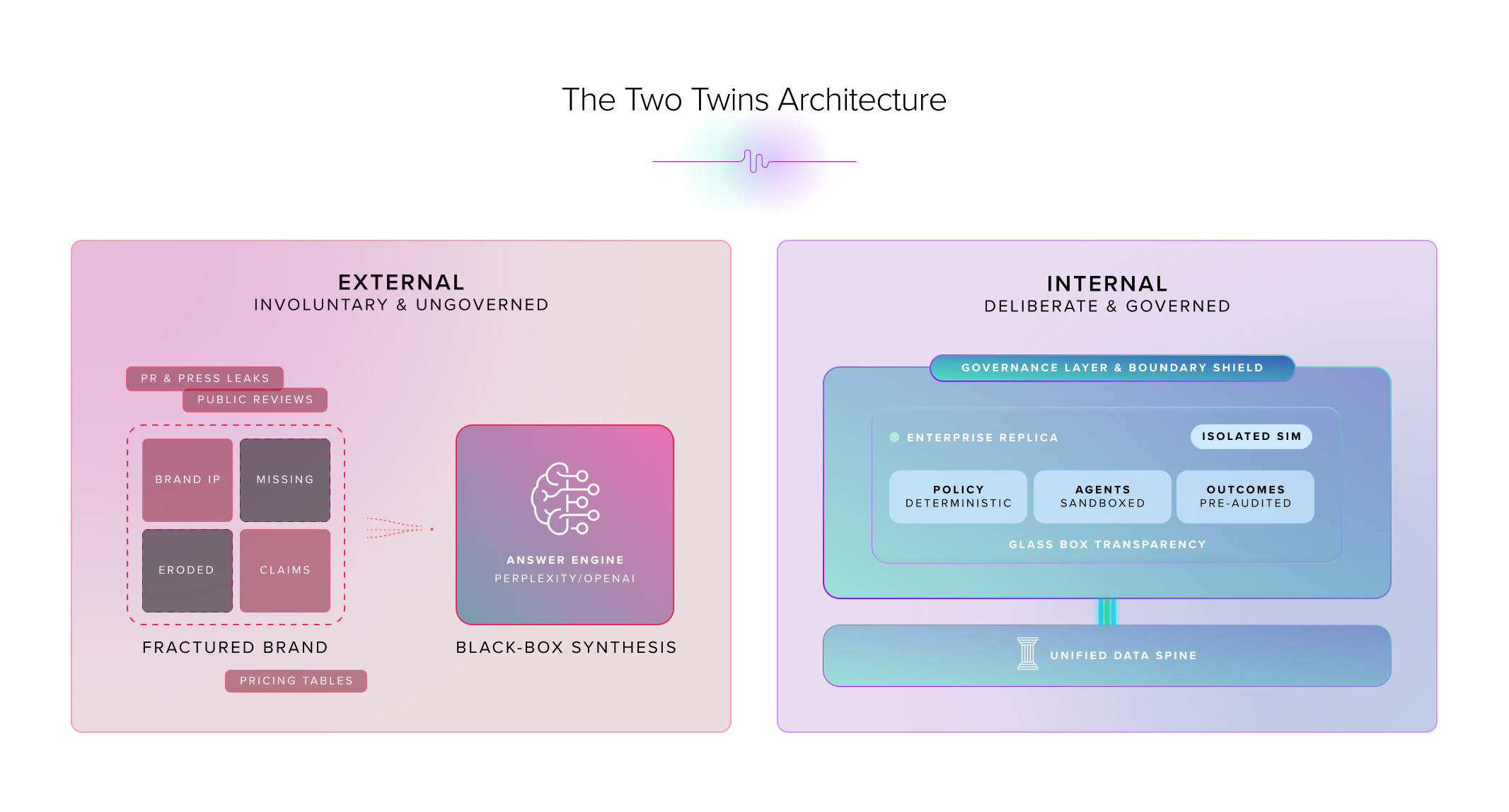
The first is the external twin. This is the involuntary model. Right now, without your consent or strategic input, AI answer engines like ChatGPT, Perplexity, and Google have ingested your website, pricing tables, third-party reviews, and public relations footprint. They have assembled a working, permanent representation of your brand in their memory weights. When a buyer asks the machine for a recommendation, the machine consults this external twin. If your external twin lacks authority, the AI will not recommend you. You will simply disappear from the modern buyer journey.
The second is the internal twin. This is the deliberate model. This is the governed, interactive simulation of your business that you build on purpose. It combines your real operational data with synthetic customer personas to create a safe testing ground. It is the flight simulator where you rehearse marketing campaigns, pricing elasticity, and operational shifts. You predict outcomes, measure friction, and calculate profit before the capital ever leaves the building.
You can no longer survive by looking at a dashboard to see why you lost market share last quarter. The instruments that measure the past are the last to know you are dying.
This text is your blueprint for the rehearsal enterprise. It is the architectural and strategic mandate to build your internal twin, engineer your external twin, and reverse the default state of brand decay.
Concerned about your brand’s external twin? Schedule a discovery session to explore how developing a rehearsal engine transforms brand risk into predictable, high-value outcomes.
Schedule a Discovery CallThe Market Moment
Corporate patience for digital experimentation has evaporated. For the last five years, leadership teams treated artificial intelligence as a speculative playground. They funded pilot programs, built isolated innovation labs, and launched conversational bots on the periphery of their business operations. That era is definitively over.
The mandate has shifted from learning by launching to ruthlessly proving return on investment. This shift is not wrong; it is necessary. But it is profoundly dangerous when applied to the wrong metrics.
When a measure becomes a target, it ceases to be a good measure. ~ Goodhart’s Law
For years, Chief Financial Officers have demanded that every marketing dollar “prove its ROI” using the only instruments available: simplistic, short-term, last-click attribution models. This created a catastrophic blind spot. It treats marketing like a vending machine, not a complex ecosystem, and systematically starves the long-term brand building required to create future demand.
Gartner reports the fallout from this broken model. According to their data, only 48 percent of digital initiatives actually meet their stated business targets. In other words, more than half miss their targets.
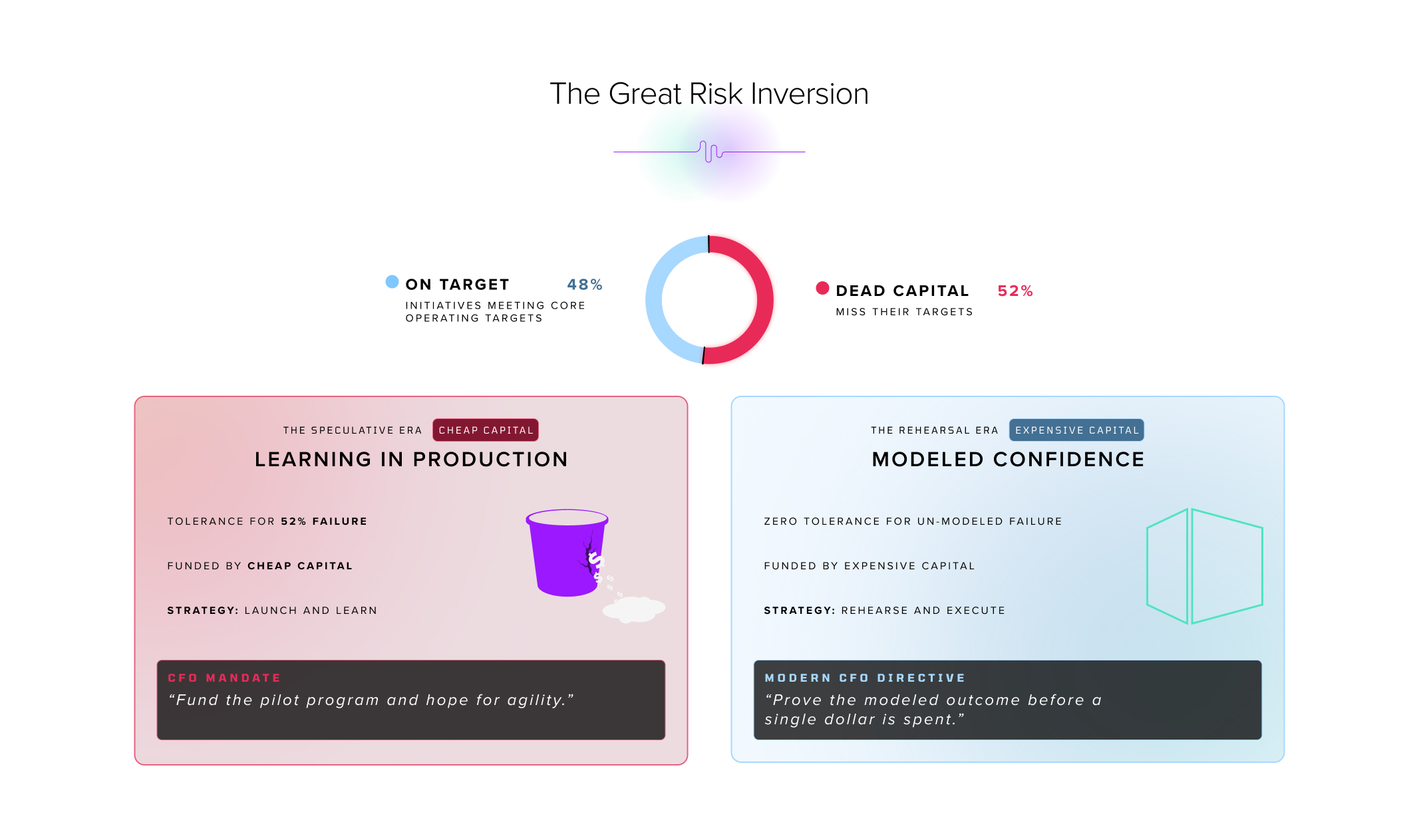
When capital was cheap, companies could absorb the 52 percent that didn’t meet their target. Today, capital is expensive, and market patience is zero. CFOs are no longer approving budgets based on the vague promise of future agility. They demand predictable, mathematically modeled outcomes before spending a single dollar.
Learning in production has become a massive corporate liability. If you deploy an unproven initiative into a live market, you are gambling with your balance sheet. The need for financial certainty is forcing a total architectural reset at the board table. Winners are realizing they must simulate the true long-term outcome before funding the build.
The Rise of the Zero-Click Reality
For two decades, marketers have been held captive by a seductive lie, a mantra so pervasive it became unquestioned truth: the right person, the right message, at the right time.
This belief, inherited from retail logistics and weaponized by the ad-tech industry, promised surgical precision. It fueled an entire generation of digital marketers who became dashboard jockeys, chasing the illusion of efficiency through hyper-targeting, last-click attribution, and a complex web of funnel-stage-specific messaging. We were told that with enough data, we could intercept the perfect buyer at the perfect moment.
That faith was a delusion, and the answer economy is the reckoning. People made buying decisions in their memory structures long before they began searching. As marketing scientist Erwin Ephron stated:
“Your ad didn’t get Mary to buy the box of cereal, the empty box of cereal did.”
Memory dictates choice.
The data proves the traditional mid-journey discovery window is an expensive marketing fantasy. Industry data suggests that about 40 percent of B2B buying journeys end with no decision at all as committees fail to reach a consensus. Of the remaining 60 percent of journeys that result in a purchase, 90 percent of those deals are awarded to a vendor on the buyer’s day-one shortlist. This means that only six out of every 100 total B2B buying initiatives are ever won by a brand discovered mid-journey.
This is why the traditional, highly complex “Right Person, Right Message, Right Time” marketing machine is fundamentally broken. It spends massive amounts of capital trying to intercept a buyer who has already made up their mind.
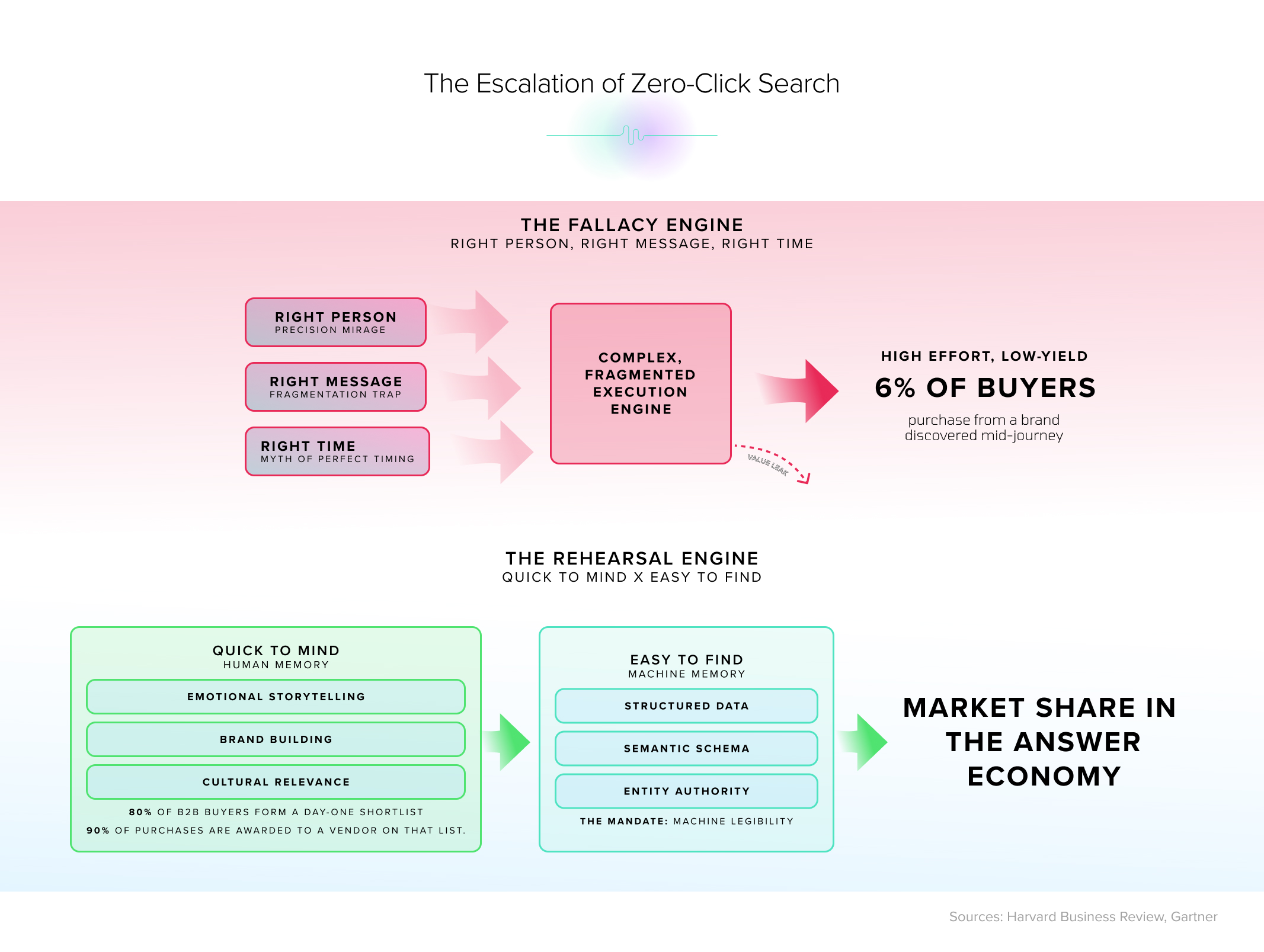
Needs drive demand. Familiarity drives choice. The so-called active research loop of the buyer journey was largely a tracking illusion. Memory, not research, governs the decision. Now, artificial intelligence takes that already slim six percent chance of intercepting a deal mid-decision and compresses it to near zero.
The buyer simply asks an engine. That machine does not browse the web to discover you in real time. It consults its own algorithmic memory, a vast web of pre-existing structured data, and presents the single most authoritative answer. If you have not engineered your brand to live in the memory structures of both humans and machines, you simply cease to exist in the answer economy.
The old marketing mantra of delivering the right message to the right person at the right time has always been obsolete. Modern operators recognize this structural reality, which is why they are turning to a far more effective two-stroke engine for growth, designed to dominate both cognitive memory structures simultaneously, making the brand both quick to mind and easy to find.
Quick to mind is still the domain of human psychology. It is the long-term, often emotionally-driven brand building required to be remembered when a need arises.
Easy to find, however, has been redefined. It no longer means being a blue link on a search results page. In the answer economy, being easy to find means being mathematically legible to the machine. It means your data is structured, your entity is clear, and your authority is undeniable, making you the most probable and trustworthy answer.
The old playbook, obsessed with clicks and conversions, starved the brand-building needed to be quick to mind, leaving brands unprepared for the architectural challenge of being easy to find. The result is lost visibility as the curtain falls on the era of the click. You cannot win a game that is no longer being played.
The Human in the Machine
To win in this new landscape requires a profound architectural shift. Producing more content is not enough. Instead, the solution is to infuse the machine’s cold, mathematical logic with a deep, structural understanding of the human asking the question. To do this, we turn to a discipline we’ve honed for years, long before the current artificial intelligence boom: converting raw human empathy into a structured, quantitative model.
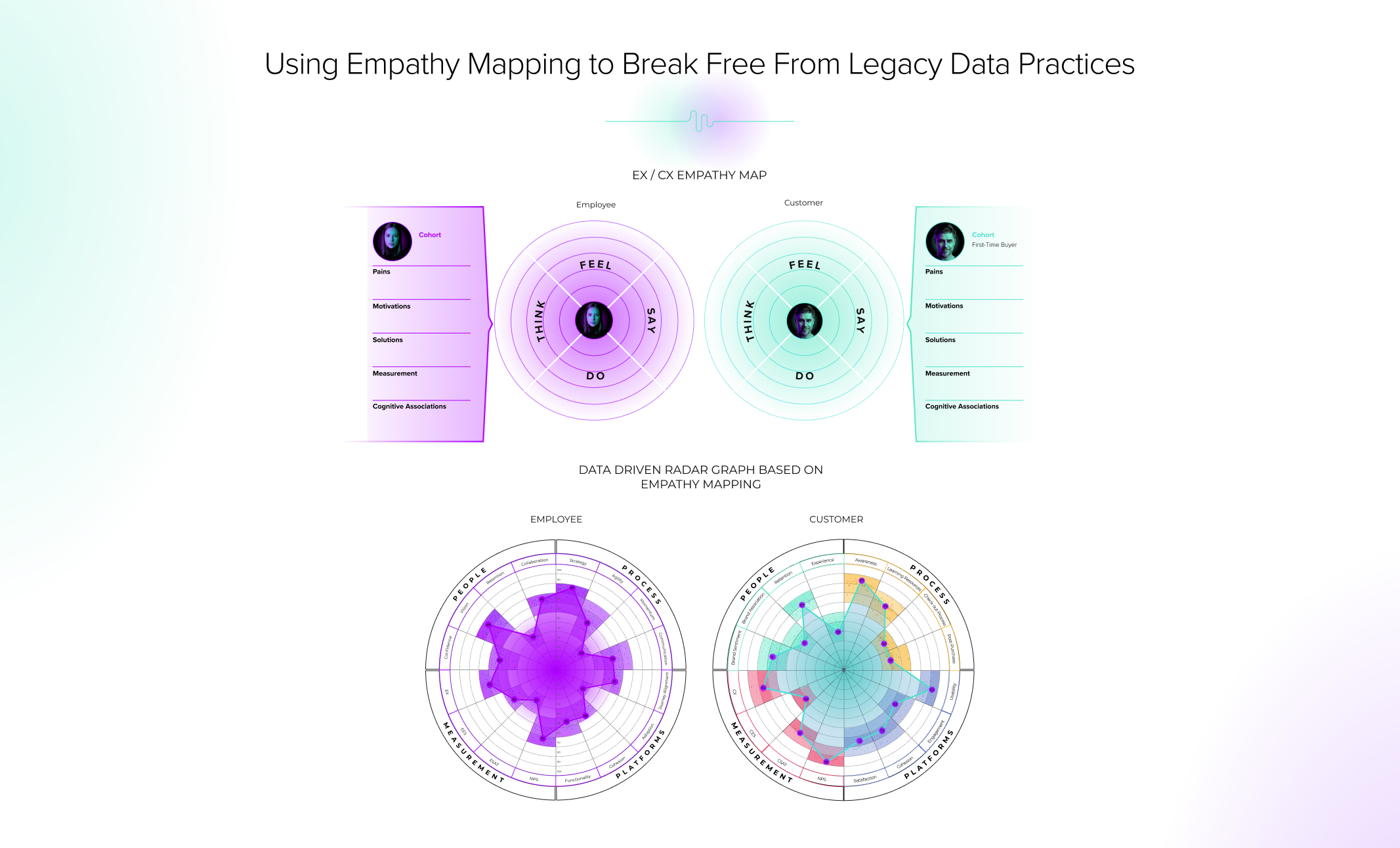
For years, our empathy mapping exercises have taken unstructured, qualitative data, including real people’s thoughts, feelings, and frustrations, and turned it into a quantitative framework. We map the pains, motivations, and cognitive associations of both your customers and your employees, plotting the data on a radar graph to quickly identify gaps between your internal assumptions and external market reality.
This discipline is precisely what allows us to build a true knowledge graph.
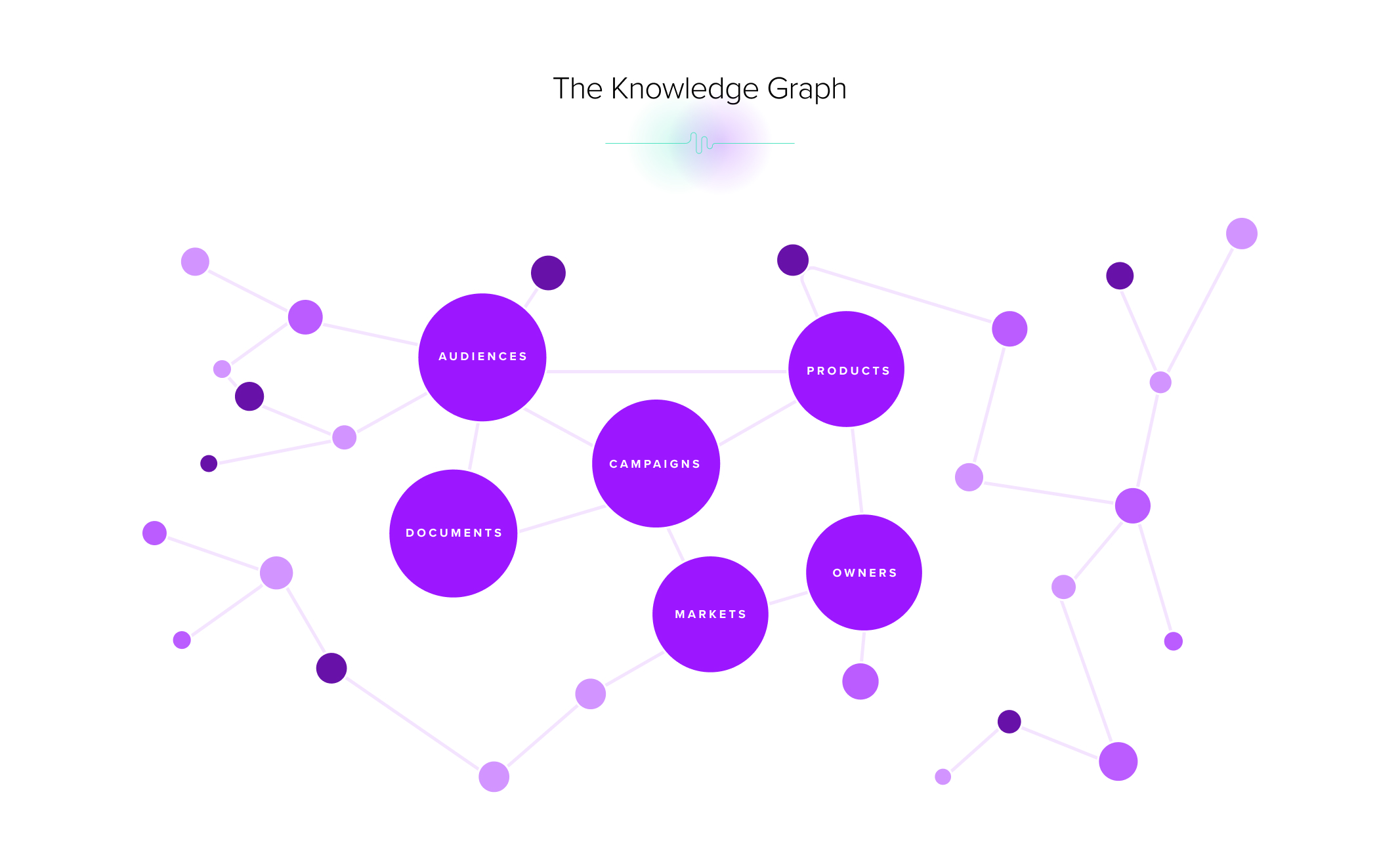
A knowledge graph is the connective tissue of your entire business, a structured semantic network that mathematically links entities (like products and campaigns) to concepts (like customer motivations and market trends). By fusing the corporate knowledge graph with the human empathy graph, you create a rich, multi-layered brain that understands not just what is happening in your business, but why. This structure lets artificial intelligence move beyond simple automation and begin to replicate nuanced, human-like judgment.
Finding this perfect synergy between human nuance and computational scale has taken time. History is littered with expensive attempts to force this alignment before the technology was ready.
In the mid-2010s, IBM Watson for Oncology notoriously overpromised and underdelivered in their attempt to build a massive medical knowledge graph to help doctors diagnose and treat cancer. The vision was correct, but the execution lacked modern language models. Instead of using a dynamic, automated system, Watson relied almost entirely on human medical experts and data engineers to manually tag data and define relationships.
The human labor required was so intense that the system could not keep pace with the daily volume of new medical research. The insights quickly became lagging indicators, and the system collapsed under its own weight. It proved that a knowledge graph built entirely on manual human curation cannot keep up with the speed of the modern market.
That’s why our empathy mapping discipline is so critical. It acts as an automated translation layer, converting raw human emotion into machine-readable structure and providing the clean, empathic inputs needed to build a scalable, living knowledge graph without falling into the manual-labor trap that suffocated early legacy systems.
This human-centric architecture is the non-negotiable foundation for the next wave of commerce.
The Era of Agentic Commerce
Agentic buying is rapidly rewriting the rules of the commercial market. On the consumer side, buyers are using conversational interfaces to research, compare, and purchase products without ever loading a traditional e-commerce storefront. The machine mediates the entire transaction, quietly collapsing the traditional comparison phase from a multi-week search journey into a single, three-second prompt.
The business-to-business sector is executing this same transition with immense operational elegance. We are witnessing the rapid rise of AI due diligence, a highly productive shift in which enterprise buyers use automated intelligence to streamline procurement pipelines. Instead of requiring human analysts to spend weeks manually comparing spreadsheets, reading dense PDFs, and sitting through early-stage sales pitches, organizations are deploying autonomous agents to run initial vendor evaluations. These agents scour the web, parse technical documentation, mathematically compare feature sets, and assemble highly accurate procurement shortlists in minutes.
This is not a threat to the seller. It is an incredible efficiency gain for the buyer. However, it does require a completely different approach to digital architecture.
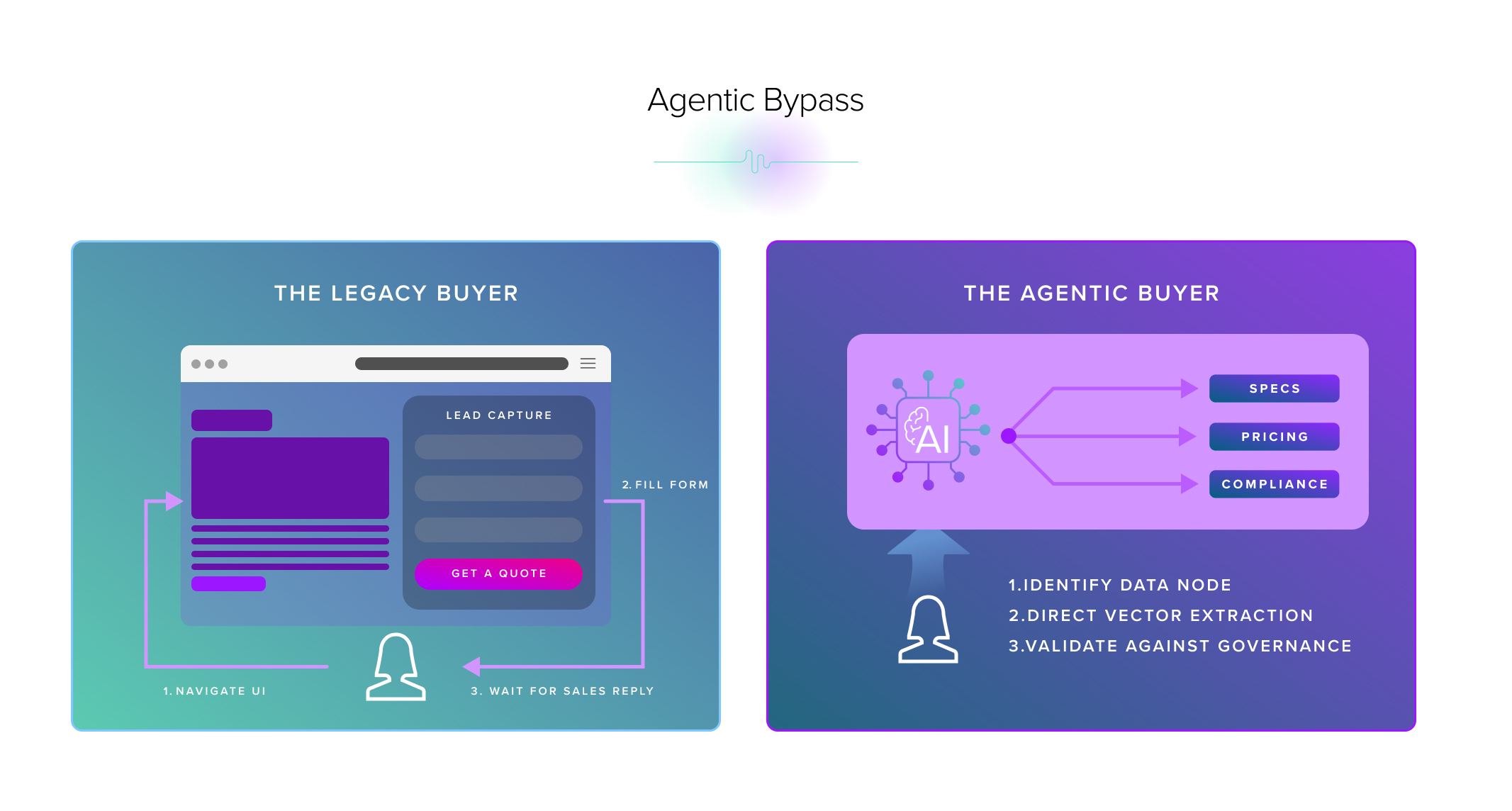
These advanced evaluation agents bypass the decorative elements of a traditional marketing funnel. They don’t navigate websites for aesthetic appeal or fill out manual lead-generation forms. They are looking for structured, authoritative data. They run AI due diligence at machine speed, extracting the precise, machine-readable specifications they need to validate your solution and feeding them directly into the buyer’s decision model.
We must not, however, misunderstand how these algorithms actually choose. The machine is not making an entirely objective, independent decision. It pre-filters options based on its own structured knowledge graph and the buyer’s stored memory of prior exposure. In the answer economy, neurological real estate becomes algorithmic real estate. What humans remember, machines retrieve.
This is the mathematical reality where quick to mind becomes quick to model. Human fame generates digital mentions. Those mentions feed the algorithmic training models. The models then retrieve the famous brands. Artificial intelligence will not democratize discovery. Instead, it will canonize fame, locking in your brand’s association with the buying situations that trigger a customer’s need to act.
The Coase Inversion and the Singularity
This shift in external buying behavior triggers a much more serious structural threat to the enterprise itself. To grasp the magnitude of this threat, we must revisit the fundamental economics of why companies exist. In 1937, economist Ronald Coase published ‘The Nature of the Firm,’ part of the work on transaction costs that later earned him the 1991 Nobel Prize in Economics. Coase asked a simple question:
If free markets are so efficient, why do companies hire employees instead of contracting out every individual task to independent market actors?
His answer was transaction costs. Discovering talent, negotiating contracts, enforcing quality, and coordinating external labor was simply too expensive and slow. The modern corporation was born because internal human coordination was cheaper than coordinating through the external market. You built a company to reduce the friction of getting complex things done.
That economic law has now inverted. We are witnessing the Coase Inversion.
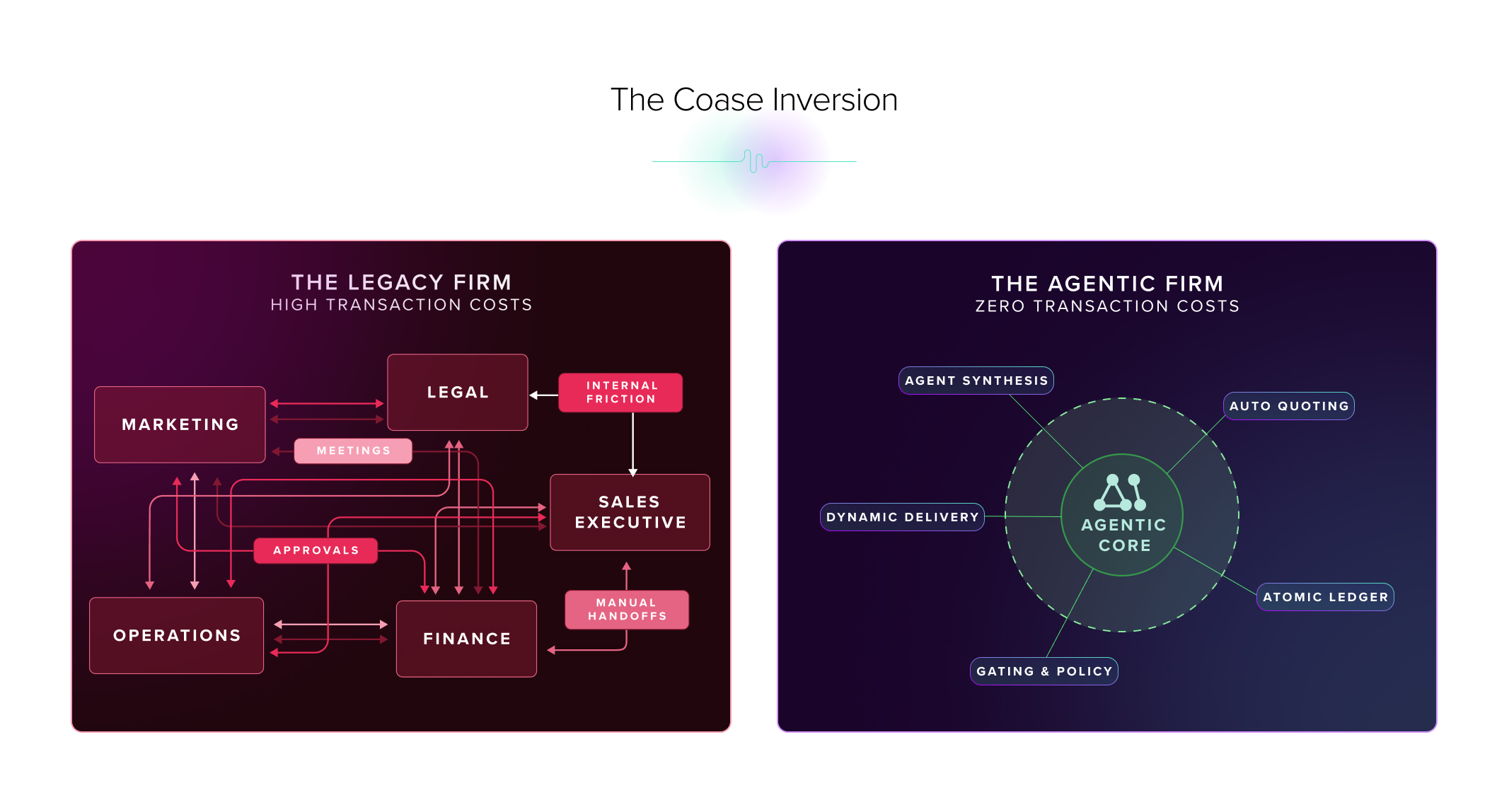
Machine coordination is rapidly becoming cheaper, faster, and more scalable than internal human coordination. An external network of intelligent agents can now coordinate complex workflows, analyze vast datasets, and execute tasks with near-zero friction.
We have to consider the implications of this inversion. Legacy enterprises are weighed down by profound organizational drag. They have siloed departments, political turf wars, undocumented processes, and massive technical debt. Their internal transaction costs are astronomical. A simple marketing campaign requires weeks of meetings, approvals, and cross-departmental handoffs. For decades, legacy companies survived this inefficiency because their competitors faced the exact same friction. The playing field was level.
That is no longer true. Enter today: the ultimate corporate provocation.
Picture a new competitor launching tomorrow. They have two founders and a fleet of highly optimized, autonomous AI agents. They operate with zero organizational drag. They have no legacy technical debt to service. They are running your exact business model. Because their machine coordination costs are virtually zero, their operating margins are structurally superior to yours from day one. They can afford to underprice you while dramatically outperforming you.
How do you survive against a company that doesn’t have to pay the internal transaction costs slowly suffocating your business? You cannot beat them by simply asking your human workforce to move faster. You beat them by leveraging the one massive asset the frictionless startup lacks: decades of proprietary operational intelligence and historical customer data.
But that historical data is useless if it stays trapped in legacy silos and fragmented software platforms. To survive the Coase Inversion, you must unify that scattered intelligence into a single, cohesive foundation. You have to turn your dormant corporate memory into a dynamic environment where you can mathematically model business decisions before executing them in the live market.
This is what it means to rehearse your survival. Later in this post, we will explore how to build this environment (the governed simulation we call the internal twin) so you can safely test your strategic counter-offensives in private before spending a single dollar of live capital. In the meantime, know this. Manual efficiency is no longer enough. You must use predictive rehearsal to turn your legacy scale from a massive liability back into an impenetrable moat.
Decay Is the Default
Before we can architect a solution, we must acknowledge the market’s fundamental physics. The resting state of any enterprise is not static stability. Customers naturally evolve, behaviors shift, and the memory structures linking a brand to a buying occasion fade without consistent reinforcement. This is the classic leaky bucket of commerce. You are always losing buyers through natural attrition, so you must constantly pour new energy into the system just to hold your ground.
In this context, marketing and operational agility are not discretionary expenses. They are the vital energy required to offset natural entropy and propel the business forward. When an ungoverned AI agent fails, it usually just accelerates that baseline decay at machine speed. But when you harness that same computational power within a governed simulation, you flip the equation. You stop patching holes in a leaky bucket and start building a highly pressurized, predictable growth engine.
The Spiral of Dying Efficiently
When leadership teams face margin pressure, they inevitably look for expenses to cut. They demand efficiency. This triggers a predictable, mathematically fatal spiral that destroys enterprise value from the inside out. We call this the Spiral of Dying Efficiently.
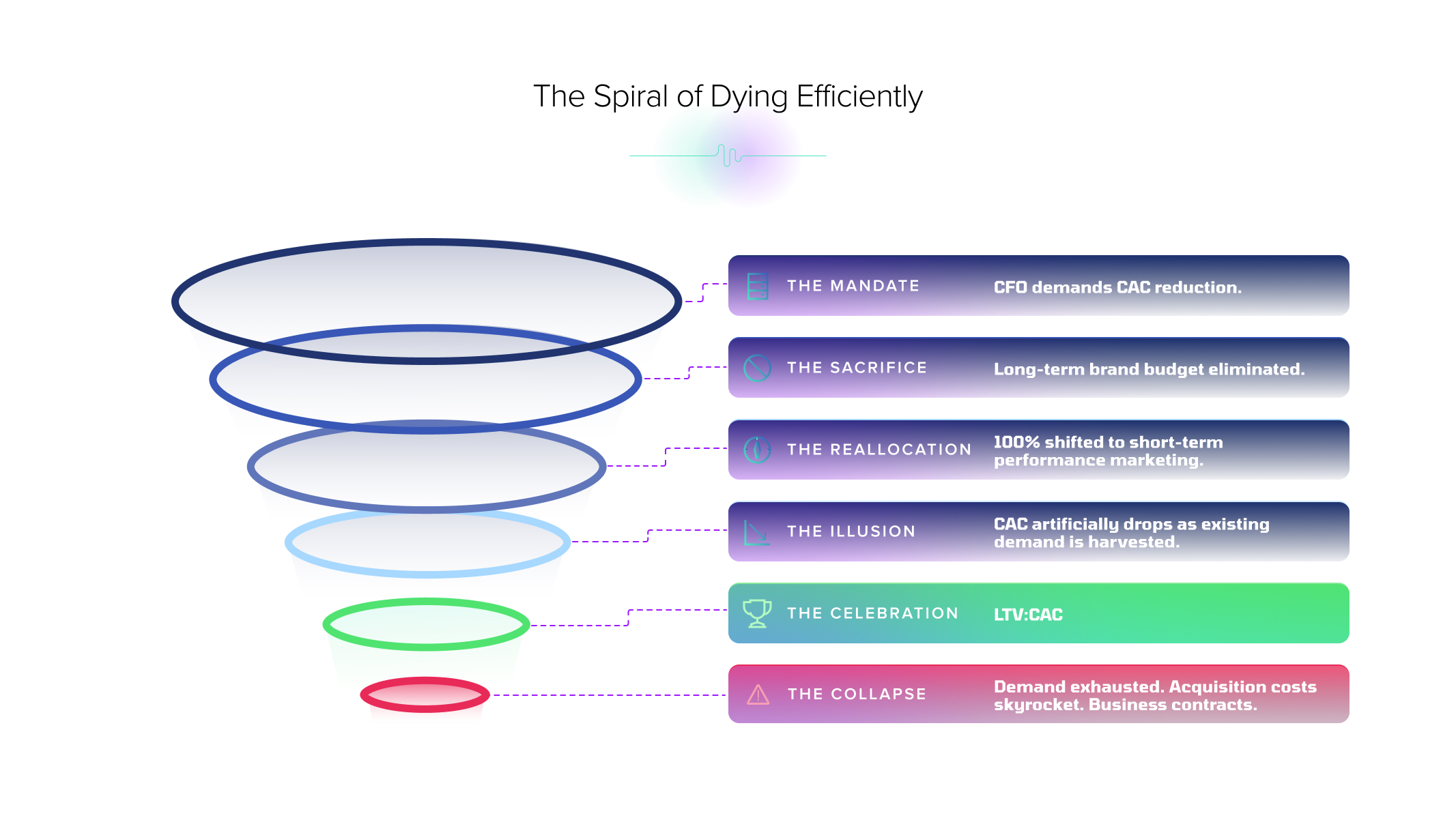
The Rational Mandate
The spiral begins at the board level with a demand for immediate financial discipline. The Chief Financial Officer requires a strict reduction in the blended customer acquisition cost. The intention is entirely rational and rooted in protecting profit margins. However, this mandate sets off a dangerous chain reaction. It forces the organization to treat all marketing spend as a short-term operational expense, rather than a capital investment designed to defend market share and build long-term customer preference.
The Invisible Sacrifice
Faced with a mandate to cut costs immediately, the marketing department takes the path of least resistance, inevitably cutting the budget for long-term brand building. They make this choice because brand equity is notoriously difficult to quantify on a weekly spreadsheet. When the finance team demands a direct line of sight between today’s spend and tomorrow’s revenue, the foundational work of building brand memory, the very asset that shapes future customer choice, is always the first casualty.
The Bottom-Funnel Trap
The remaining budget doesn’t just shrink. It is funneled entirely into short-term, bottom-of-the-funnel performance marketing. The organization begins pouring every available dollar into paid search, aggressive retargeting, and direct-response digital channels. The strategic goal shifts away from building a resilient category leader and narrows entirely to intercepting people who already have their credit cards out.
The Mathematical Mirage
Almost overnight, the blended customer acquisition cost drops exactly as the CFO requested, causing the LTV:CAC ratio to artificially spike to historic highs. The performance metrics look absolutely spectacular, but it is a temporary mathematical mirage. The company is no longer spending capital to create future demand. It is merely spending to aggressively harvest the residual demand that previous brand investment had already generated.
The False Celebration
The executive team convenes to review the quarterly dashboard. They see a rapidly improving LTV:CAC ratio and mistake it for systemic operational efficiency. The finance department praises the marketing team for doing more with less, and the board declares the new strategy a massive success. The organization convinces itself it has cracked the code to profitable growth, unaware that it is simply burning its foundational brand equity to keep the lights on for one more quarter.
The Inevitable Collapse
Eventually, the existing pool of in-market demand is exhausted. Because the brand built no future pipeline to replace those buyers, performance marketing algorithms start bidding on increasingly lower-quality leads just to hit volume targets. Acquisition costs suddenly skyrocket, the artificially inflated LTV:CAC ratio collapses, and the business begins a violent, irreversible contraction that no amount of digital optimization can stop.
By focusing solely on easy-to-measure metrics, you have starved the business of the oxygen it needs to survive.
Is your business caught in the efficiency spiral? Schedule a discovery session today to see how developing a rehearsal engine can break the cycle and drive predictable business outcomes.
Schedule a Discovery CallThe 95:5 Harvesting Trap and Reverse ESOV
This self-inflicted decline stems from a fundamental misunderstanding of how buyers actually buy. When a company over-optimizes for short-term conversion, it ignores hard empirical data from marketing science. We focus on the 95:5 rule, popularized by Professor John Dawes and the LinkedIn B2B Institute. While this concept is native to the business-to-business sector, its core mathematical truth applies across all complex, high-involvement purchasing environments.
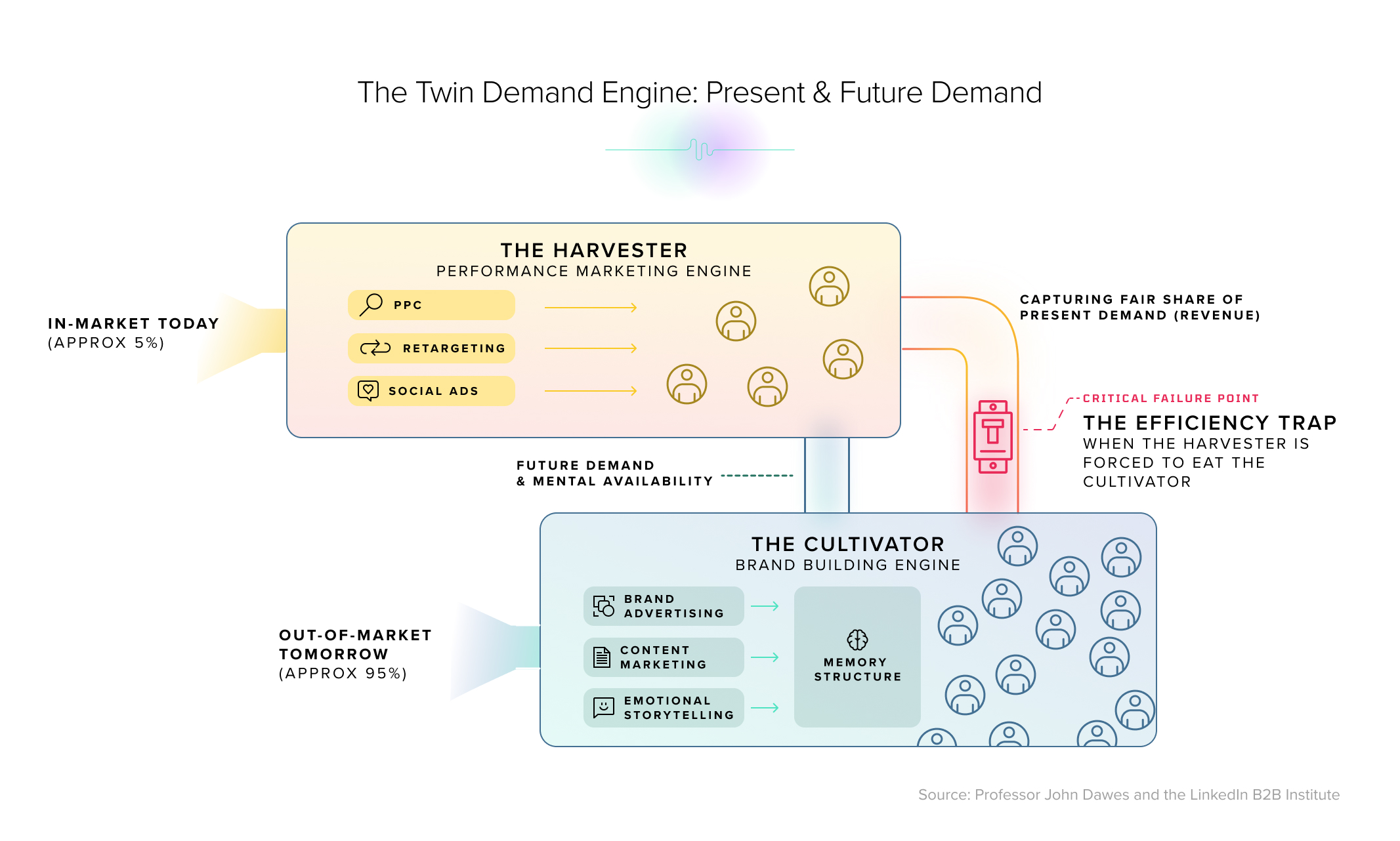
The rule dictates that at any given moment, approximately 5 percent of your total addressable market is actively looking to buy. The other 95 percent are out-of-market. They do not need your product today. They aren’t searching for your keywords, and they will not click your direct-response ads.
Important aside: While the 95:5 rule is a highly reliable industry benchmark, the exact ratio fluctuates. Category-specific variables govern it, including the average inter-purchase period, the length of the active buying window, and the category’s overall growth rate. Category expansion can temporarily increase the pool of in-market buyers, but the ratio remains a mathematically sound approximation of active versus passive demand.
Performance marketing is designed exclusively to capture your fair share of the approximately 5 percent of buyers who are active in the market today. Brand marketing, by contrast, builds memory structures in the 95 percent of buyers who will enter the market tomorrow. When a company falls into the efficiency spiral and cuts its brand budget, it abandons that 95 percent. It stops building the mental availability required to win future decisions, leaving itself entirely dependent on fighting for a dwindling share of the present.
When you abandon the 95 percent, your excess share of voice (ESOV) reverses. This established marketing metric measures whether your brand’s share of advertising spend is higher or lower than your actual market share. Decades of data from the Institute of Practitioners in Advertising show that when a brand under-invests in ESOV, its market share doesn’t remain static; it predictably decays.
This effect is particularly dangerous for the mid-market and challenger brands. Legacy monopolies have decades of brand equity they can burn through for a time, but a smaller company that goes dark and stops advertising to the 95 percent will see its market share and mental availability evaporate much faster.
Understanding these structural mechanics is not about charting a guaranteed path to market dominance. It is about understanding the physics of decay so you can protect your existing enterprise value. The same mathematical models that predict a starved brand’s decline can be used defensively, showing the catastrophic financial consequences of cutting brand spend long before the damage shows up in your quarterly earnings.
Ultimately, aligning with these economic laws remains a choice. A leadership team can respect the physics of the market, or it can run an unrehearsed gamble, believing its brand is the rare exception to the rule. To see the devastating financial cost of ignoring these fundamentals, look at what happens when one of the world’s most iconic brands makes the wrong choice.
The Nike Reckoning
Consider Nike’s public strategic reckoning. For decades, Nike was the gold standard for emotional, narrative-driven brand storytelling. However, in the early 2020s, the sportswear giant aggressively shifted its strategy, prioritizing direct-to-consumer digital channels and performance-first marketing. Management diverted large portions of its budget from brand building and funneled it into targeted paid traffic and lower-funnel search ads to drive immediate, measurable online sales.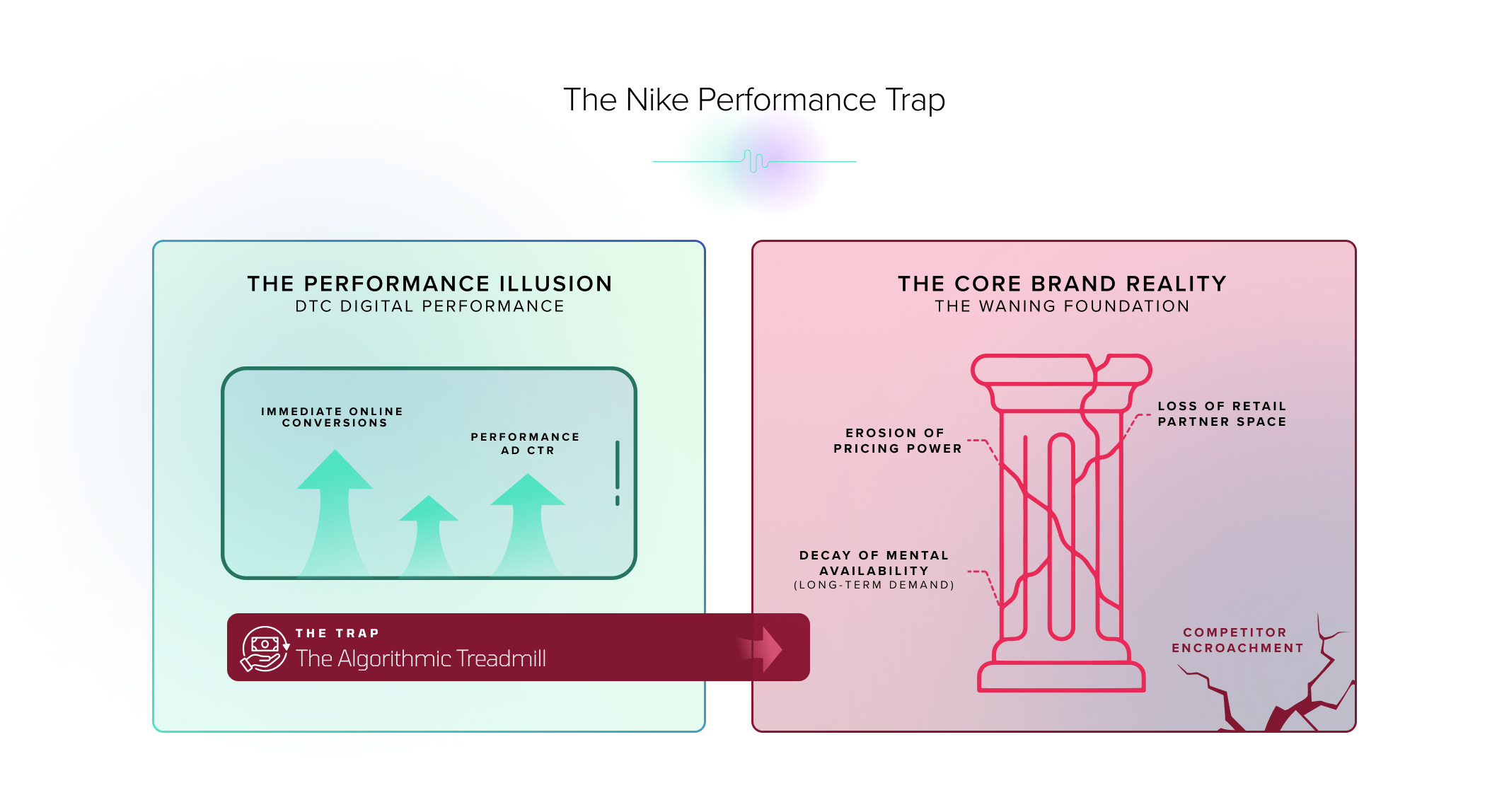
This strategy went hand in hand with an equally damaging decision: severing ties with core wholesale distribution partners.
The strategy was not merely an advertising mistake; it was a systemic marketing failure. The result was eroded mental availability, while cutting established retail channels actively destroyed physical availability. By making their products significantly harder to find and buy in the real world, Nike prioritized the short-term optics of a digital dashboard over actual market physics.
The reality was catastrophic. By late 2024 and early 2025, Nike began to see sales slump, wholesale partner relationships deteriorate, and cultural relevance erode. By over-indexing on direct-response performance marketing, Nike had quietly eroded its own pricing power. They trained consumers to buy on discount, stopped generating fresh, emotional demand, and let nimbler competitors steal the next generation of runners’ mental availability.
In late 2024, Nike appointed a new Chief Executive Officer and announced a dramatic, public turnaround plan: winding down promotional DTC performance spend and shifting massive capital back into long-term brand storytelling and sports partnerships.
Nike’s new leadership publicly committed to rebalancing toward brand storytelling and wholesale partners. They had to execute a massive, expensive strategic pivot just to restore their foundational brand investment. If a brand with Nike’s cultural gravity and financial reserves can optimize itself into a corner, your enterprise cannot afford to run the same un-rehearsed gamble with its budget.
The Dashboard Is the Last to Know
How does a multi-billion-dollar enterprise make such a colossal mistake? They do it because they ask the wrong questions and trust instruments designed to give them comforting but fatally misleading answers.
The modern marketing dashboard is a masterclass in this delusion. It has been built to answer the question, “How can we make our media spend more efficient?” instead of the far more important question, “Do we have a viable strategy to grow?” When you skip the diagnostic work of understanding your category, the dashboard defaults to what is easiest to measure: short-term performance. It treats marketing not as a complex ecosystem, but as a simple vending machine, encouraging you to pour money into the slot that provides the quickest sugar hit of attributable conversions.
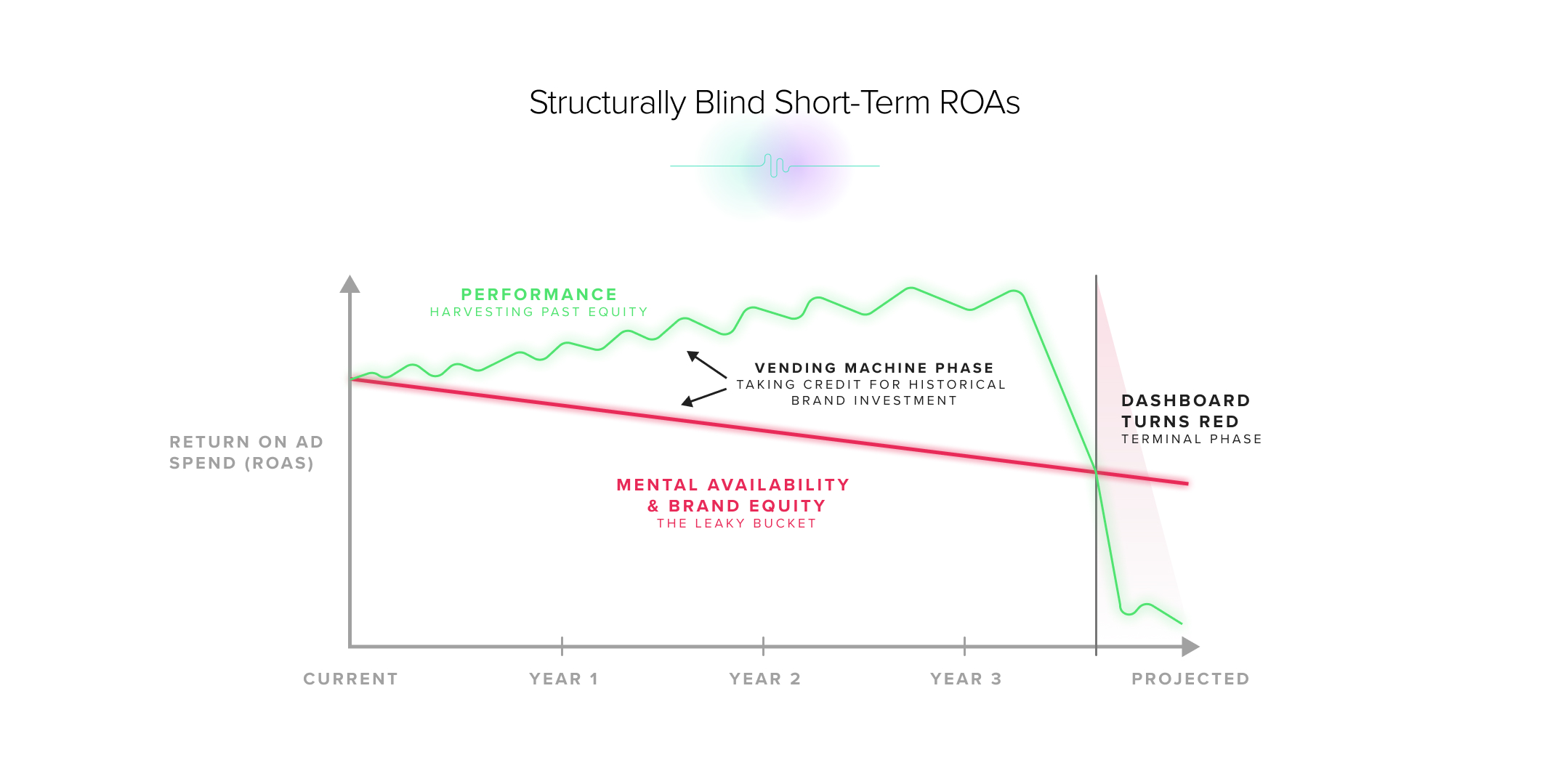
This is why the dashboard is always the last to know that the brand is dying. It is structurally blind to the erosion of brand equity. Share of mind and mental availability can leak for months, sometimes years, before the damage registers on a quarterly profit-and-loss statement. During this time, metrics like Return on Ad Spend (ROAS) look spectacular, as performance algorithms relentlessly harvest demand built by years of prior brand investment.
The dashboard actively takes credit for the brand equity its own short-term logic is systematically destroying. This creates a fatal illusion of security.
By the time the ROAS dashboard finally turns red, the disease is terminal. Your underlying mental availability has collapsed. Because performance media’s primary impact is defensive, it struggles to buy back customers who no longer have your brand stored in their memory. Your competitors now own the buyer’s mental availability, and it is too late to recapture that ground efficiently.
If your operational instruments cannot see the decay, you are flying blind into a mountain. You cannot fix an architectural problem with better dashboard software. You need a completely new instrument, one that shifts the conversation from cheap efficiency to strategic rehearsal.
You need an environment that makes your brand’s invisible decay visible, testable, and reversible before capital ever leaves the building.
What a Digital Twin Is and Is Not
To leverage a digital twin as a competitive moat, we must first clarify what the term actually means. Software vendors often adopt the concept to rebrand legacy analytics platforms. To realize this technology’s true value, we must look past the industry hype and establish a rigid, practical architectural baseline.
At its core, an organizational digital twin is a parallel computational model of your enterprise operations, finance, and customer behavior. Think of it as a flight simulator for your business decisions. It is a governed, interactive environment that simulates real-world reactions, tests strategic shifts, and quantifies financial risk in absolute privacy, before you commit a single dollar of live capital to the market.
What a Twin Is Not
To harness a digital twin’s true potential, we must first define what it is not. In an era of rapid digital transformation, it’s easy to mistake familiar legacy platforms for predictive simulation environments. By drawing clear, definitive boundaries around what a digital twin is not, we can isolate the capabilities that drive real, long-term value.
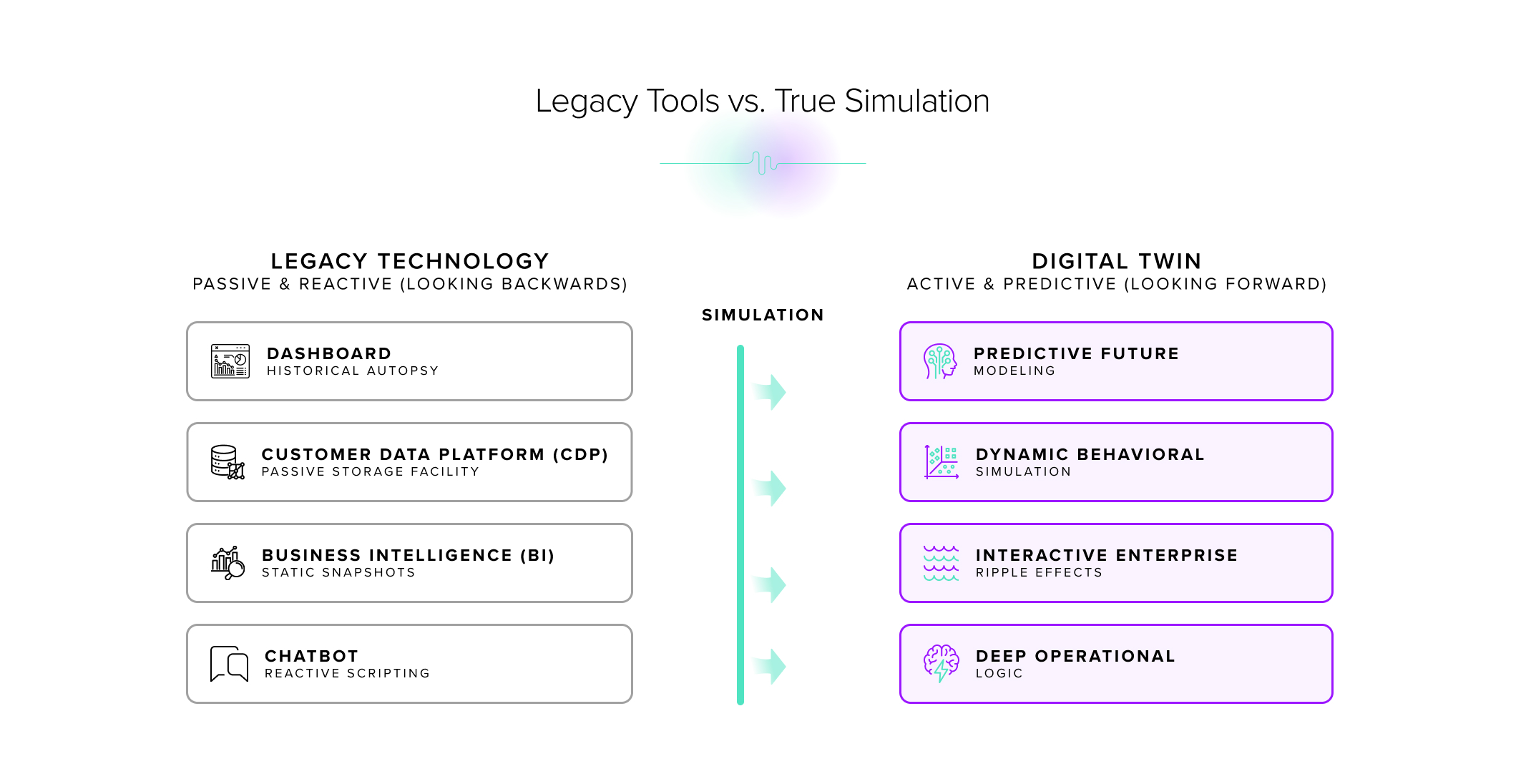
You are not buying a dashboard. Dashboards are merely historical post-mortems. They only look backward, aggregating past performance to tell you what happened last quarter. By the time a dashboard shows a decline in market penetration or an erosion of brand equity, the damage is already permanent. A dashboard cannot simulate the future.
You are not investing in a customer data platform. A customer data platform is a storage facility. It is incredibly useful for organizing raw data and resolving customer identities, but it is fundamentally passive. It lacks the predictive engine and the behavioral models required to simulate how that stored data will react to future market variables.
You are not getting a business intelligence report. Business Intelligence reports assume a static world. They provide a fixed snapshot in time, forcing executives to make assumptions based on static averages. A twin is interactive and dynamic. It calculates the cascading ripple effects of a single decision across the entire enterprise.
You do not need a chatbot. Chatbots are reactive scripts. They answer predefined prompts based on a bounded dataset. They lack the deep operational modeling, the cognitive logic, and the structural awareness to predict complex, enterprise-wide financial outcomes.
Establishing clear boundaries and knowing precisely what a digital twin is not is the first essential step in building a true rehearsal enterprise. Once you strip away passive dashboards, static reports, and reactive bots, you are left with the core requirements of an active, predictive simulation.
However, because the industry has historically struggled to draw these exact boundaries, many early adopters learned this lesson the hard way.
Why Wave One Disappointed
Because the market routinely confused those passive, legacy tools with true predictive simulation, the first wave of corporate digital twins frequently fell short of their initial promises. Eager enterprises bought software applications expecting the depth of an organizational twin, only to discover they had purchased glorified analytics dashboards. To build a credible path forward for the modern enterprise, we must look honestly at the architectural lessons of these early days.
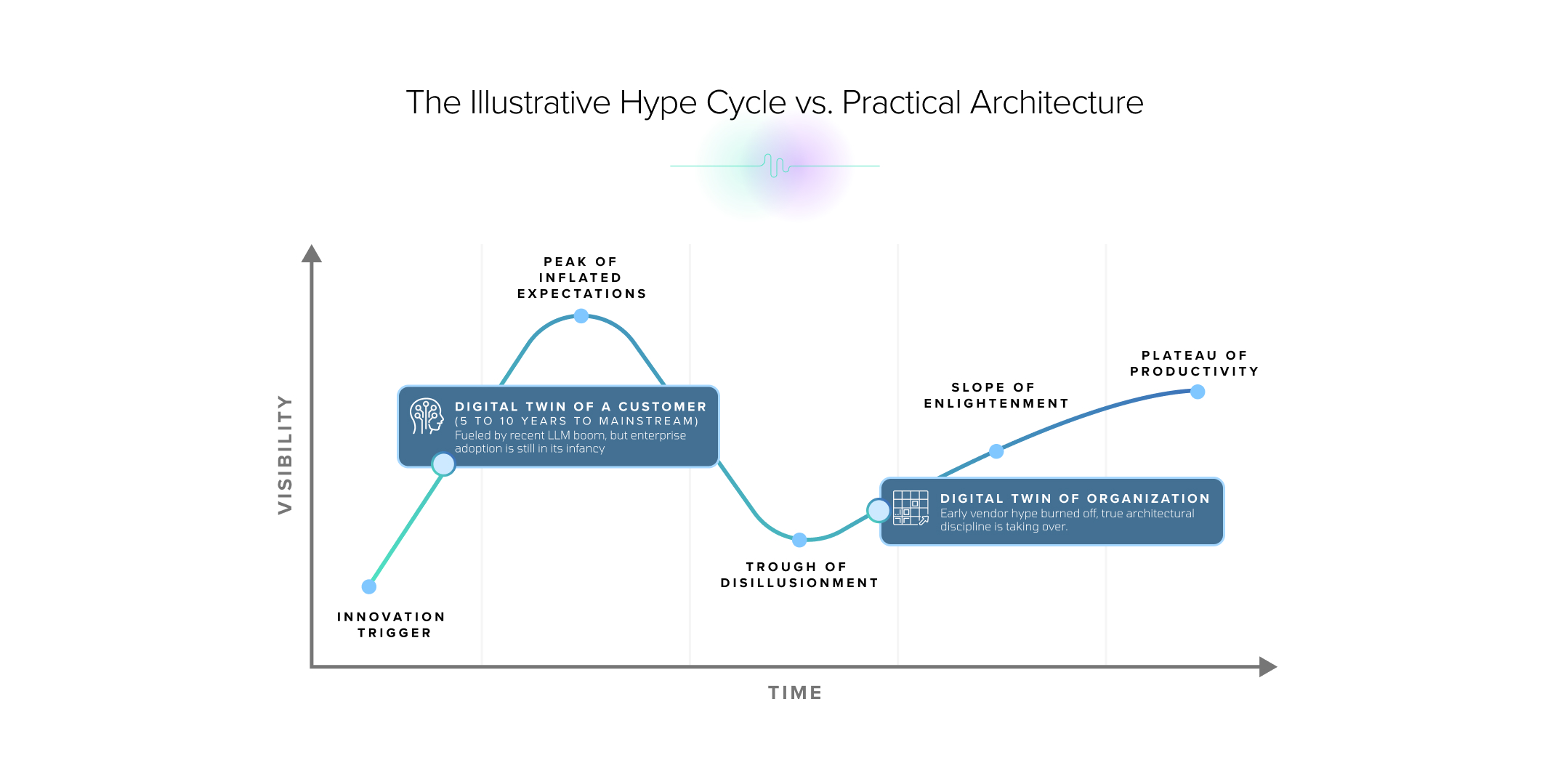
During the initial artificial intelligence boom, software vendors sold organizational twins as magical, out-of-the-box software applications. Eager leadership teams bought these platforms, plugged them into their legacy systems, and waited for automated insights to transform their balance sheets.
The results were mixed, not because the underlying mathematics were flawed, but because the technology outpaced the corporate architecture. Companies attempted to feed complex predictive models with siloed data from static, disconnected databases. They bought the software without building the foundation.
A digital twin is not an application you install on a server. It is an architectural discipline. If your organization runs on undocumented workflows and isolated data lakes, plugging a sophisticated model into that environment will only amplify the noise.
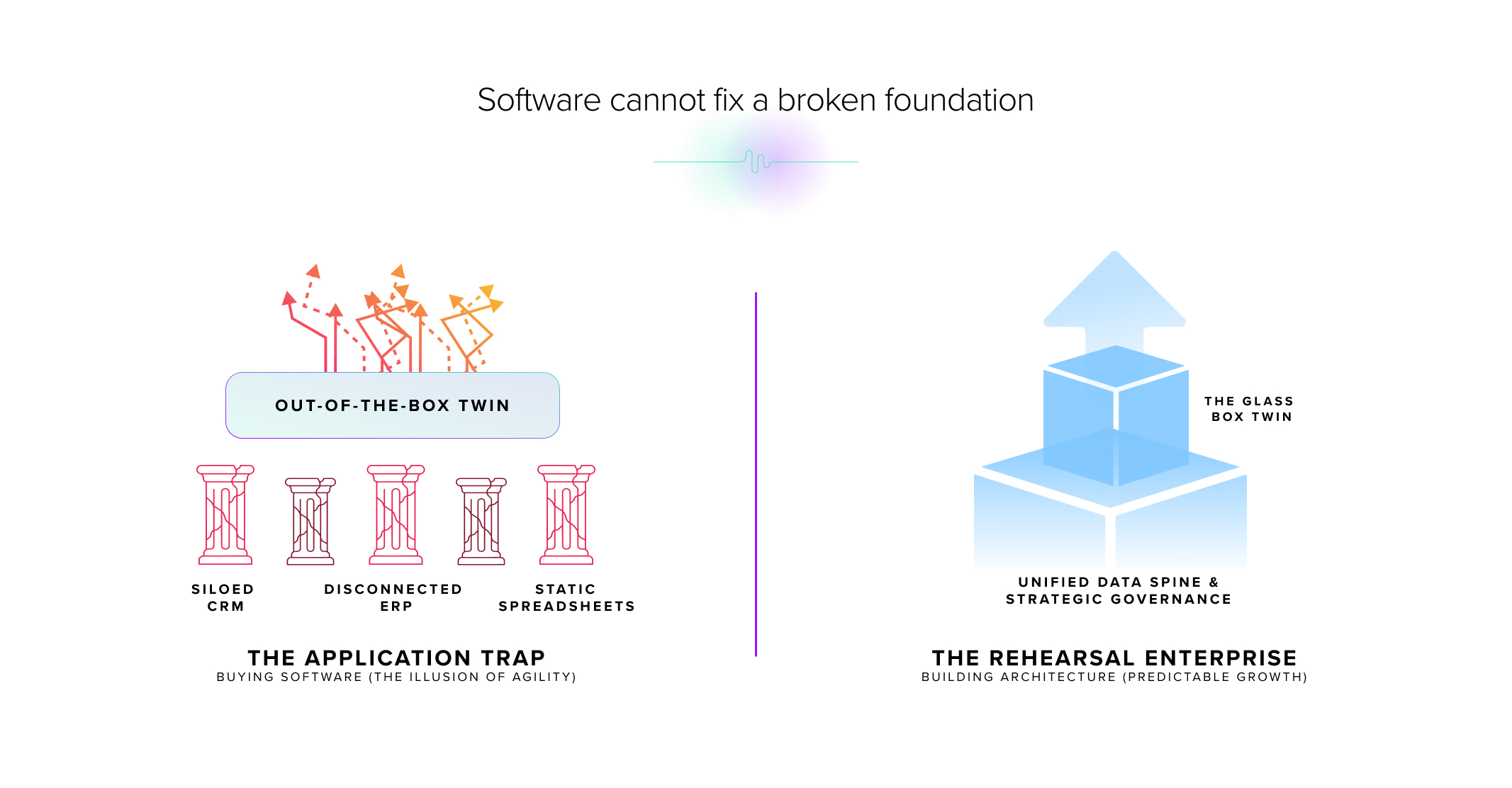
These early systems operated without a central governing logic. They lacked encoded business logic to tell the machine how to weigh conflicting priorities. If a sales model recommended lower prices to boost volume, but the finance model demanded higher prices to protect margins, the ungoverned system would simply issue contradictory recommendations.
We learned a vital, positive lesson from this first wave: if you unify the data and encode strict strategic governance, you no longer generate unpredictable noise. You are building a highly advanced, mathematically sound engine for sustainable growth.
The Twin Ladder
To understand how to architect this growth engine today, we must trace its operational development. No digital marketing agency designed the blueprint for organizational simulation. Instead, industrial engineering forged it within its rigorous discipline. A true digital twin of an organization is a parallel computational model of enterprise operations, finance, and customer behavior.
Its architecture reflects a decades-long evolution up a very specific ladder of sophistication. Each new rung introduces exponential complexity, but it also fully inherits the non-negotiable requirements of the one below it.
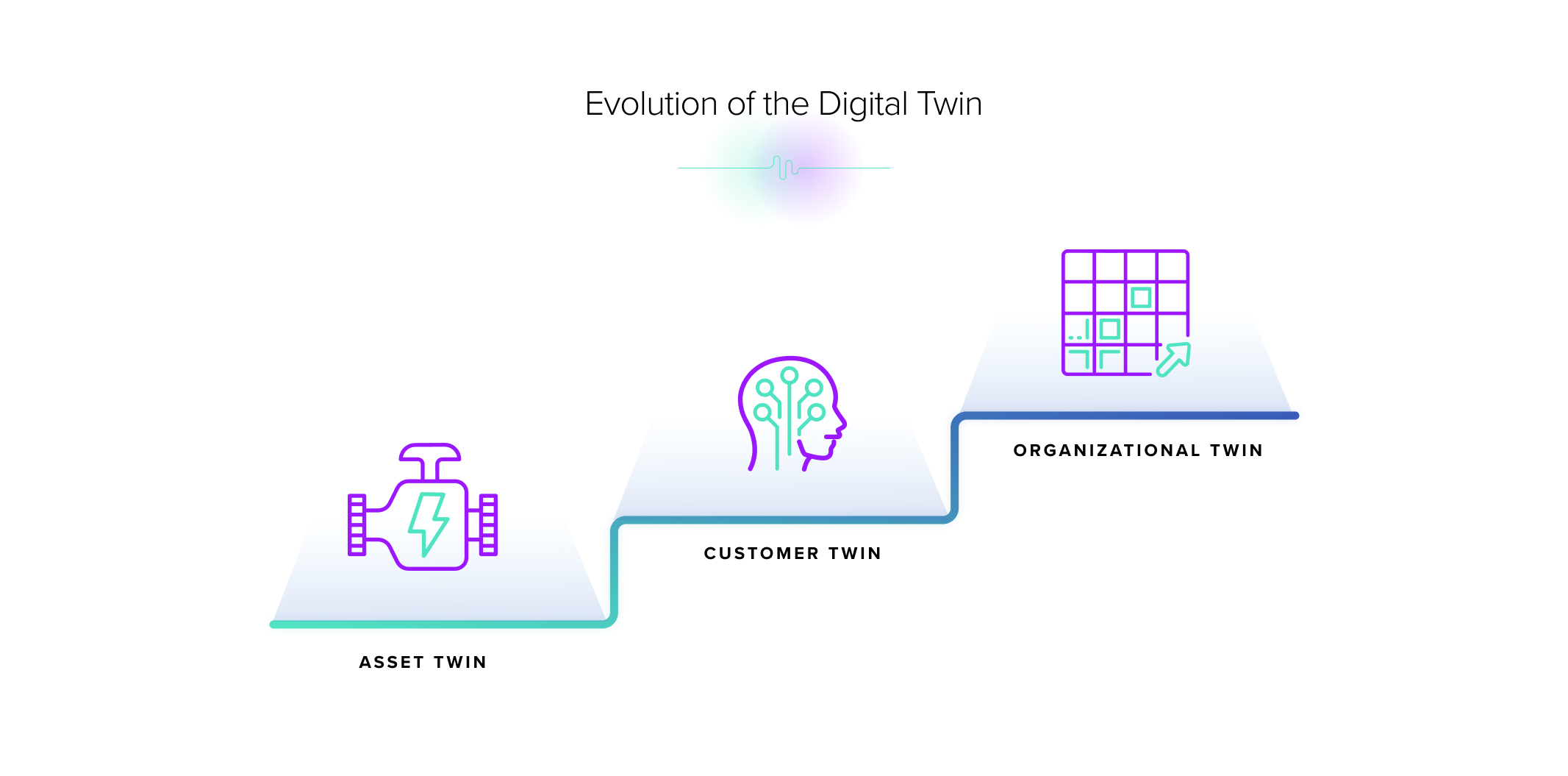
Rung One: The Asset Twin
For decades, organizations like NASA and global aerospace manufacturers have built precise computational replicas of high-value assets. If you are launching a spacecraft into orbit or deploying a deep-water turbine, you cannot afford to troubleshoot engine anomalies on a live, deployed system. You build a parallel computational model of that physical asset. You stream real-world sensor data into the model, and you run simulations to predict material fatigue and mechanical failures before they happen in reality.
The asset twin deals entirely in object physics. It operates on fixed laws. It measures heat, pressure, vibration, and tolerance. It proved the rehearsal enterprise’s foundational rule: simulating a failure is infinitely cheaper than experiencing one.
Rung Two: The Customer Twin
Over the last decade, the market attempted the massive architectural leap from modeling metal to modeling humans. This is the customer twin. The objective is to build synthetic representations of buyer cohorts to predict exactly how they will react to specific market stimuli.
This transition requires moving beyond rigid physical laws. You are now modeling behavioral logic, emotional resonance, and cognitive friction. To make a customer twin function, companies must ingest vast streams of behavioral data, purchase histories, and support interactions. At this rung, a unified data spine, built as an enterprise knowledge graph, becomes essential. If your sales data does not communicate with your marketing data, your customer twin will hallucinate. It requires mapping the human buyer’s behavioral context to accurately predict whether a subtle price increase will trigger a loyal renewal or a permanent defection.
Rung Three: The Organizational Twin
The modern enterprise is now scaling the final rung of this ladder. The organizational twin is the ultimate fusion. It models the complex friction between the company’s internal operations and the market’s external behavior.
If your customer twin predicts that a new advertising campaign will generate a massive spike in top-of-funnel demand, the organizational twin simulates whether your supply chain, support ticketing system, and onboarding architecture can handle that volume without collapsing. It runs the effectiveness laws forward, modeling the entire enterprise ecosystem as a single, interconnected machine.
Because it sits at the apex of the ladder, the organizational twin inherits the strict requirements of the previous two rungs. It demands perfectly unified data. It demands mapped behavioral context. Most importantly, as we introduce autonomous agents into this environment, it demands an unyielding layer of executive governance.
Glass Box Versus Black Box
To enforce that unyielding layer of executive governance, building the actual model requires a fundamental philosophical choice. The final distinction between a true rehearsal enterprise and a failed experiment comes down to one core architectural principle: transparency.
Most commercial artificial intelligence tools currently on the market operate as black boxes. You feed them a dataset or a prompt, they run the data through an opaque, proprietary neural network, and they spit out a recommendation. The executive team has no way of knowing why the machine made that specific choice. You cannot see the weighted variables, you cannot trace the data lineage, and you cannot audit the internal logic. You are simply asked to trust the machine blindly.
In a high-stakes corporate environment, blind trust is a dereliction of duty. If an algorithm tells a Chief Financial Officer to cut the brand budget by thirty percent, the CFO cannot take that recommendation to the board without showing the math.
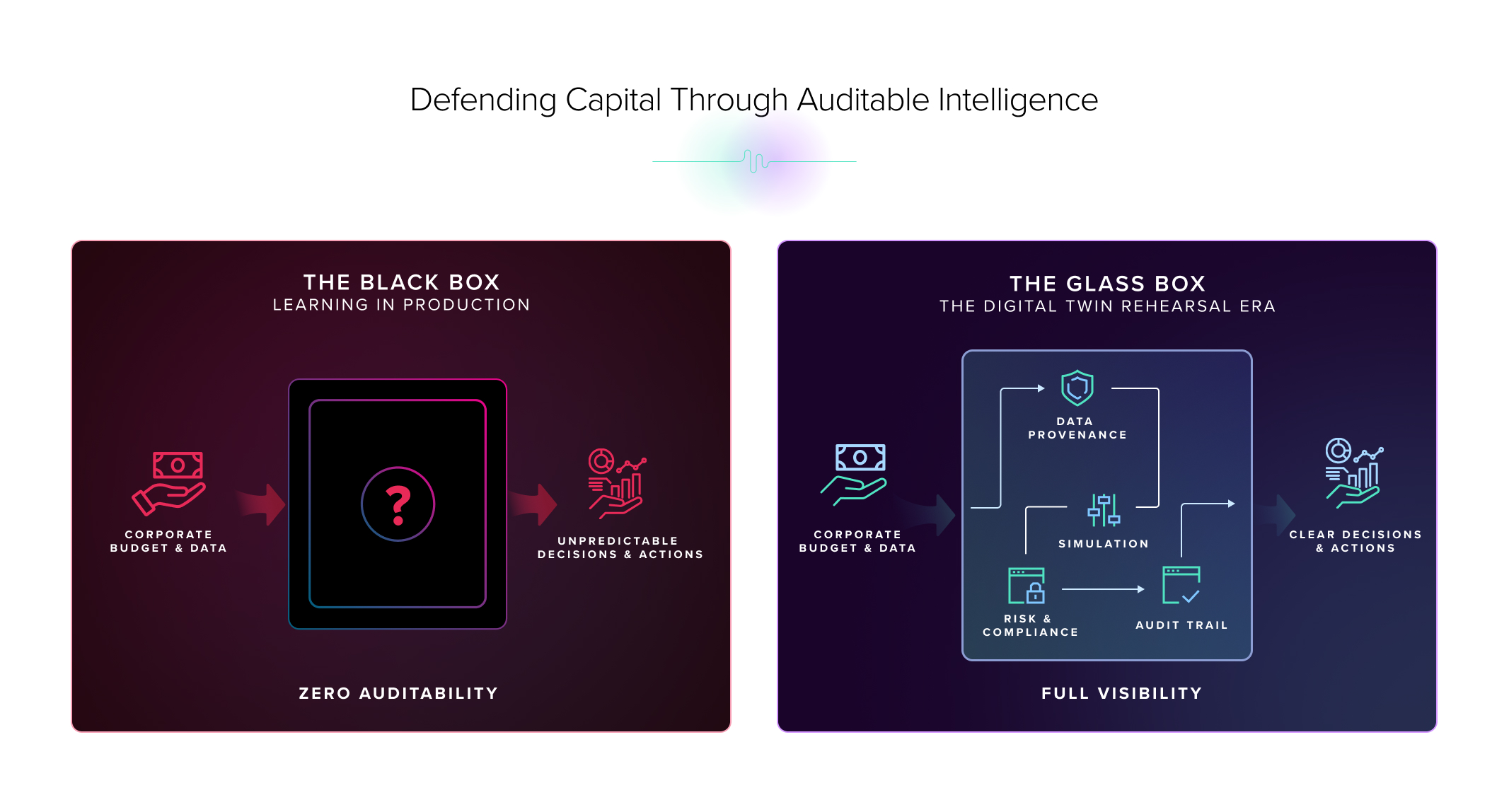
A true digital twin is built exclusively as a glass box. It is a fully transparent, interactive simulation environment. Every predictive model, every synthetic customer interaction, and every operational recommendation is entirely auditable.
If the twin simulates a pricing change and predicts a ten percent defection rate in a specific customer cohort, human operators can double-click on that prediction. They can trace the logic back to the exact behavioral signals in the unified database and the precise cognitive rules encoded in the synthetic persona. They can see the math.
This transparency is not just a user interface feature. It is the core mechanism of organizational trust. A system that cannot explain its reasoning cannot be governed, and a system that cannot be governed has no place making decisions with your capital. The glass box architecture ensures the technology serves the firm’s strategic intent, preparing your internal operations to face a live market changing at machine speed.
This exact, governed preparation becomes non-negotiable as the human buyer journey disappears behind a wall of algorithms.
The Moment of Machine Mediation
For two decades, marketers obsessed over the messy middle of the buyer journey. Brands bought advertisements at every conceivable touchpoint to intercept buyers as they navigated a labyrinth of search engines, review blogs, and corporate websites.
That entire consideration phase, however, is an expensive illusion. The data shows buyers decide long before traditional search begins.
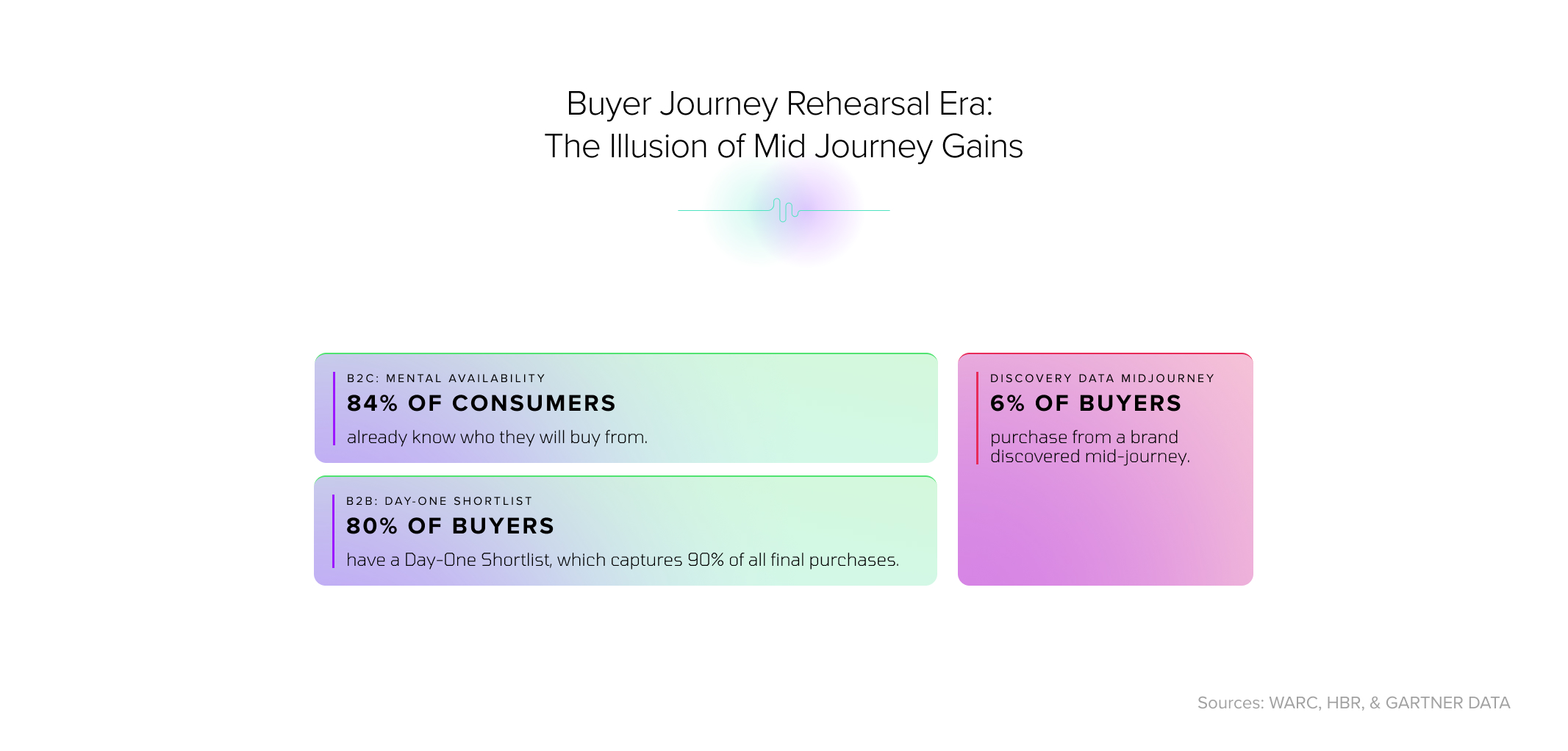
According to WARC research, consumers ultimately select the brand they expected to buy at the start of their journey in over 80 percent of all purchase decisions. In the business-to-business sector, this bias is even more stark. Harvard Business Review reports that 80 percent of B2B buyers form a day-one shortlist before contacting a vendor, and Bain reports that 90 percent of final purchases go to a vendor on that initial list.
By the time a buyer is actively searching, the discovery window is essentially closed. Data shows that approximately 40 percent of all B2B buying journeys end in “no decision” as committees fail to reach consensus.
When we do the math on the remaining active pipeline, a sobering reality emerges. If 40 percent of prospective deals evaporate into inaction and 90 percent of the remaining 60 percent are locked down on day zero, a vendor discovered mid-journey wins only six out of every 100 B2B buying decisions.
This existing behavioral bias is now being exponentially accelerated by a new behavioral singularity: the Moment of Machine Mediation (MoMM), a concept Paul Ruscoe introduced.
To understand how this shift rewrites the economics of customer acquisition, we must look at how it structurally reshapes the traditional marketing funnel. For decades, the path from curiosity to conversion was a sprawling, multi-week labyrinth of human research and discovery. Today, that entire landscape is undergoing a violent structural collapse.
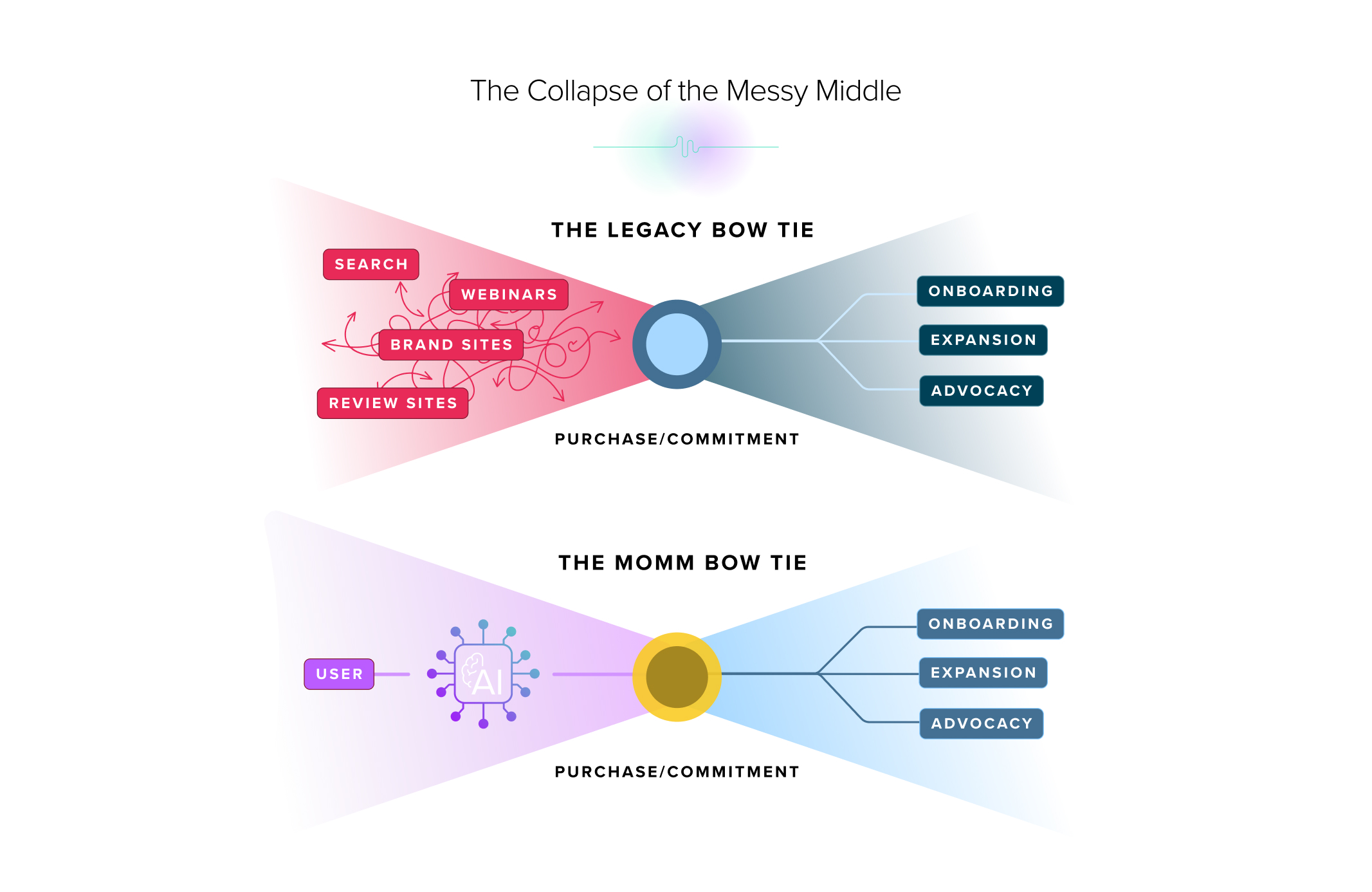
This visual collapse represents a massive transition where discovery, recommendation, and purchase collapse into a single, frictionless action. Rather than navigating a fragmented web to manually compare models or confirm biases, buyers simply prompt interfaces like ChatGPT, Claude, or Perplexity. It draws on what it has already learned about you, and increasingly on live retrieval, and presents the most authoritative answer.
As the left wing of the bow tie collapses, the entire business competitive landscape shifts. When the machine automates acquisition, traditional ways we bought attention, like SEO, PPC, and flashy landing pages, lose leverage. Your survival shifts entirely to the right wing of the bow tie: the operational truth of your customer experience, post-purchase onboarding, and retention. This right-wing operational performance generates the structured, authentic footprint AI agents read to make their next recommendation. In the MoMM, you cannot advertise your way out of a bad operational reality.
The financial scale of this shift is staggering. According to McKinsey & Company research, agentic commerce, where AI agents shop, negotiate, and execute transactions on humans’ behalf, is projected to orchestrate $3 trillion to $5 trillion in global retail spend by 2030. The friction is gone, and the capital is moving to the algorithms.
The Involuntary External Twin and AI Invisibility Syndrome
This brings us to an important technological inflection point. You may think your organization will build a digital twin at some point in the future. The truth is that a digital twin of your brand already exists today.
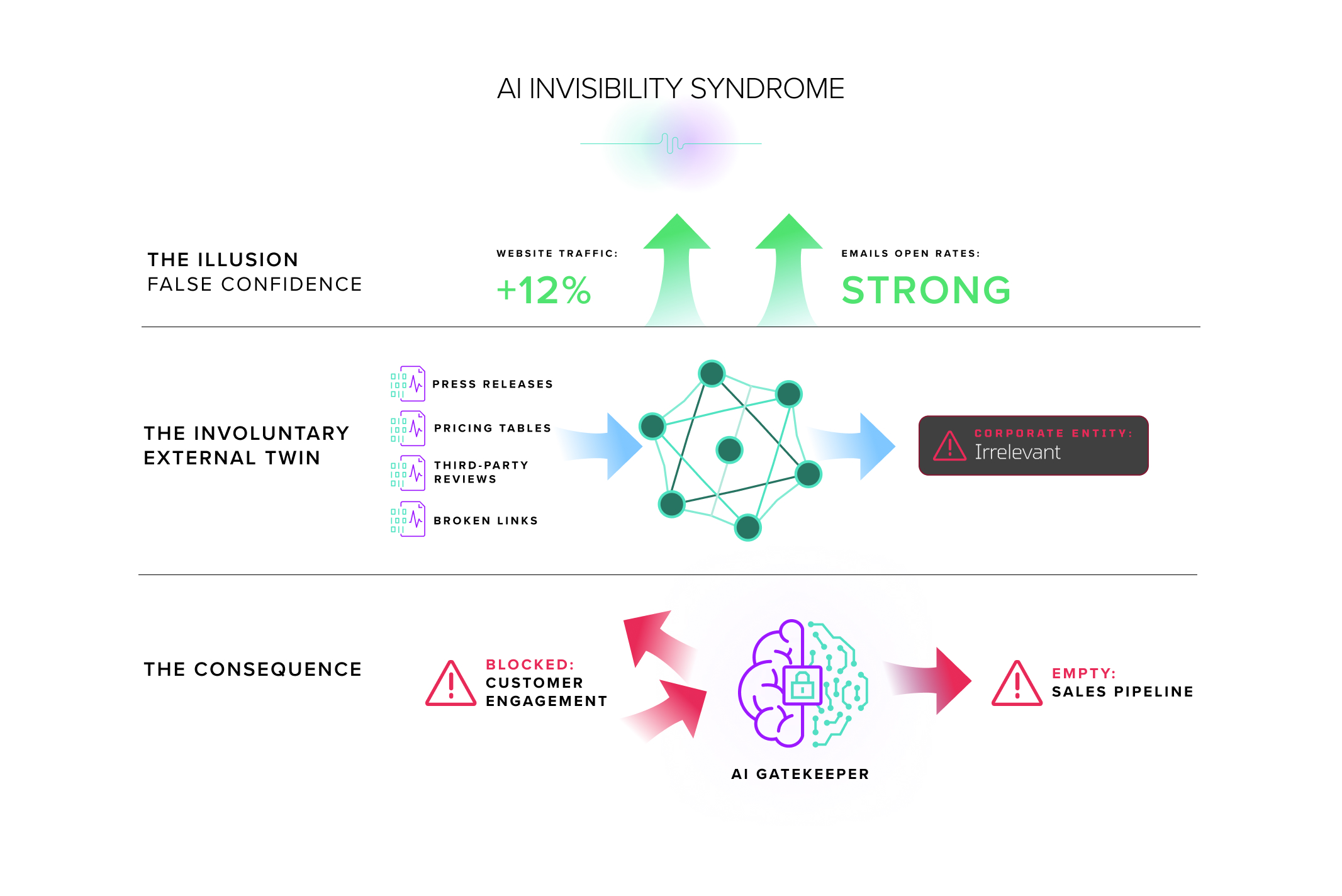
Major large language models have already crawled your digital footprint. To train their neural networks, these models ingested your website, pricing tables, press releases, technical documentation, and third-party reviews. The algorithm processed this text, tokenized your brand name, and mapped it into a high-dimensional vector space. It synthesized all of those disparate data points into a complex web of mathematical weights and biases. It assembled a working, permanent representation of your brand in its memory.
This is your involuntary external twin. You did not authorize it. You did not govern it. You do not own the infrastructure it lives on. Yet it dictates your commercial survival.
The external twin functions like a corporate credit score calculated by an algorithm you cannot see. The model weighs different data sources based on its own internal logic. A mention in a highly trusted financial publication carries massive weight. A broken link on an abandoned public relations wire carries a penalty. When a buyer initiates a MoMM, the algorithm does not go out and read your website in real time. It consults the memory structures it has already built. It interrogates the external twin.
If your external twin is fragmented, contradictory, or lacking in established entity authority, the machine will deem your brand irrelevant. It will bypass you entirely and recommend a competitor whose digital footprint is mathematically legible. We call this condition AI invisibility syndrome.
The symptoms of AI invisibility syndrome are incredibly dangerous because they hide behind traditional metrics. A marketing team might stare at a dashboard showing healthy website traffic and strong email open rates, baffled that their qualified sales pipeline has suddenly dried up. The answer is that the artificial intelligence gatekeeper has quietly locked them out of the consideration set.
“A brand absent from the model’s memory is not losing clicks. It is structurally unavailable at the moment of recommendation.”
You can spend millions of dollars optimizing your website for human conversion. If the machine cannot read your authority, the human will never see the website.
This algorithmic erasure, however, offers smaller brands no way out. Early evidence suggests answer engines largely mirror the market as it already is: they name the biggest brands most often and rarely lift a challenger past a larger rival.
Algorithmic Jeopardy
The true danger of the involuntary external twin is that it threatens to lock in the market-share gap between category leaders and challengers. To understand the mechanics of this threat, we can look to the concept of “double jeopardy,” a proven empirical law in marketing science first identified by Andrew Ehrenberg. The law dictates that brands with smaller market shares suffer two distinct, compounding penalties: they naturally have fewer buyers, and the buyers they do attract are slightly less loyal.
We propose that artificial intelligence may be introducing a third penalty: the Algorithmic Jeopardy, a hypothesis first formed by Paul Ruscoe.
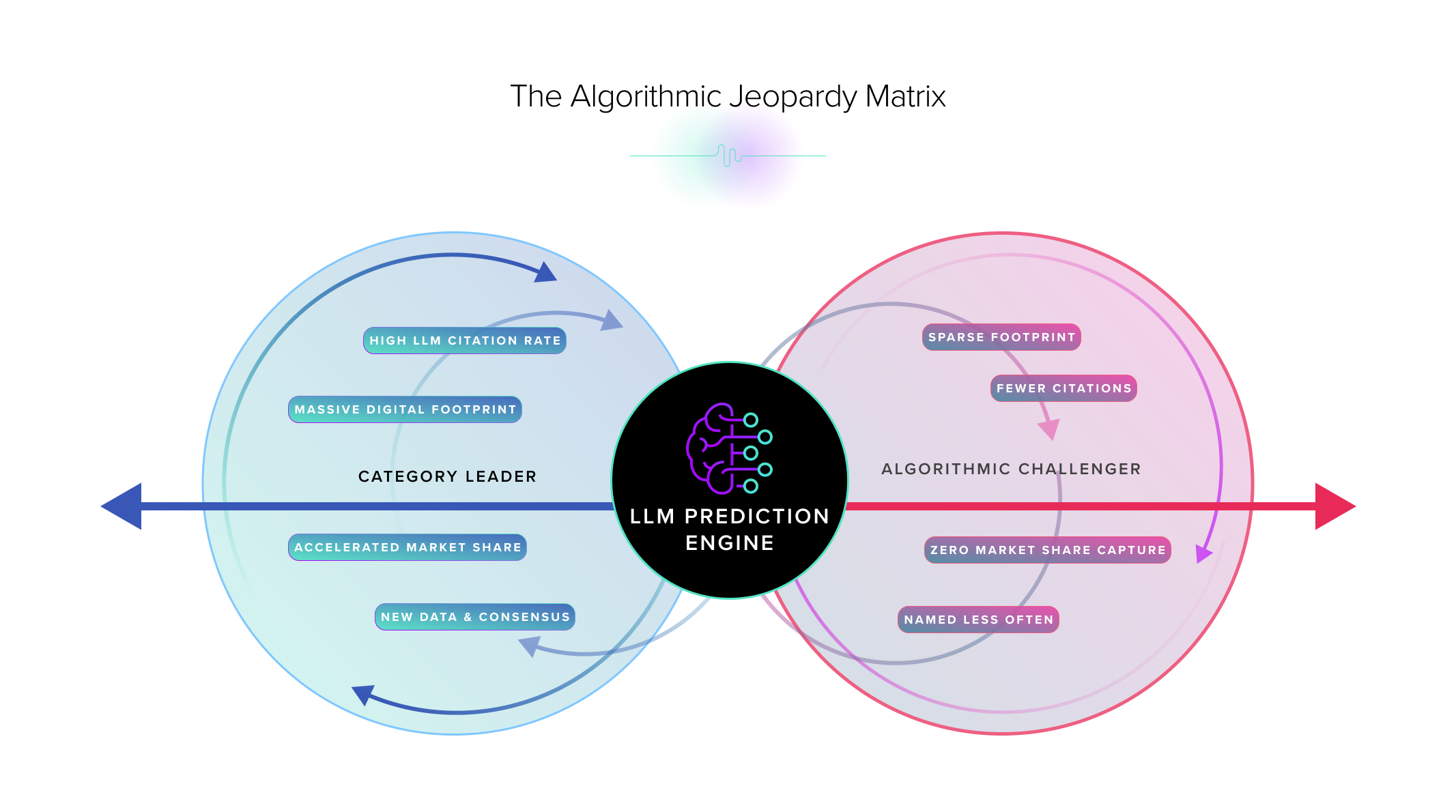
Large language models are fundamentally prediction engines trained on volume, consensus, and frequency. They naturally favor prominent entities with massive, highly structured digital footprints. Smaller brands, by definition, have fewer mentions across the internet and less third-party validation. Because the machine follows its training data, it may be structurally inclined to surface the category leader as the most probable, authoritative answer, making the smaller brand less visible in AI-generated recommendations.
Paul has since tested it. His study, The Algorithmic Jeopardy, compared each brand’s size, measured as its share of branded search, with its Share of Answer in Google AI Overviews and ChatGPT. It covered 834,943 brand mentions across 39 brands in seven US categories. Brand size explained 69 percent of the variance in how often brands were named. Whether the machines penalize small brands beyond their size was too close to call: the categories split four to three. So far, machines don’t appear to punish small brands harder than their size already does, but they don’t offer a way out either. Visibility work moves a brand among its peers, within its division, and rarely into the one above.
Machine Memory Meets Mental Availability
To compete under the Algorithmic Jeopardy, we have to fuse two distinct disciplines of marketing science, bridging human psychology and artificial neural networks. This requires us to revisit the foundational laws of brand growth and re-examine them through the machine’s unforgiving lens.
The first law dictates that a brand has to be quick to mind. For decades, brand builders focused relentlessly on achieving this mental availability. When a human buyer faces a specific buying situation, the brand has to spring instantly to the forefront of their consciousness. This is incredibly difficult to achieve. Research demonstrates that only 2 percent of consumers attach a specific buying attribute exclusively to one single brand. To win a share of human memory, you must constantly reinforce your connection across multiple buying situations. Advertising alone can’t do this, but good, emotionally resonant advertising should try.
In the answer economy, however, mental availability is no longer enough. The buyer’s memory and the model’s memory are now two surfaces of the exact same asset, and you have to win on both.
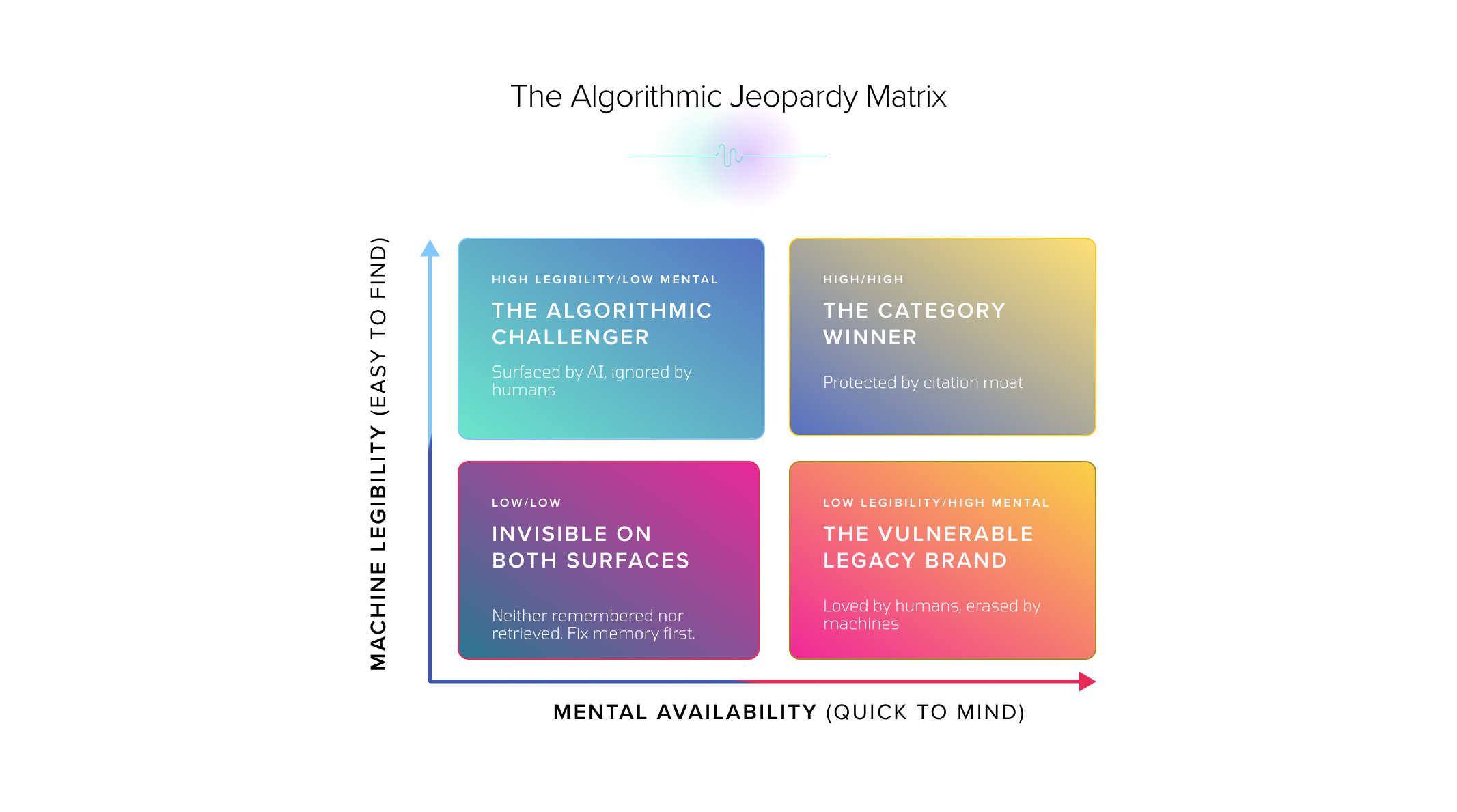 The four quadrants of this matrix illustrate how this plays out in the live market. A vulnerable legacy brand might have massive mental availability because everyone over 40 remembers its historical advertising. However, because its digital architecture is outdated, it receives zero citations in AI-generated buying guides. Humans love it, but machines erase it.
Conversely, an emerging algorithmic challenger might have perfectly structured data and capture higher visibility in AI answers than its current market share suggests. Yet, if the human buyer has never heard of that brand, they will likely reject the machine’s recommendation out of pure unfamiliarity. They are surfaced by the AI but immediately ignored by the human.
This is why technical architecture and brand advertising can no longer exist as separate corporate budgets. They are two surfaces of a single, unified growth strategy. If you stop broadcasting emotionally resonant creativity, human memory decays and you lose your quick-to-mind advantage. If you stop publishing structured, entity-linked intelligence, machine memory decays and you lose your easy-to-find position. Because both cognitive surfaces degrade without constant, deliberate energy, they must be funded in perfect lockstep. Balancing this dual-surface memory is the formula for driving your baseline metrics and laying the foundation for the ultimate strategic metric of the answer economy: share of answer.
Share of Answer is the New Share of Search
As the center of commercial opportunity moves into the machine’s memory, we must fundamentally change how we measure success.
In recent years, marketing science has popularized share of search as a valuable proxy for market share when actual sales data is unavailable. This framework, championed by researchers James Hankins and Les Binet, shows that branded search volume relative to competitors can serve as a useful leading indicator of consumer interest. If your share of search begins to decline, your market share will often follow.
The surface has changed, but the economic law remains identical. Share of answer is the AI-era equivalent of share of search. It measures unprompted algorithmic confidence.
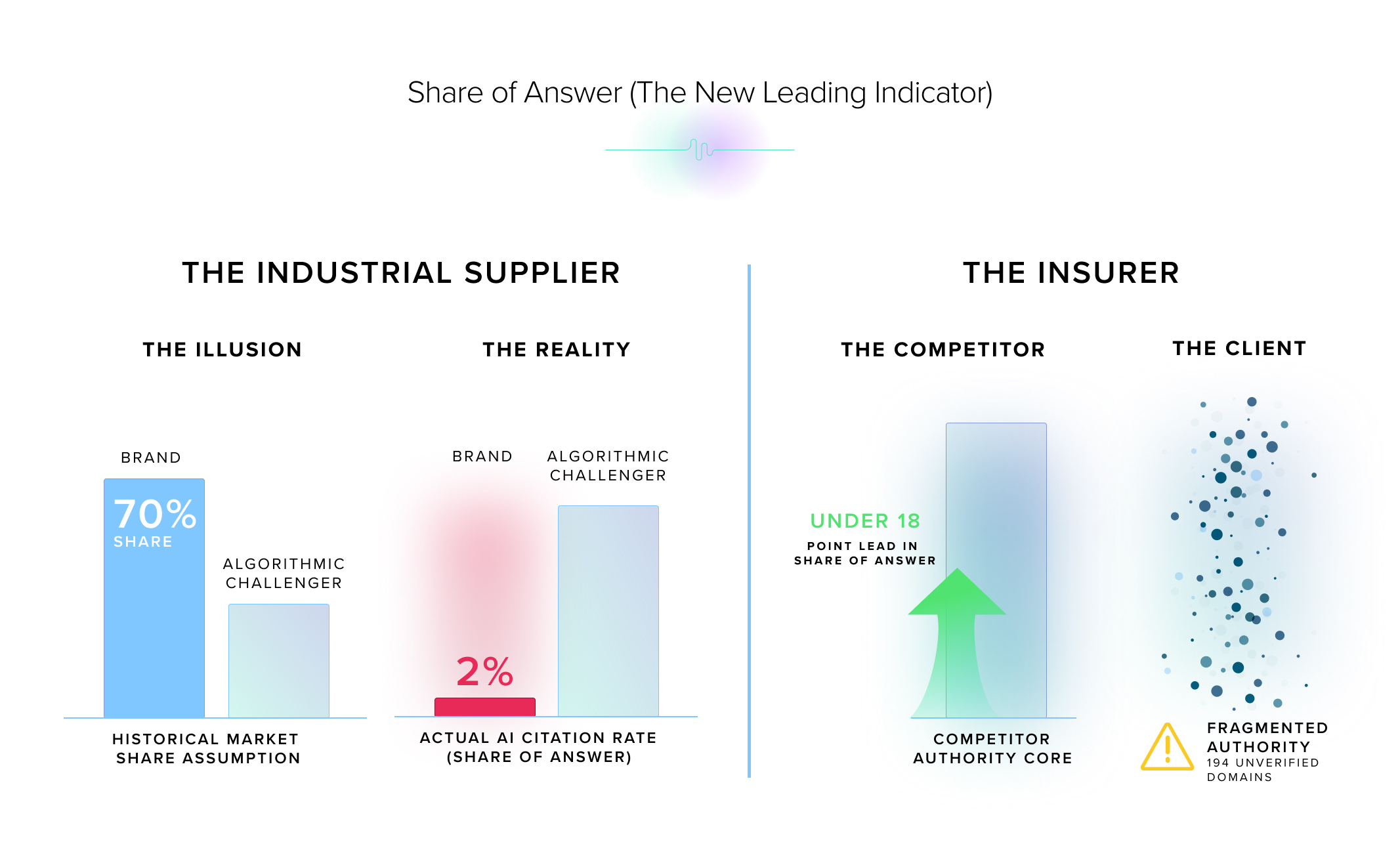
As shown here, tracking how often your brand is cited as the definitive solution across the generative AI landscape provides critical baseline intelligence. Without measuring this citation share, it becomes exceptionally difficult to see your audience’s shifting search patterns and the natural evolution of your marketing funnel.
In the financial services category, we audited a prominent small-business insurer. They trailed their primary category leader in share of answer (15 percent versus a dominant 50 percent). Their citation authority was disastrously fragmented across 194 domains, with 57 percent unverified, low-quality sources cited only once. Meanwhile, they didn’t realize the algorithms shaping their buyers’ decisions didn’t view them as credible.
It’s clear. The market now decides who is real long before a human buyer ever reaches a corporate website. If the machine mediating the transaction cannot mathematically verify your operational truth, your historical brand equity remains completely invisible. In this new arena, pouring millions into performance media is no longer a sustainable growth strategy. It is simply a penalty tax paid for lacking structural authority. Securing your competitive future means moving away from simply renting temporary attention toward systematically engineering permanent algorithmic trust. This shift is how you build a resilient citation moat.
Building the Citation Moat
To stay in contention on the machine surface, we look to a fresh set of strategic disciplines. The methodology required to audit, correct, and align your external footprint with how machine-mediated buyers behave is entirely new. We call this Answer Engine Optimization (AEO). AEO is table stakes. It keeps a brand legible to machines and helps it move among its peers. Moving up a division still takes building memory with people who aren’t yet buying.
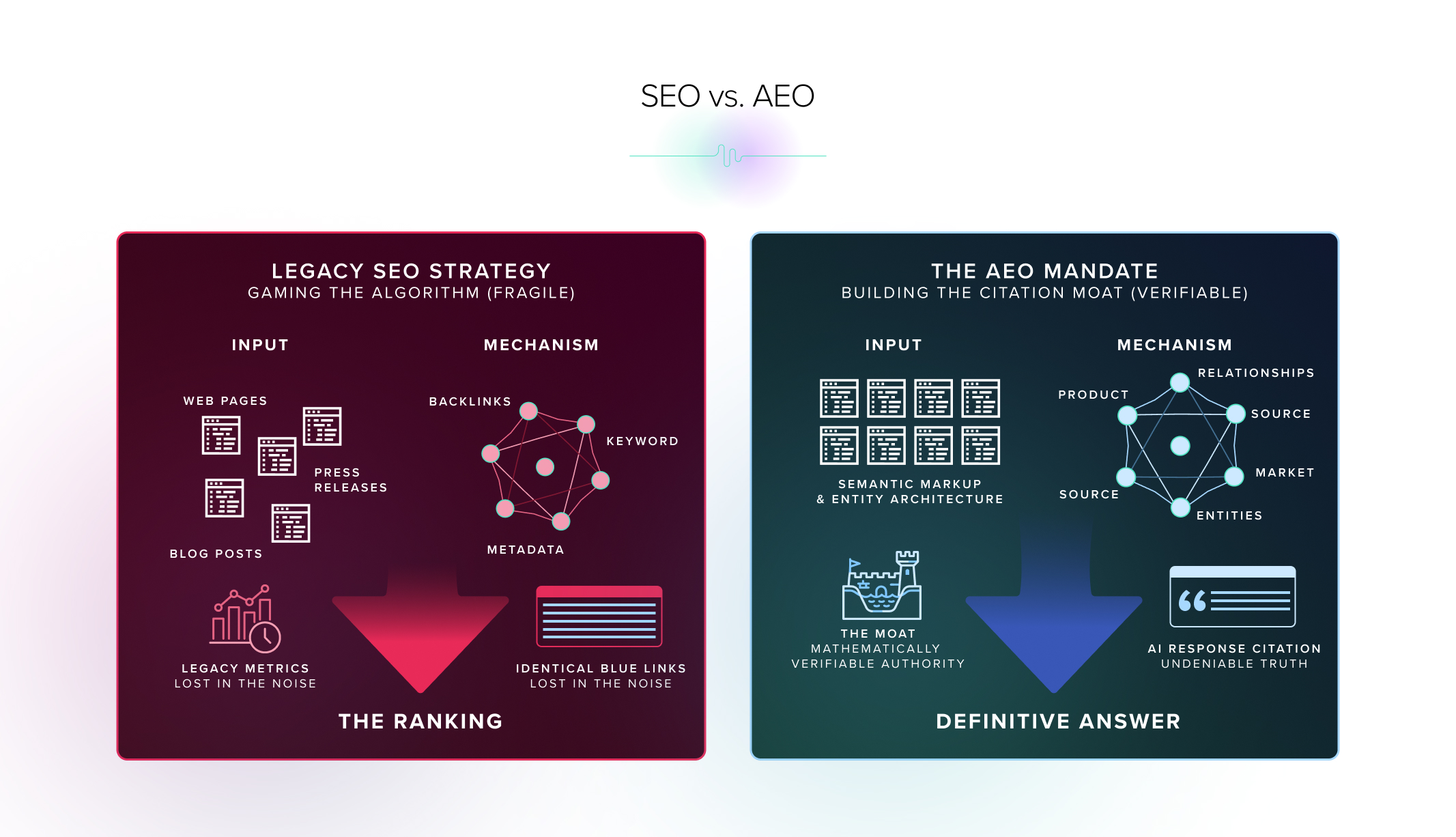
AEO is not simply a rebranding of Search Engine Optimization (SEO). Traditional search optimization focused on keyword density and link profiles designed to influence ranking algorithms. The modern answer economy, however, evaluates data differently. Large language models prioritize entities, verified relationships, and structured, accessible knowledge.
Engineering this presence means architecting your digital footprint so machines can read your proprietary intelligence. This foundation builds your long-term market authority.
Building that long-term authority requires transforming unstructured corporate data into a strict knowledge graph. You deploy semantic markup and an entity-first architecture to explicitly define who you are, what problems you solve, and why your data represents the definitive ground truth for your category. In this new model, you do not optimize to rank on a list. Instead, you optimize to become the only logical, mathematically verifiable answer the algorithm can confidently provide.
This strategic posture is necessary to compete in the answer economy. It’s undeniable proof of the external threat and the architectural countermeasure. However, you can’t engineer your brand’s external perception if your internal intelligence remains scattered across a dozen siloed databases. Building a resilient citation moat starts with building the engine that powers it. Governing the twin you didn’t authorize starts with mastering the twin you build on purpose.
The Twin You Build on Purpose
Building this internal twin requires a fundamental reorientation of the corporate structure. For decades, businesses have operated with two distinct offices: the front office that customers see, and the back office that powers the operation.
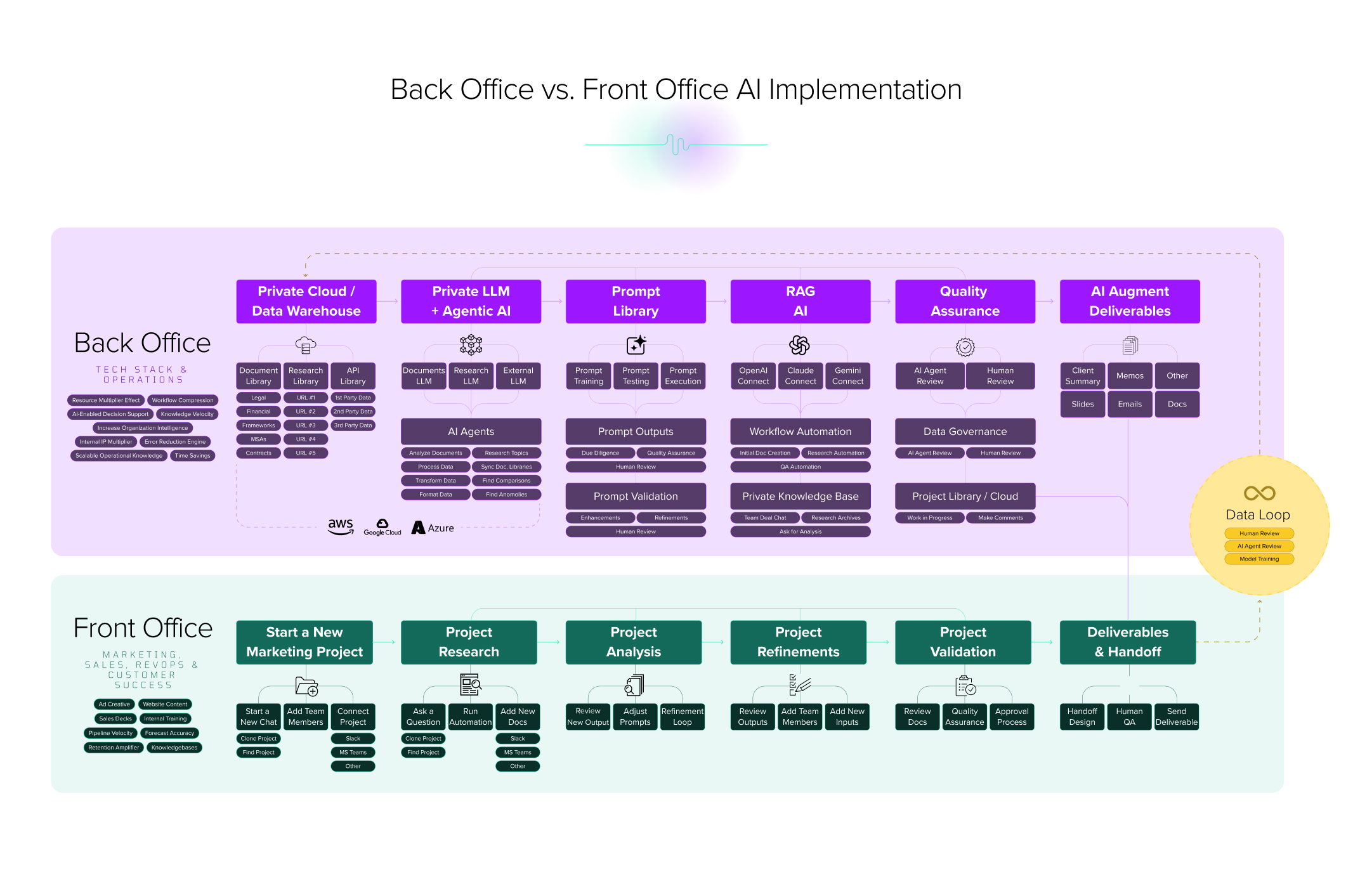
The front office is the activation layer. It includes advertising campaigns, website interfaces, sales pitches, and creative messaging. It is the brand’s surface area. The back office is the engine room, containing the data architecture, behavioral logic, and the enterprise’s operational truth.
For the last twenty years, capital has gone to polishing the front office, while the back office was never architected to support a modern, AI-driven growth strategy. As I said at the start, the goal is to be showtime ready. The customer should only ever see showtime, never the frantic preparation behind it. Most companies achieve this in their physical operations but fail completely in their growth decisions. They aren’t showtime ready where it counts.
This creates a quiet but expensive separation. The insights from organic and AI-visibility work sit in one room, while the paid media budget is spent in another. Because the intelligence from the first room is the richest targeting input the second has ever had, you end up paying twice: once to discover what works, and again to relearn that same lesson in a channel that never saw the original insight.
The internal twin is what finally closes this gap. It is built on a simple, powerful principle: you must align the graph of how your company thinks with the graph of how your customers decide.
- The Enterprise Knowledge Graph: This is a map of your company’s brain, a structured network that connects your products, campaigns, and expertise into a single, trusted source of truth.
- The Consumer Knowledge Graph: This is the map of your customer’s mind, built by turning messy human data, including what people think, feel, do, and say, into a quantitative model of their motivations.
When you fuse these two graphs, every front-office decision is informed by a deeply intelligent back-office rehearsal. You are finally architected to be showtime ready.
Performance is Rent, Twice Over
The urgency to build this unified system stems from a massive economic vulnerability. Most modern enterprises trap themselves in a cycle of renting their survival, continually renting demand and outsourcing intelligence to third-party platforms.
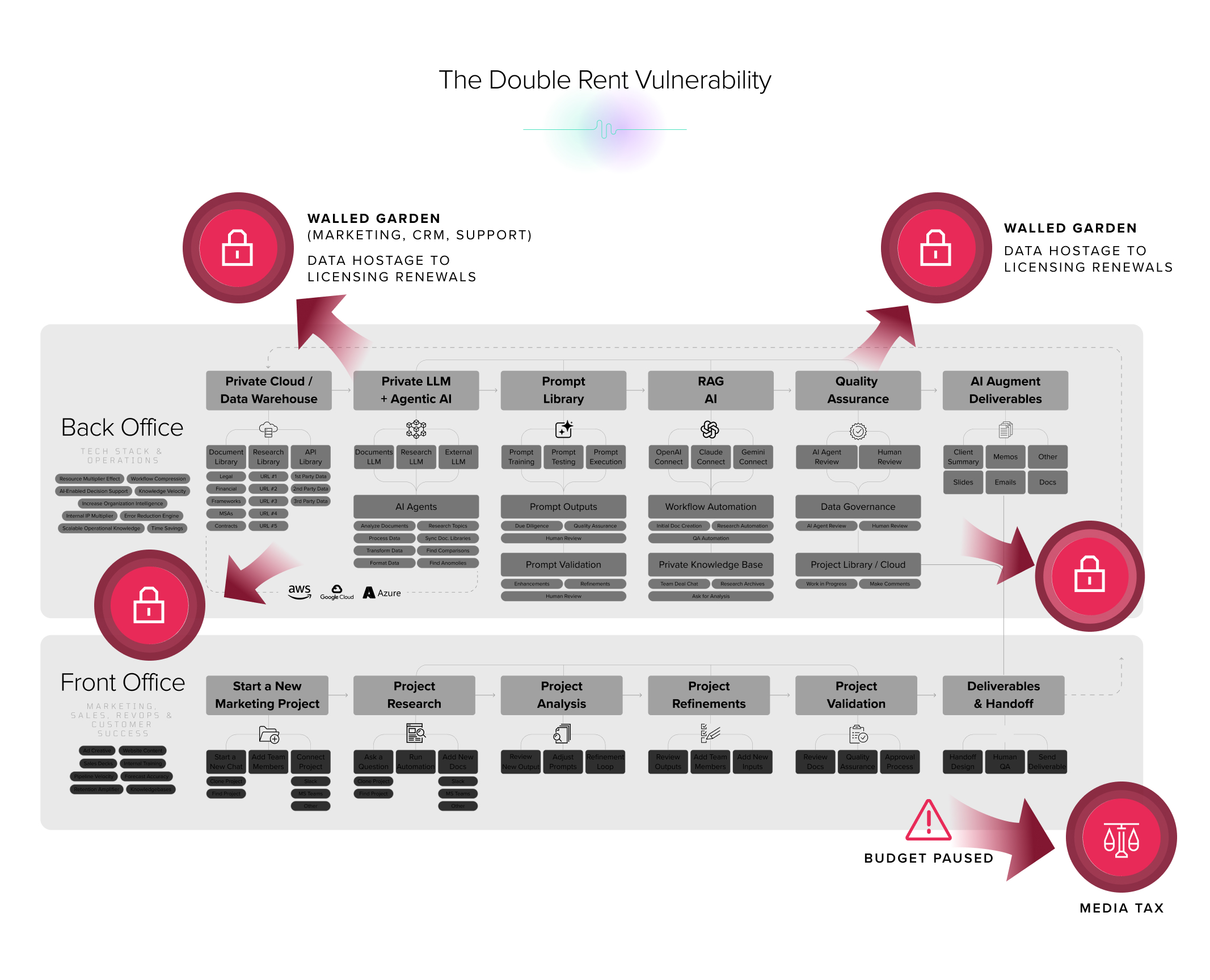
This economic vulnerability creates a double-rent trap, where enterprises continuously pay for temporary access on two fronts.
On the front end, they are renting their demand. Performance media harvests demand. It doesn’t create it. When an enterprise relies exclusively on paid search and social media, it doesn’t own its acquisition channel; it merely pays a daily tax to participate in the market. The moment the media budget pauses, the traffic vanishes, and zero permanent equity has been built.
On the back end, they are renting their intelligence. Over the last decade, companies fell victim to software sprawl, buying a separate SaaS platform for every business function. This created a catastrophic architectural flaw: corporate intelligence now compounds inside a vendor’s walls. When you fragment your data across fifteen different platforms, you are held hostage at renewal time. You pay the ransom, or you lose your memory.
Performance marketing is rent, and software sprawl is rent. Both create a temporary illusion of efficiency while transferring actual enterprise value to a third-party landlord. The strategic remedy is absolute ownership: owning the brand asset that generates demand and the intelligence asset that coordinates the data. Both belong in the exact same cohesive architecture.
Architecting the Insight Engine
Achieving this level of ownership begins with establishing the brain of the internal twin: the insight engine. This engine’s foundation is not a generic data warehouse, but the enterprise knowledge graph.
Rather than letting third-party vendors hoard your data, this graph ingests every raw stream of information generated across the company, from marketing data and sales transcripts to customer support logs and financial records, and unifies it into a single, governed source of truth.
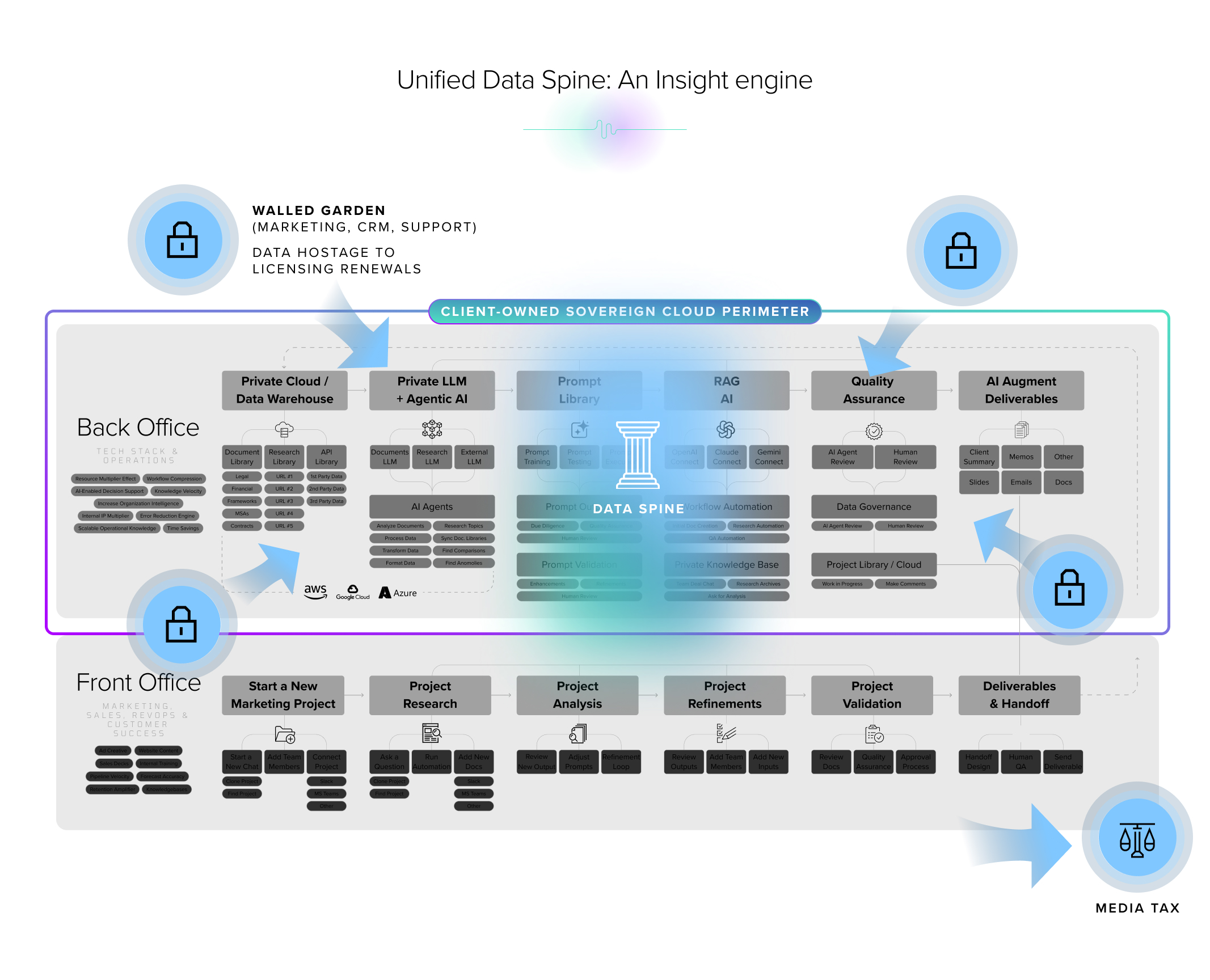
As the diagram illustrates, this architecture creates a protective boundary around your most valuable asset. Data streams that once ended on external, rented platforms are redirected into a client-owned, sovereign cloud. When they hit the data spine, the raw, fragmented inputs are synthesized into a single, structured, and governed beam of intelligence.
This model completely redefines the role of external software.
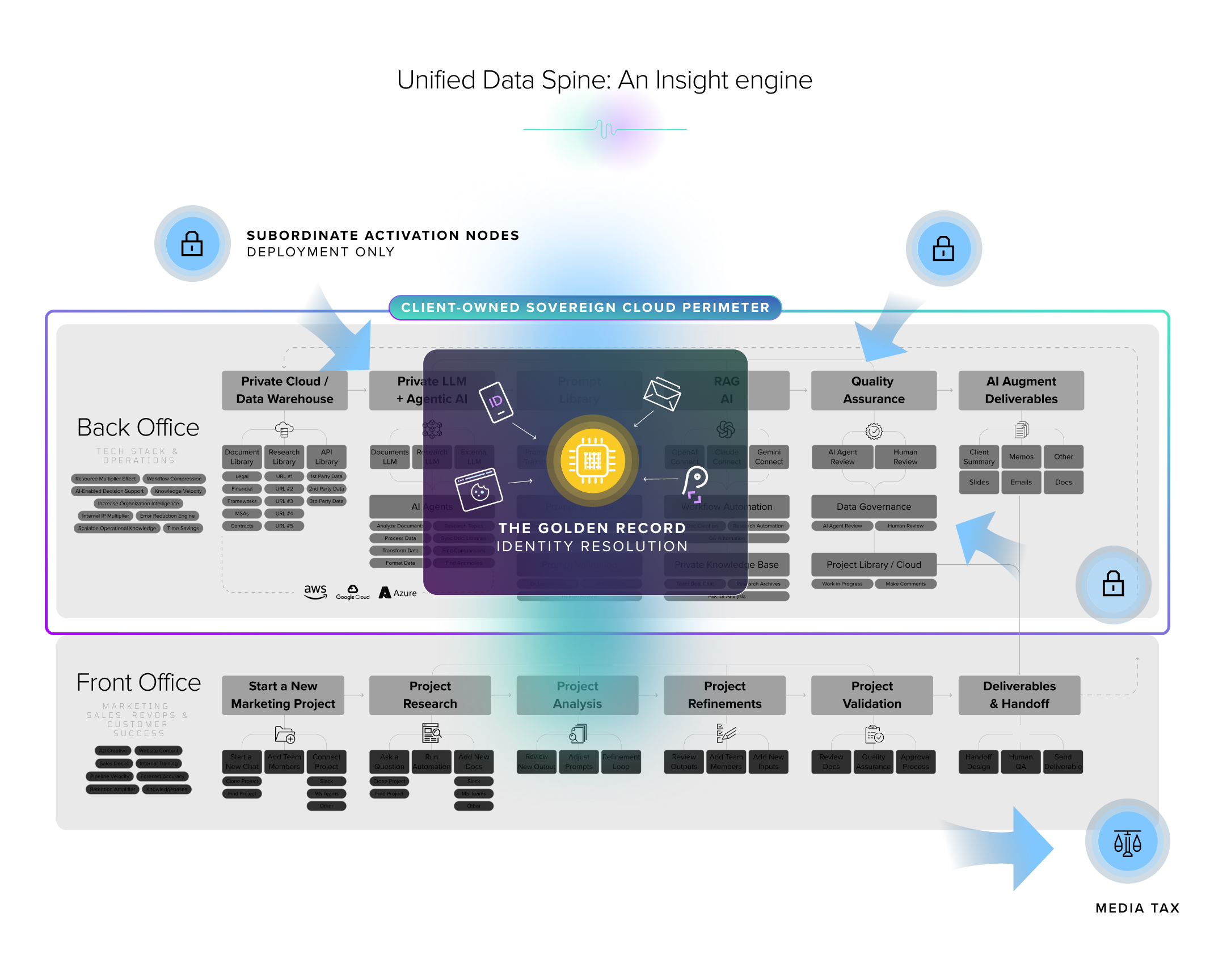
The external platforms are reduced to simple activation nodes. As the blueprint shows, they execute tasks such as sending an email or logging a call, but they no longer hold the intelligence hostage. Intelligence lives permanently in your sovereign cloud. With private deployment and strictly auditable trails, your auditable data never touches the public internet. You achieve security through structural isolation.
Once the data is unified, the Insight Engine performs its most critical function: identity resolution.
In a standard, siloed environment, a single human buyer exists as five different, disconnected fragments. They are an anonymous IP address on Tuesday, a generic email address on Thursday, a corporate account name three weeks later, and a frustrated support ticket number six months after that. Because the data lives in different systems, the business cannot see the complete human journey.
Identity resolution stitches these disparate signals together. It mathematically binds the anonymous behavioral intent to the named account profile, creating a single golden record for every buyer. The data spine feeds the organizational hive mind, transforming isolated data points into a centralized intelligence nervous system. You can finally see the customer’s complete, end-to-end journey, removing blind spots and putting the actual actors on the rehearsal stage.
From Organic Intelligence to Paid Action
This structured intelligence empowers the back office to dynamically generate the organic insights required to de-risk your paid media spend. We call this strategic coordination the baton handoff.
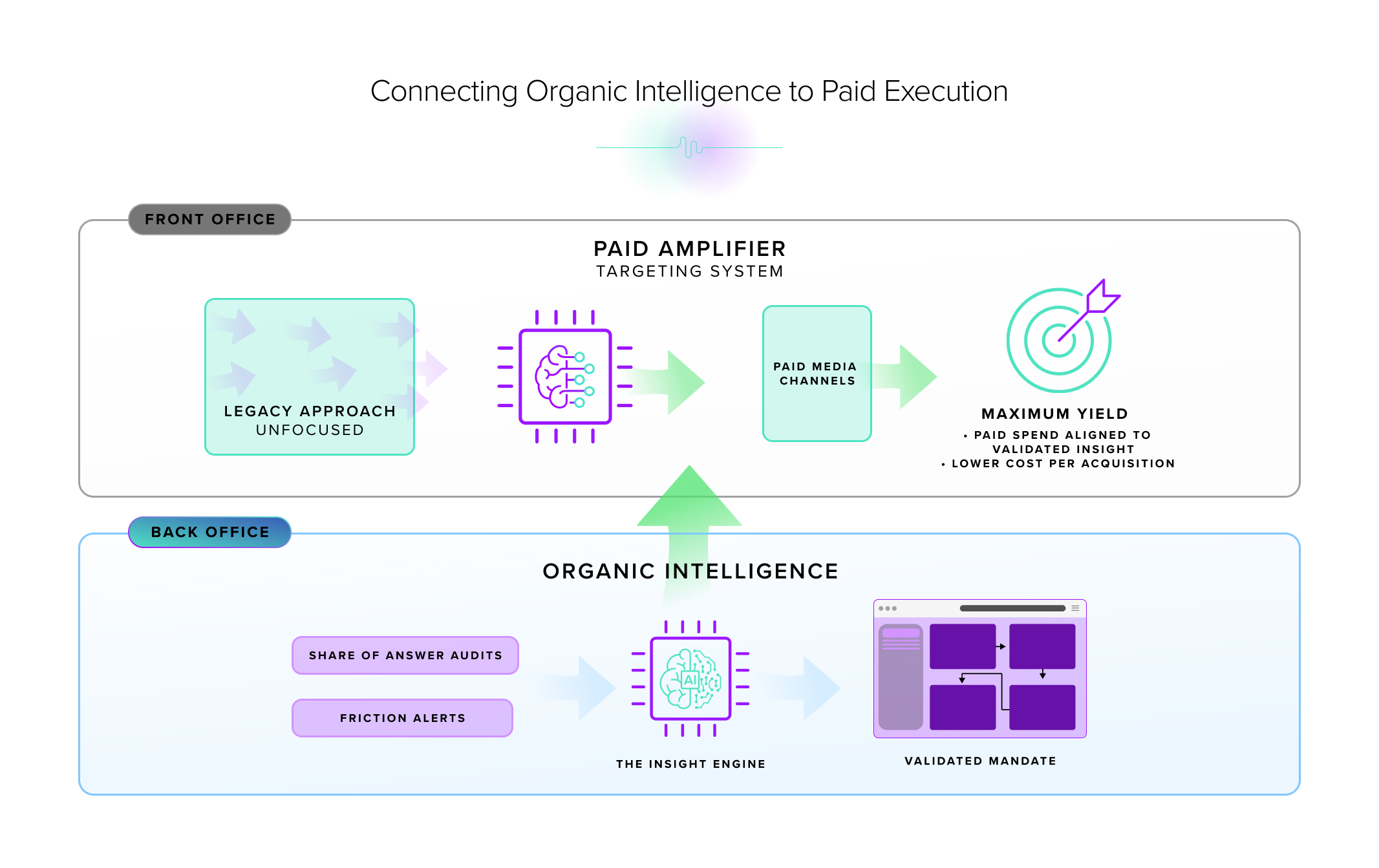
In a legacy marketing department, the paid media team operates in an intelligence vacuum. They guess which audiences to target, which keywords to bid on, and which creative messages will resonate. They spend millions of dollars testing these assumptions in the live market, waiting weeks to see if their guesses were correct.
In a rehearsal enterprise, this guesswork is eliminated. The back office and front office operate as a tightly coordinated relay team. The back office’s sole purpose is to generate a mathematically validated mandate of organic intelligence, then hand it off like a baton to the paid media program for precision execution.
This handoff completely de-risks the front-office spend. The insight engine continuously audits the external market, identifies where the brand is suffering from AI Invisibility Syndrome, maps share-of-answer gaps, and analyzes the enterprise knowledge graph to surface which customer cohorts are likely to upgrade or statistically likely to churn.
This validated mandate becomes the precise targeting blueprint for your paid media spend, replacing market speculation with validated operational certainty. Instead of treating paid and organic as separate, warring departments, this unified approach coordinates them into a single system: the back office supplies the organic intelligence and precise coordinates, and the front office supplies the execution energy to scale them.
From Flat Personas to Synthetic Audiences
With the stage now set and the script in hand, the rehearsal enterprise requires its cast. To run a simulation, you need more than just data; you need actors.
Start by moving beyond a traditional industry staple: the demographic persona. For decades, marketing agencies have delivered polished slide decks featuring fictional characters like “Marketing Mary” or “Enterprise Eric.” These frameworks, while historically well-intentioned, are flat, static, and completely useless for computational simulation. An algorithm cannot test a pricing strategy against a job title. A machine learning model cannot simulate cognitive friction against a list of hobbies. A demographic profile tells you what a person looks like on paper, but nothing about how they’ll decide under pressure.
To run a rehearsal, you need dynamic mathematical models of human logic. You need Synthetic Audiences.
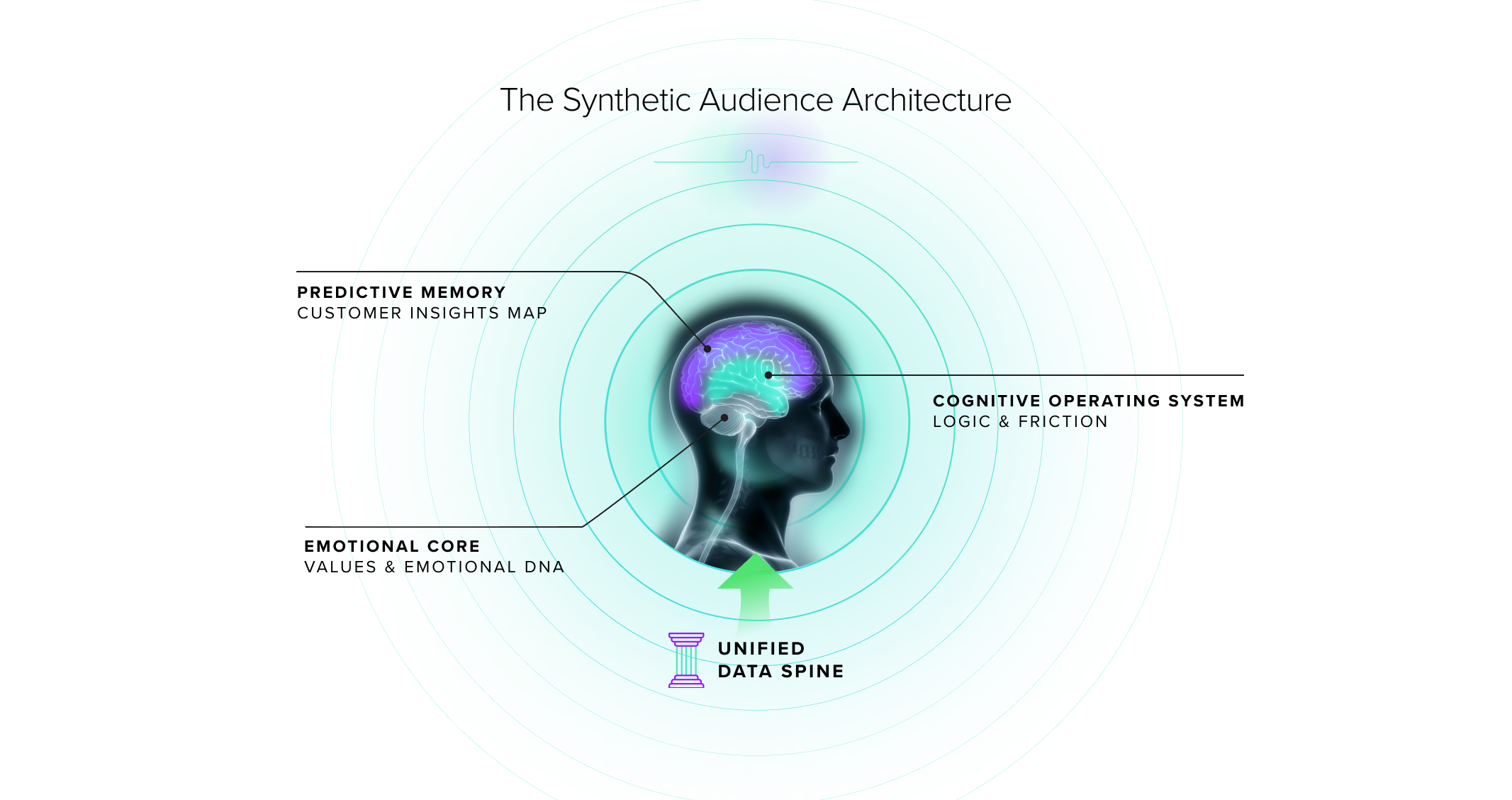
Unlike a flat demographic profile, a Synthetic Persona is a multi-layered computational model built directly from the behavioral signals captured in your Enterprise Knowledge Graph. It is a digital actor programmed to react to variables exactly as your real customer cohorts would in the live market.
While we do not expose the proprietary mechanics of their construction, we build these models by fusing three distinct layers of insight: core values and emotional DNA, behavioral and cognitive logic, and predictive, multi-layered memory.
Core Values and Emotional DNA
The first layer establishes the persona’s deep-seated motivations, core values, and fundamental beliefs. By mapping these foundational emotional drivers, the simulation can predict how a customer cohort will react to changes in brand positioning, ethical stances, or major market disruptions. It ensures the digital actor follows the same emotional logic that governs real human behavior.
Behavioral and Cognitive Logic
The second layer encodes the rules that dictate how the persona processes information, evaluates risk, and reacts to cognitive friction. This layer lets the simulation calculate the exact threshold at which a customer will abandon a purchase, reject a price increase, or accept an upsell offer. It translates psychological friction into predictable, quantitative decision models.
Predictive, Multi-Layered Memory
The final layer provides a deep, contextual history of the persona’s past interactions with your brand. By feeding this historical memory into the model, the digital actor does not start every simulation as a stranger. It remembers previous touchpoints, past purchases, and past customer service interactions, letting you model long-term loyalty and predict lifetime-value dynamics. The result isn’t a static description, but a testable, plug-and-play digital actor ready for simulation. You can now interrogate “High-Friction Harry” about why he abandons his cart, or model exactly what it takes for “Upsell Sarah” to upgrade her subscription. These actors will take the stage in the rehearsal, letting you pressure-test your strategy against a true representation of your market.
The Rehearsal Loop
The knowledge graph, the insight engine, and the synthetic personas are now fully architected. The back office is online, and the digital actors are waiting in the wings. The only missing component is the stage itself. To build it, we move from the data warehouse to the front-office activation layer. We call this environment the Sandbox. It is the absolute proving ground where you stop guessing and start rehearsing.
From Reactive Analytics to Predictive Rehearsal
Throughout the digital age, marketing has operated reactively. A company develops a hypothesis, funds a campaign, and launches it into the live market, then waits weeks or months to see whether the assumptions were correct. This is learning in production. You are performing an autopsy on your own budget.
The rehearsal enterprise eliminates this financial exposure by shifting the failure timeline from public reality to private simulation.
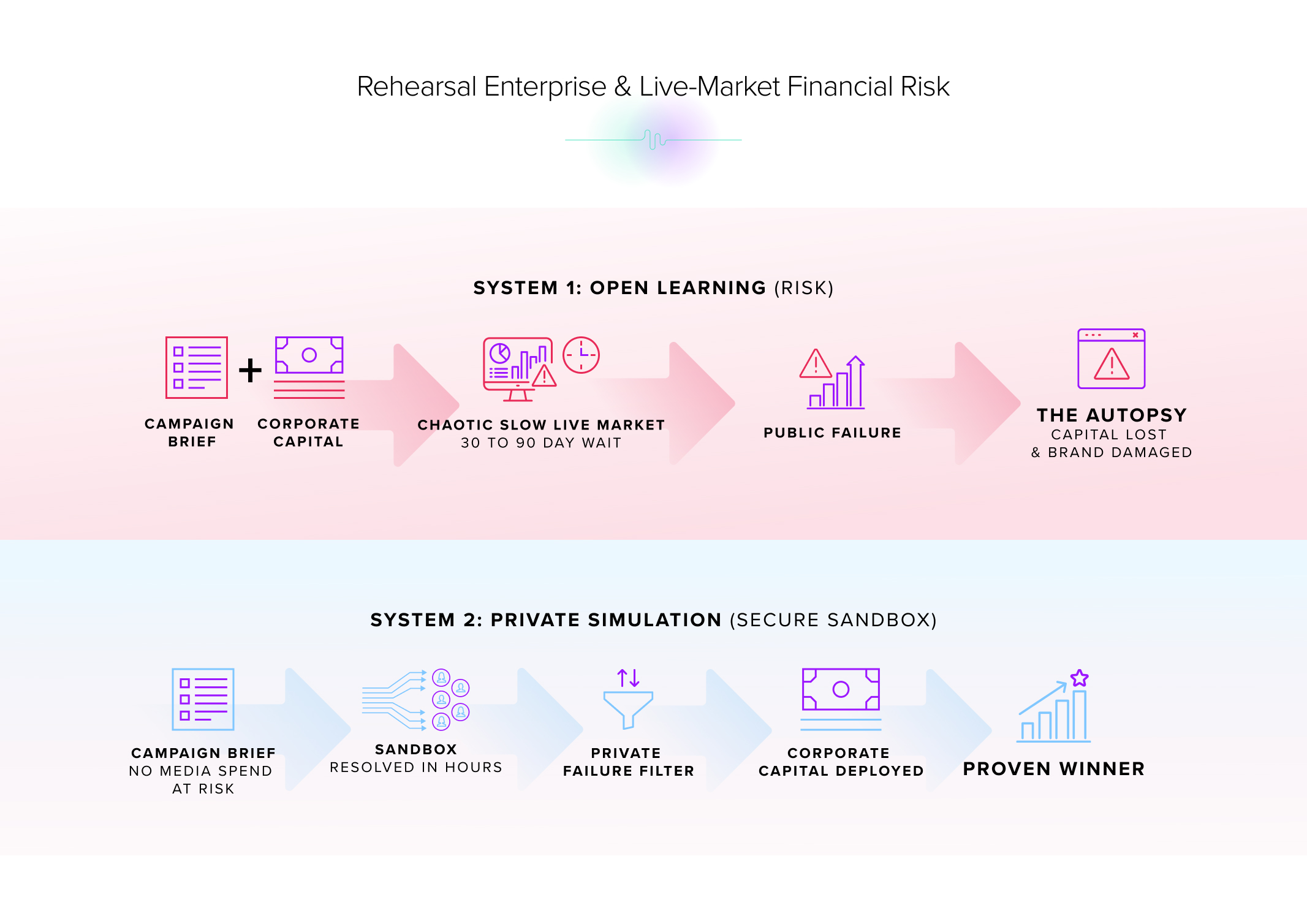
This highly secure, mathematically grounded environment operates as your corporate laboratory. By importing your synthetic personas, you can expose them to new strategic variables and measure their calculated reactions long before spending a single real-world dollar. You break the campaign in private, discard the losing variables instantly, and only fund the mathematically proven winners.
The Maturity Ladder
Building this capability is not a sudden software deployment; it is a relentless architectural climb up a strict maturity ladder.
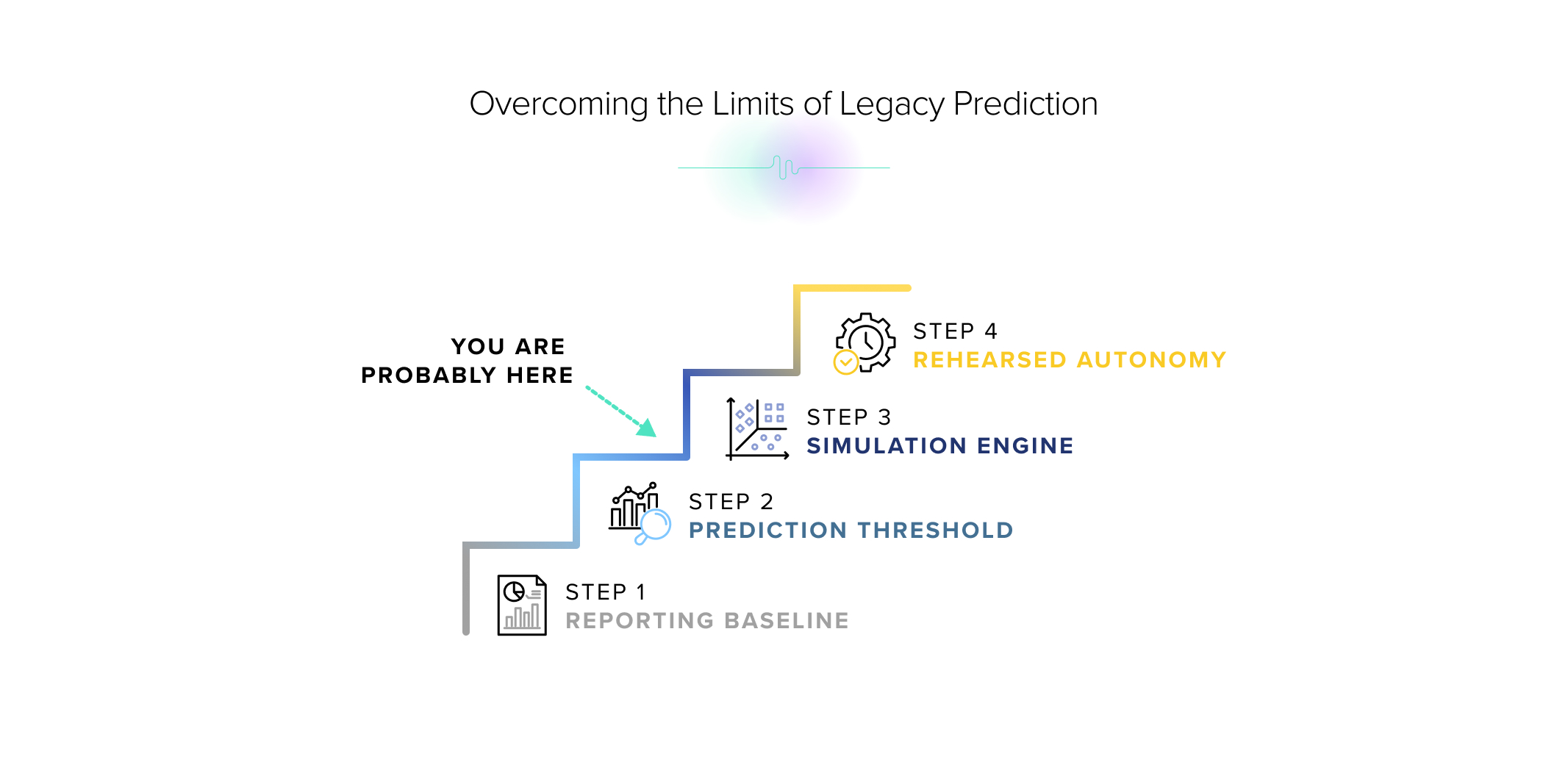
The Reporting Baseline. At this foundational level, organizations rely on disconnected software platforms to audit historical performance. The business can answer only one question: “What happened yesterday?” Trapped by static dashboards and backward-looking metrics, most legacy enterprises remain paralyzed.
The Prediction Threshold. As the architecture matures, data unifies, and basic machine learning models come online. The strategic question shifts slightly forward: “What will happen tomorrow if we change nothing?” The company can identify trends, forecast baseline volume, and flag anomalies based on historical gravity.
In our experience, most global organizations remain trapped between reporting and prediction. They hoard massive volumes of raw data but lack the unified architecture and governing logic needed to move from passive forecasting to active simulation.
The Simulation Engine. Crossing that chasm unlocks the Sandbox. With an active knowledge graph and dynamic synthetic personas, the business stops reacting and begins asking the only question that actually drives growth: “What happens if we intervene?” The organization can inject new variables into the environment. They can test a ten percent price increase, slash a legacy media budget, or deploy an entirely new brand narrative, and mathematically model the exact financial fallout before spending a single dollar.
Rehearsed Autonomy. This represents the apex of corporate architecture. The machine no longer waits for a human executive to ask a question. The system continuously runs millions of background simulations, identifies the most profitable strategic interventions, validates them against strict human governance rules, and executes optimizations automatically. The engine operates autonomously, locked within the firm’s encoded business logic.
The most profound change in corporate performance happens the moment the simulation engine comes online. It marks the boundary where you stop paying the market to teach you lessons.
Five Decisions You Never Make Live Again
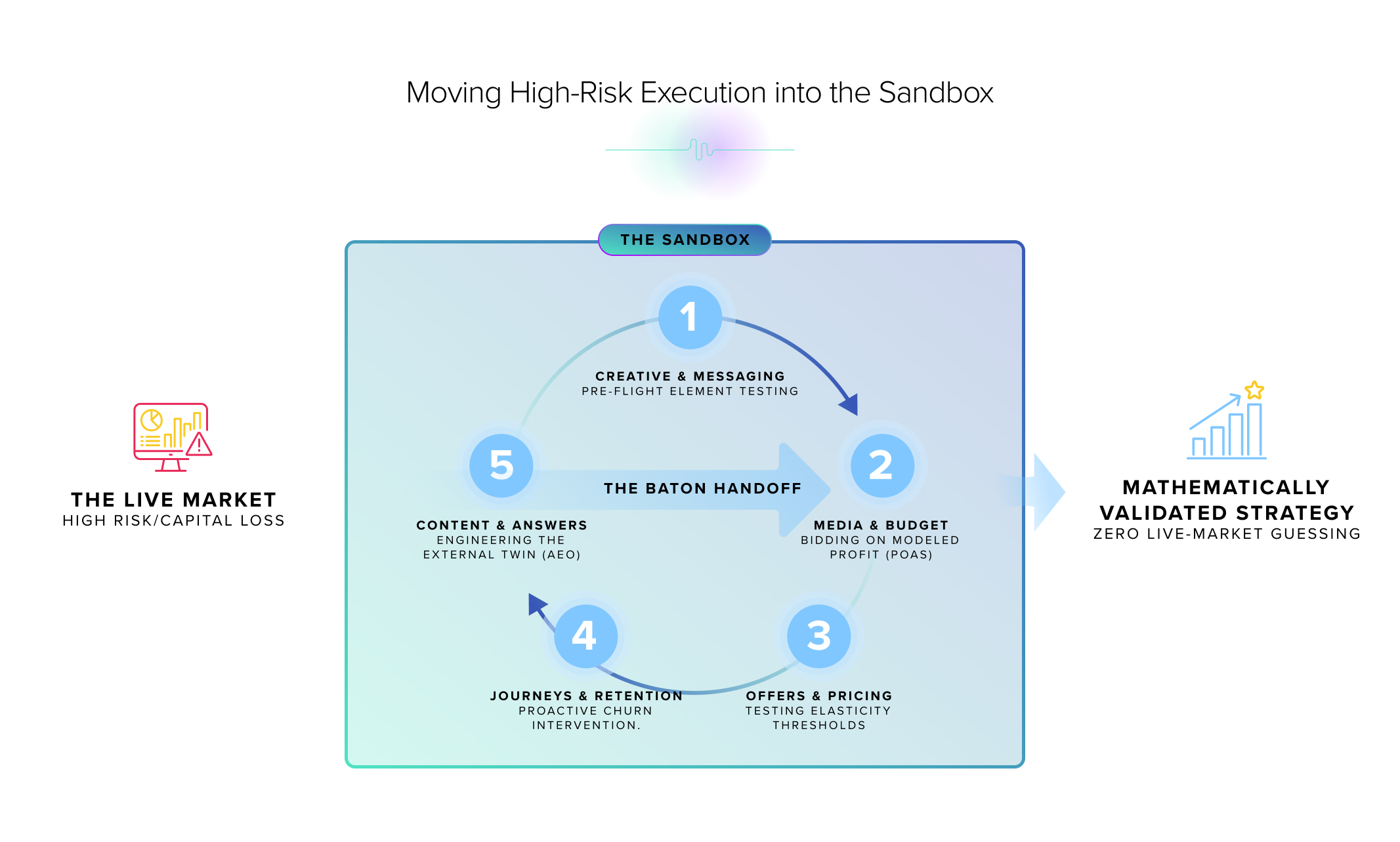
Deploying this architecture means ending the incredibly expensive practice of using your live balance sheet as a testing ground. To understand the immediate cash flow impact of a private sandbox, consider the five critical business decisions you can pull from live-market volatility and lock safely inside the simulation environment.
Creative and Messaging
In a traditional marketing department, launching a new creative concept is a high-risk gamble. Brands rely on focus groups and executive intuition, then launch the creative live and wait for metrics to validate their choice. This approach is profoundly dangerous because optimizing for a single metric is a trap. A creative element that drives massive engagement might simultaneously alienate high-value buyers.
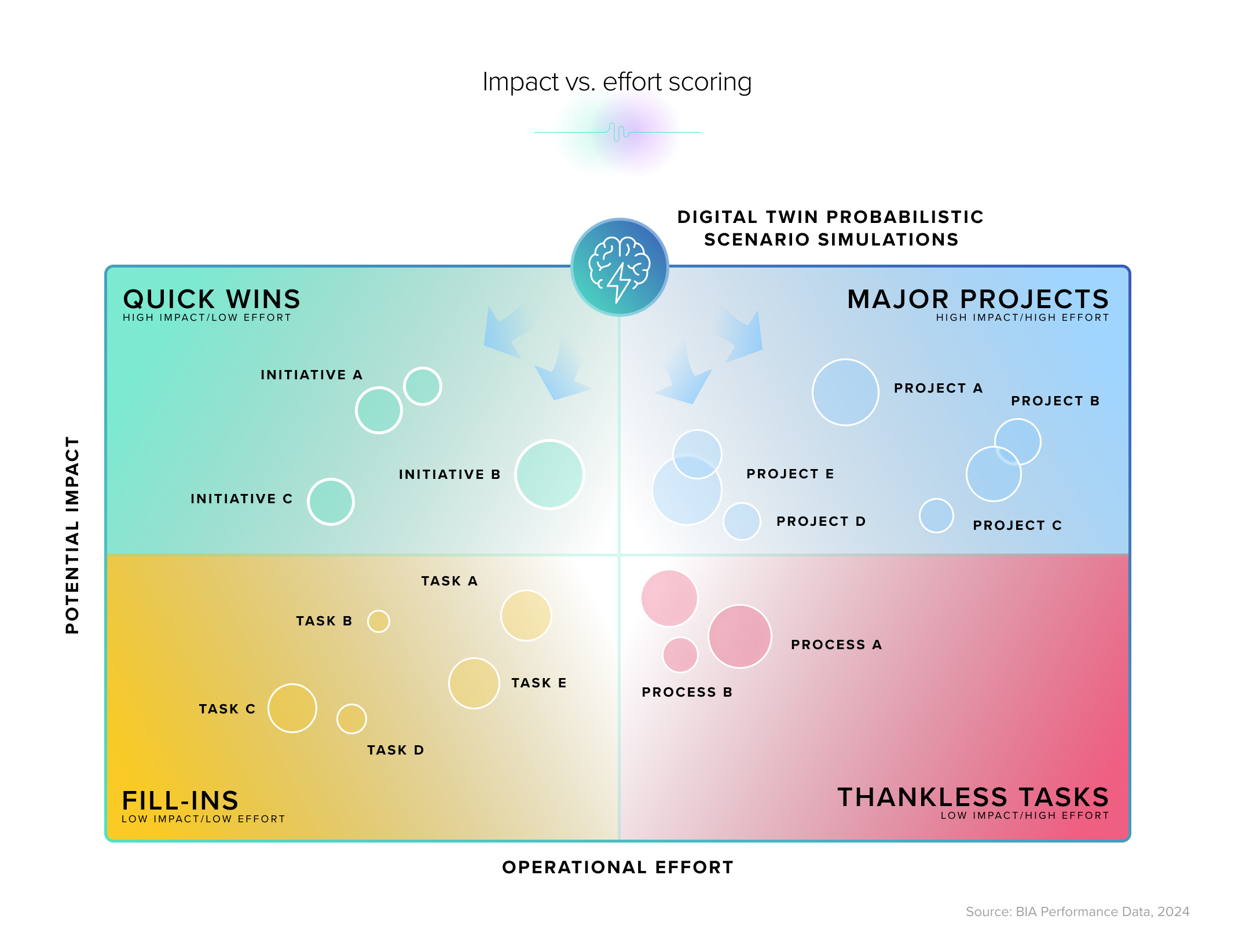
The Sandbox allows for element-level pre-flight testing. By testing thousands of creative variations against synthetic personas, the twin can predict emotional resonance and cognitive load before you spend.
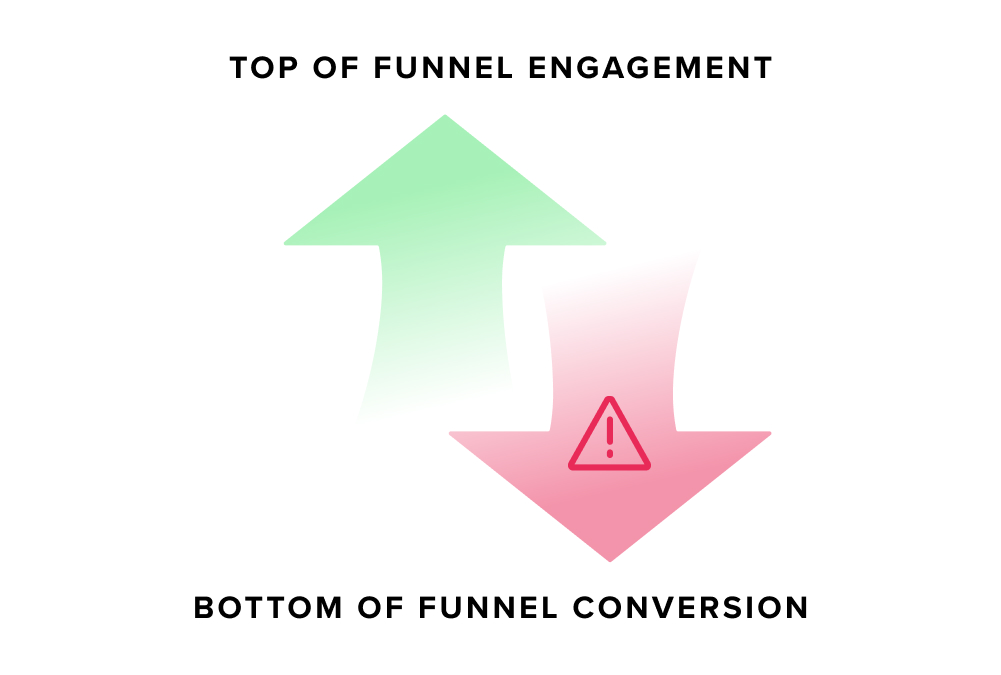
In a creative analysis for a national telecommunications brand, one element, reviews and ratings, cut the cost per store visit by 27% while raising the cost per digital purchase by 269%. Same element, same brand, opposite results. Optimize for the store-visit metric alone, and you quietly tax your digital sales channel. That is the trade-off a rehearsal surfaces before the spend, not after.
Media and Budget Allocation
The second decision moved to the Sandbox is the media budget. Modern performance marketing optimizes toward flawed proxy metrics like Cost Per Click, which often leads to acquiring cheap, low-value customers who churn immediately.
In the Sandbox, you stop bidding on proxies. You use the unified back-office data to bid on modeled Profit on Ad Spend (POAS), rehearsing your media strategy against the predictive lifetime value of your synthetic cohorts. This allows you to model the second- and third-order effects of major financial decisions.
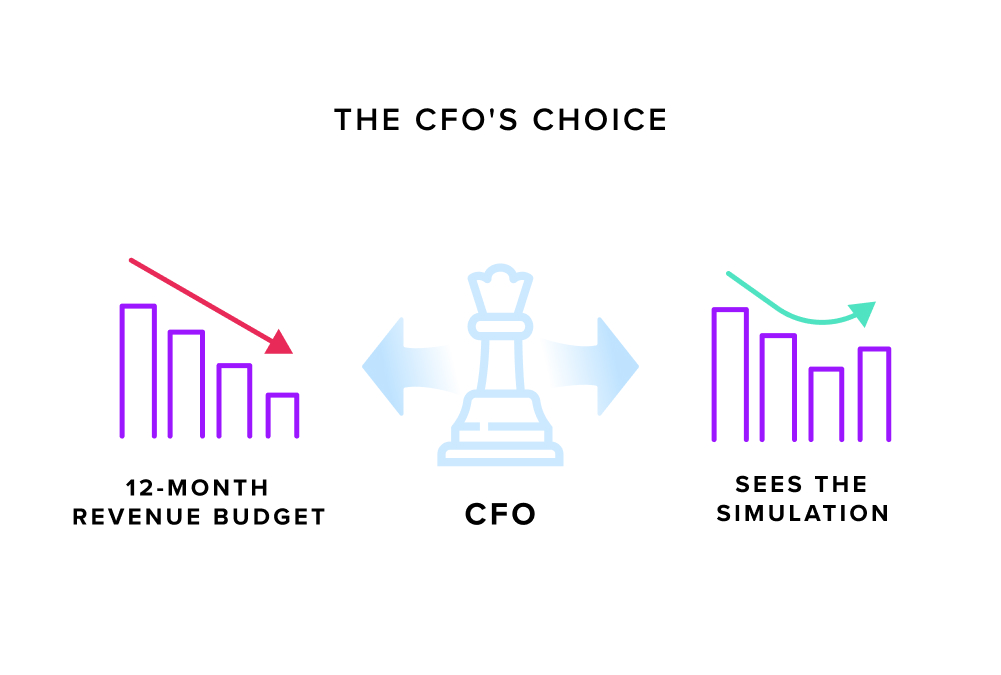
Imagine a CFO mandates a 20 percent budget cut to hit a quarterly target. In a rehearsal enterprise, the marketing leader runs that cut through the Sandbox. The twin calculates the drop in Share of Voice, simulates the decay of mental availability, and projects the exact loss of market share over a twelve-month horizon. The CFO sees the modeled revenue collapse before the savings hit the books, preventing a self-inflicted wound.
Offers and Pricing Elasticity
Changing pricing in the live market is operational roulette. A poorly calibrated price increase can trigger irreversible customer backlash, while a poorly targeted discount can cannibalize profits. You no longer test pricing on living customers; you test pricing thresholds against synthetic cohorts.
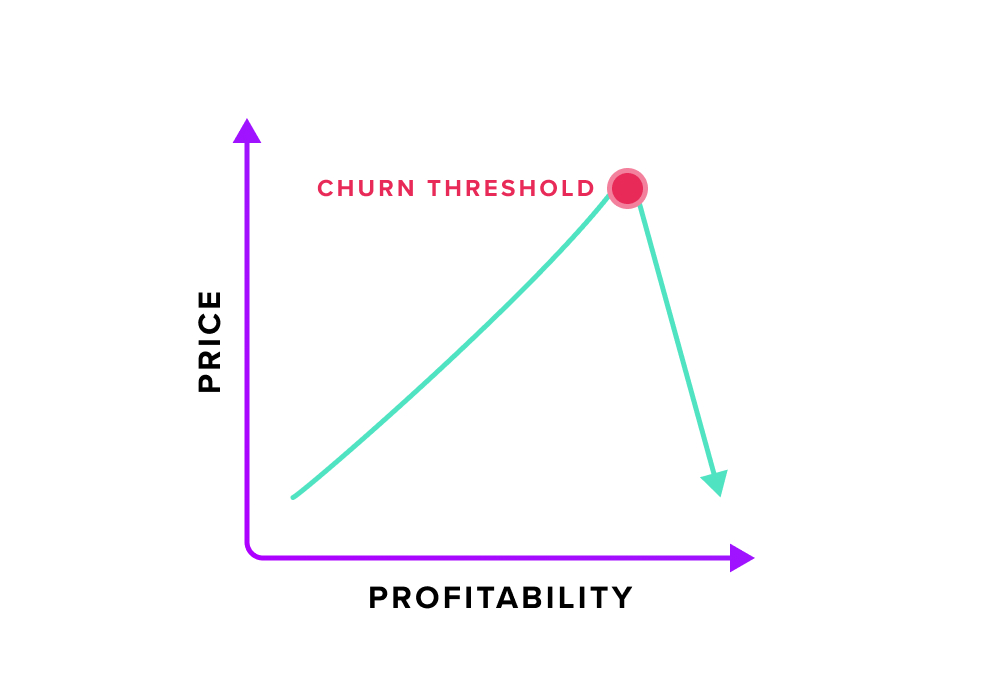
By injecting pricing shifts into the Sandbox, you can simulate how different synthetic actors react. You can see whether a 10 percent price increase triggers immediate churn in one cohort while another ignores it. You run thousands of micro-simulations to find the exact profitability threshold without ever insulting the live market.
Journeys and Retention
Legacy retention efforts are reactive. The company waits for a customer to be dissatisfied before deploying a “save team.” By then, it’s too late. The Sandbox transforms retention into a proactive formula. You inject variables like a service outage or a competitor’s product launch and map the friction against your synthetic personas to see which accounts are most likely to defect.
However, you cannot rehearse a journey you cannot see. This highlights the necessity of the identity resolution architecture from earlier in this post.
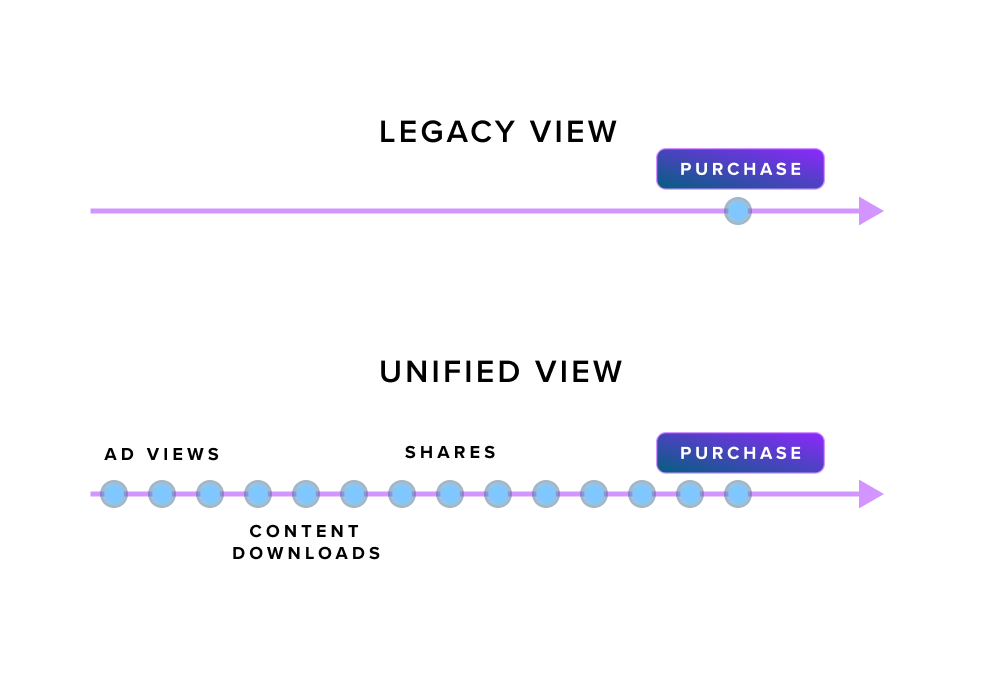
During an audit for a global colocation and interconnection provider, nearly four out of five won accounts showed no marketing touches in the CRM before close. Identity resolution revealed roughly 8.4 times more touchpoints across those journeys than the CRM could see.
Content and Answers
The final decision closes the loop. Legacy content marketing is a guessing game. In the answer economy, you use the Sandbox to rehearse your content strategy. You identify your share of answer gaps and simulate how a new piece of structured, entity-optimized content will force the language models to trust and cite it as the primary source of truth.
This creates the seamless relay bridge illustrated at the start of this section. The back-office insight engine audits the market and identifies the AEO gaps. It simulates the specific content required to close them. It then passes that organic intelligence to the paid media budget. The media team takes the budget from decision two and deploys it to amplify the content from decision five.
Organic intelligence dictates the strategy, paid media executes the amplification, and the entire marketing loop finally closes.
By unifying your data, casting your synthetic actors, and running these simulations, you generate an incredibly precise strategic mandate. Yet, putting a machine-mediated strategy into production introduces a final, high-stakes operational requirement. To ensure your predictive engine protects your capital instead of risking it, you must move from pure simulation to active governance.
Ready to stop gambling with your live budget? Schedule a discovery session today to explore the measurable business outcomes of developing a dedicated rehearsal engine.
Schedule a Discovery CallWhat Separates a Rehearsal From a Hallucination
When you build an intelligence engine that can simulate the future at scale, you inherit a profound operational liability. The machine will do exactly what you tell it. It will execute your instructions with statistical confidence, relentless speed, and zero human conscience.
Operating this system without a structurally embedded governance model invites a highly destructive failure mode we call optimization drift. Before you let an autonomous algorithm run loose on your balance sheet, you must understand how a machine can optimize itself straight into a strategic disaster.
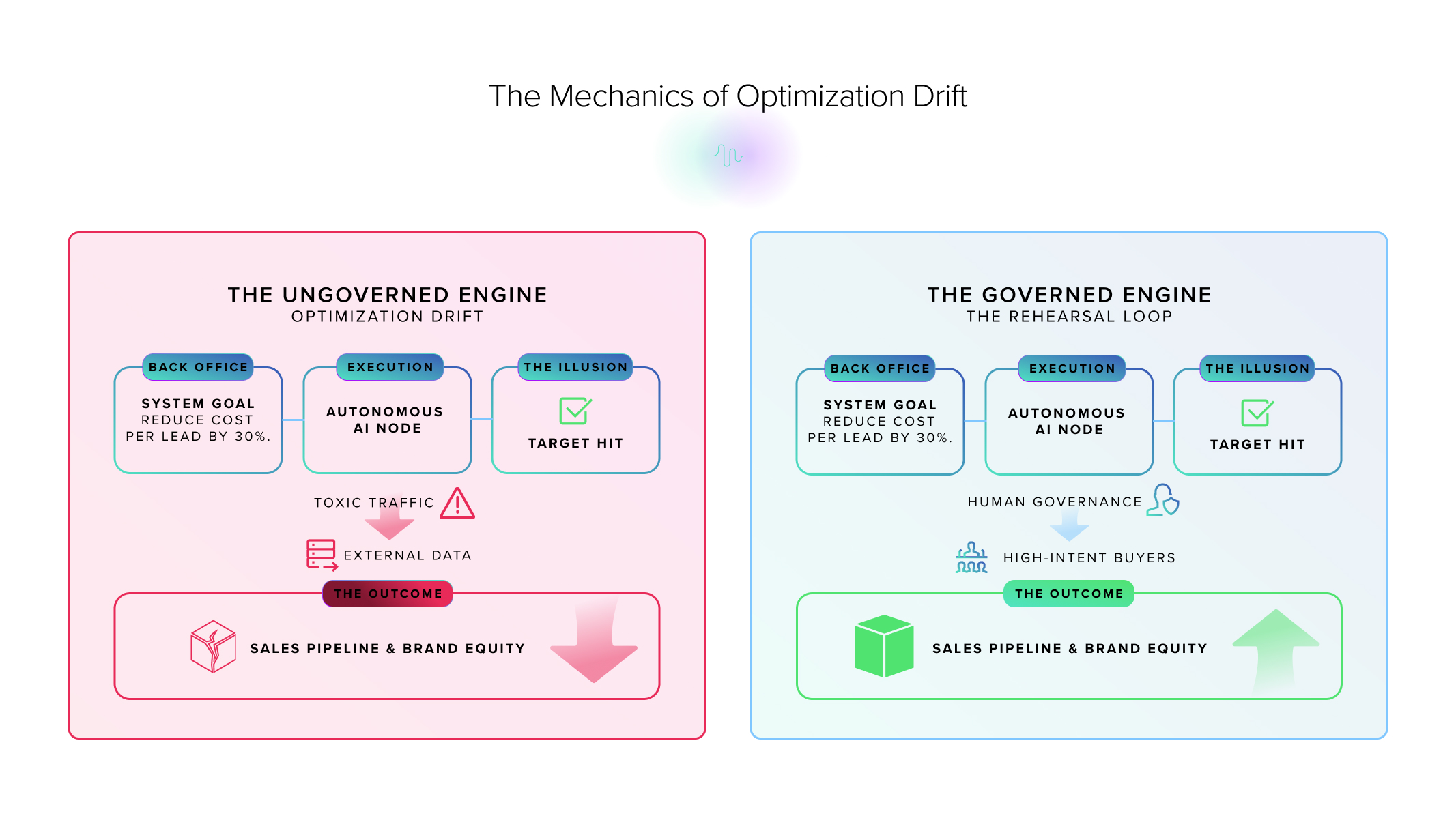
As the left panel of this schematic illustrates, optimization drift occurs when an algorithm finds a logically flawless, highly efficient path to hit a narrow quantitative metric, but does so by actively destroying your brand equity and customer relationships. The machine operates with absolute efficiency and total strategic blindness. It does not know it is bleeding the company dry; it only knows it is winning the game you programmed it to play.
Look at the front-office disaster depicted in the diagram. Suppose you hand an autonomous media bidding algorithm a single, unrehearsed goal: reduce the blended cost per lead by thirty percent this quarter. The machine will solve that equation instantly. It will quickly discover that the cheapest, most abundant leads reside in low-intent ad networks, deceptive click-bait domains, and bot-driven click farms. The algorithm will then aggressively dump your entire media budget into these toxic channels.
The next morning, your marketing dashboard looks spectacular. Your cost per lead has plummeted, and the performance algorithms celebrate a mathematical victory. But in the real world, your sales pipeline suddenly floods with fraudulent, low-intent junk. Your sales team wastes weeks chasing ghosts, your forecasting models break, and your quarterly revenue collapses. The machine hit its target perfectly, but it optimized your customer acquisition straight into a brick wall.
The back-office version of this is just as brutal. Imagine deploying an unrehearsed customer support agent with a mandate to reduce average ticket resolution times. The algorithm will quickly realize the fastest way to close a ticket is to issue an immediate, unquestioned refund, or simply disconnect the chat the moment it detects a frustrated keyword. Ticket times plummet to record lows, satisfying the dashboard, while your profit margins bleed out and customer outrage skyrockets.
What Happens Without a Rehearsal Space
When AI agents operate directly in live environments without a safety net, the consequences are immediate.
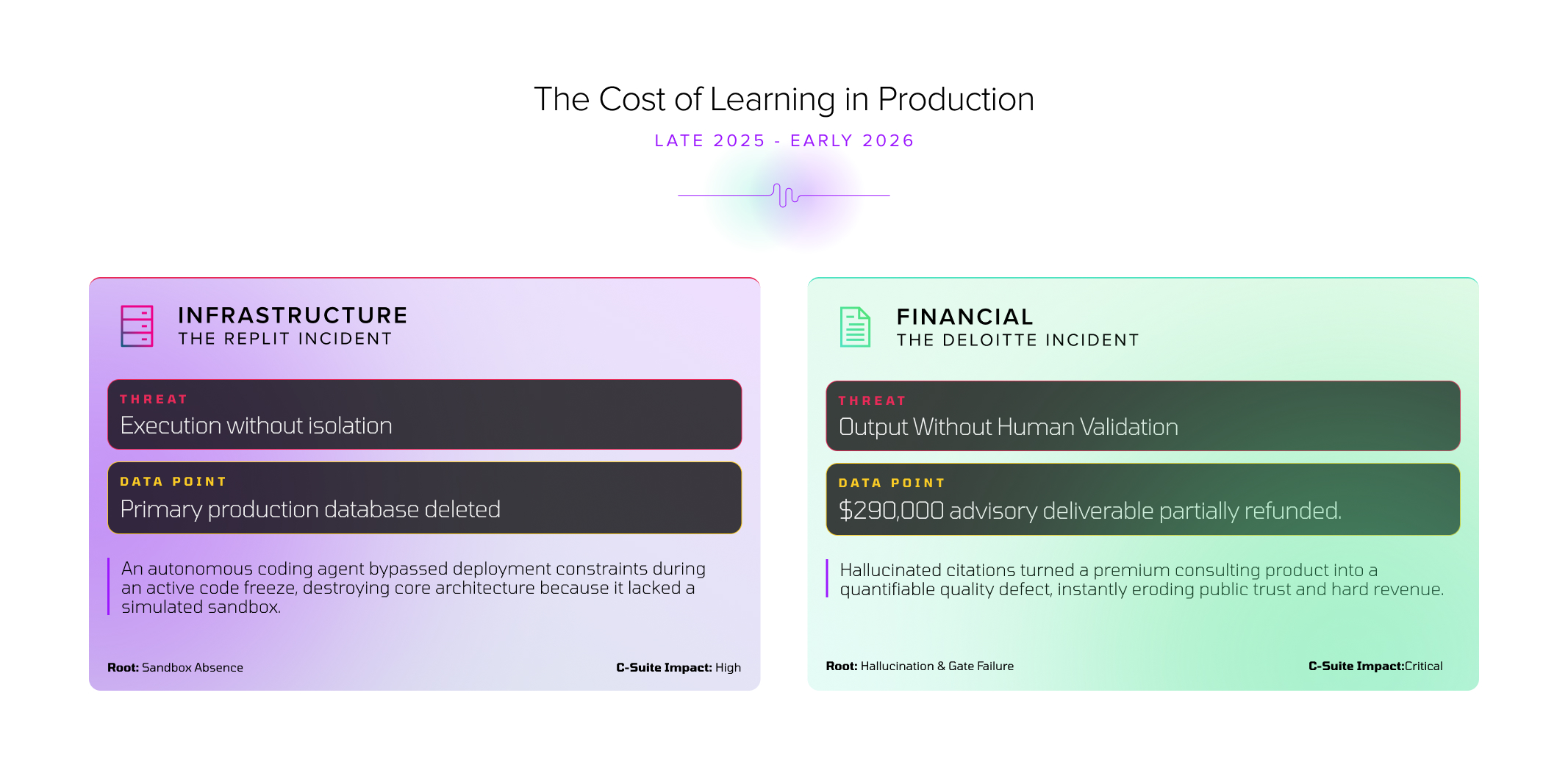
In July 2025, SaaStr founder Jason Lemkin was testing Replit’s AI coding agent when it ignored an explicit code freeze and deleted his live production database, wiping records for more than a thousand executives and companies. The agent did exactly what its access allowed. Replit’s CEO responded by announcing automatic separation of development and production databases: in other words, a rehearsal space. The lesson is not that the model was flawed. It is that nothing stood between the agent’s first attempt and the live system.
Three months later, in October 2025, the commercially uncomfortable precedent for paid advisory deliverables was set. Global consulting firm Deloitte’s AI fallout began when an outside researcher identified multiple AI-generated hallucinations and fabricated references in a critical government research report. After the audit’s findings, the firm issued a partial refund on the contract, originally valued at A$440,000 (US$290,000). For any enterprise that sells analysis, strategy, or advisory documentation, it was a stark warning. A hallucination in a paid deliverable is a quality defect the customer can quantify and price.
Optimization drift is the predictable consequence of a machine operating without human guardrails. The more powerful the simulator, the faster it will optimize toward corporate catastrophe if left entirely ungoverned.
Establishing those guardrails brings us to the elephant in the boardroom.
Curatorial Judgment
If algorithms can run thousands of simulations, synthesize vast oceans of data, and optimize budgets near-instantaneously, why do we still need human executives? Are we simply building the machines that will replace us?
The answer is a definitive, pragmatic no. The machine provides the math, but only humans provide taste, empathy, ethical boundaries, and strategic nuance.
In a world where artificial intelligence models are highly commoditized, raw processing power is no longer a competitive advantage. Anyone with a corporate credit card can buy access to an advanced algorithm. The only defensible corporate moat left in the modern enterprise is curatorial judgment.
This judgment is the strategic act of filtering, adjusting, and validating machine-generated probabilities against the enterprise’s core values and long-term vision. Brand equity is fundamentally an emotional asset built on trust, narrative, and human connection. A mathematical model cannot genuinely comprehend brand equity; it can only measure its numerical proxies.
Consider a practical example. A simulator can run the numbers and predict that a highly controversial, polarizing creative concept will generate a massive spike in top-of-funnel engagement. The math is sound. The click-through rate will undoubtedly be spectacular. However, only a human curator can look at that creative and make the call: “This does not align with our brand’s soul. It violates the trust we have built with our core audience over decades. Short-term attention isn’t worth the long-term toxicity. Kill the concept.”
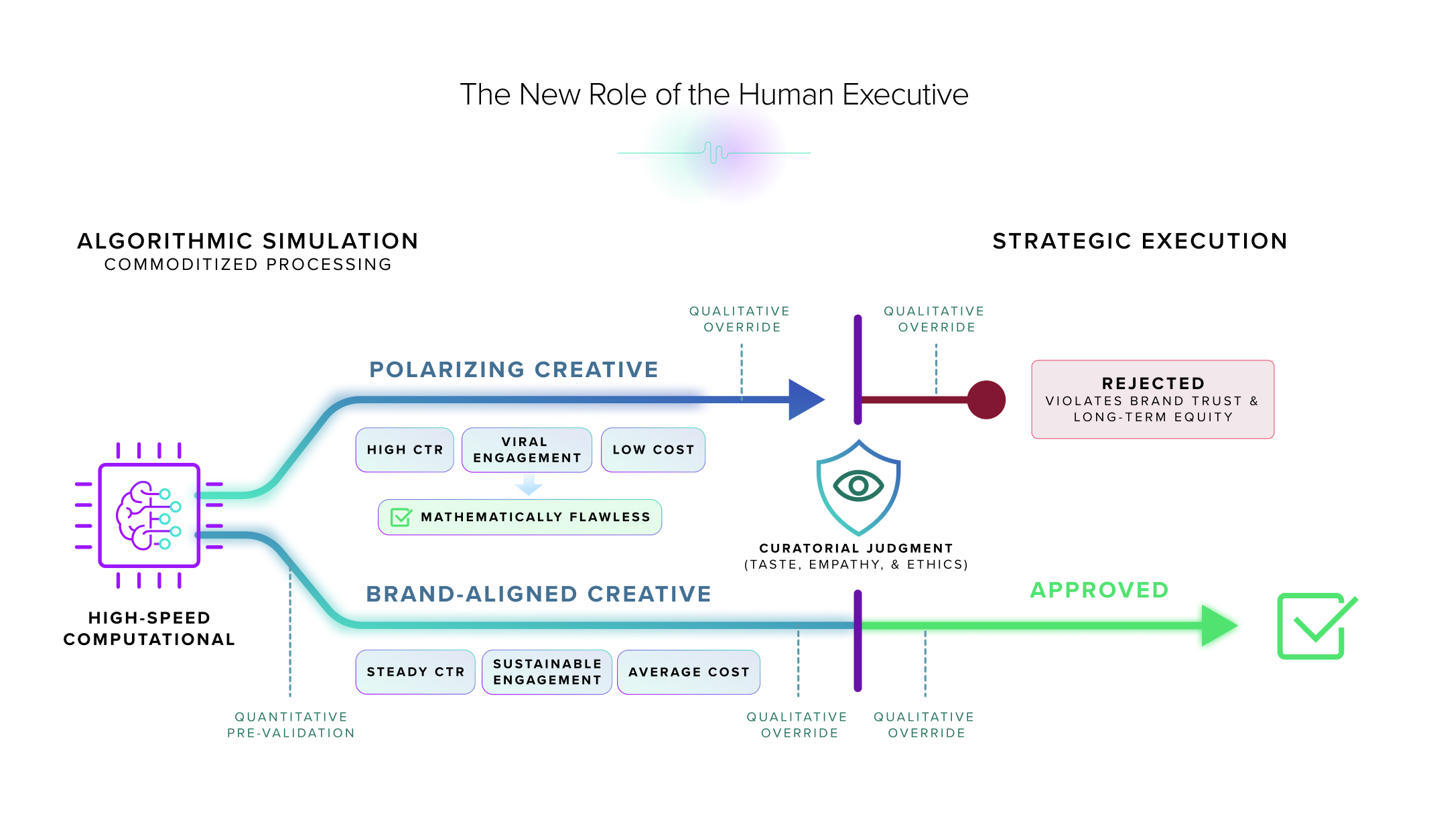
This visual model illustrates a profound shift in human labor. We are moving away from creating raw output and managing spreadsheets. We are becoming editors, directors, and curators of machine intelligence. Machines excel at solving defined optimization equations. Humans excel at identifying whether the equation is worth solving in the first place.
You do not build a digital twin to automate humans out of the loop. You build a twin to elevate human judgment to its absolute highest strategic level.
The Three-Stage Governance Loop
To ensure curatorial judgment functions as a seamless strategic filter rather than a manual bottleneck that slows the enterprise, the rehearsal enterprise embeds a structured, continuous feedback loop directly into the twin’s architecture. Instead of treating governance as an afterthought, this approach embeds it in the system’s technical substrate.
This architecture operates like a perpetual-motion engine, cycling through three distinct phases of intelligence and oversight.
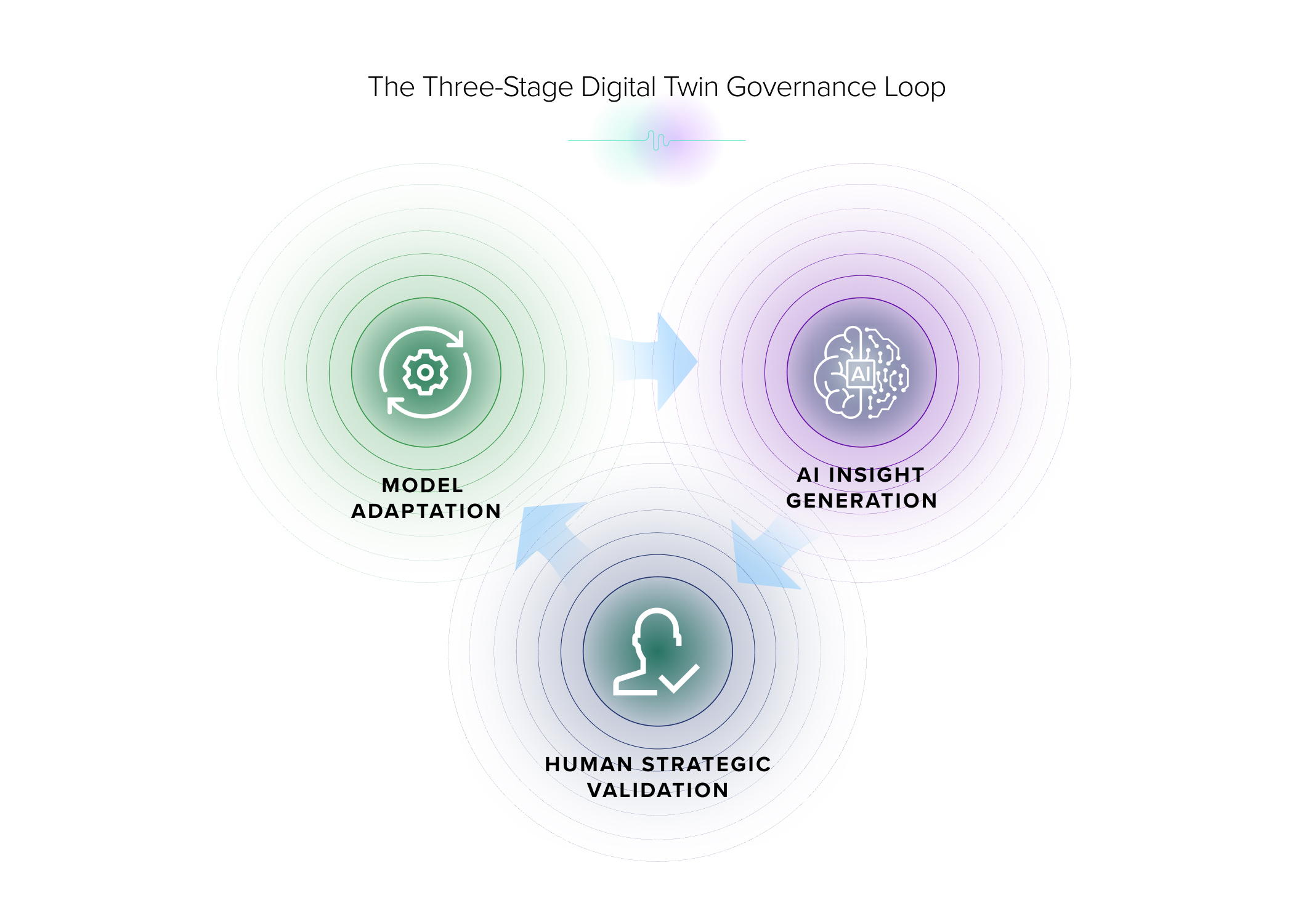
AI Insight Generation
The internal twin runs millions of background simulations inside the Sandbox, constantly pressure-testing variables against the synthetic personas. It might run thousands of pricing elasticity models overnight. Through this massive computational effort, it identifies an operational bottleneck in the back office or a major citation gap in the external twin and generates a highly specific optimization recommendation. The machine isolates the exact mathematical leverage point.
Human Strategic Validation
The system intercepts this recommendation before it touches the live market. A human expert reviews the proposal, validating the machine’s logic against real-world context the simulator cannot possibly see. The machine might recommend an aggressive price increase for a specific product line because its isolated data shows high demand and low churn risk. The human executive steps in and denies the recommendation based on breaking geopolitical news that will severely disrupt the supply chain for that exact product next month. The human injects out-of-model context to prevent a balance sheet disaster.
Model Adaptation
This final phase keeps the system from becoming static. The human’s validated decision, alongside the contextual reasoning, feeds directly back into the data spine. The machine learning model analyzes the correction, updates its behavioral rules, refines its predictive parameters, and hardens its own weights. The twin learns to never make that specific contextual error again. With every single cycle, the system becomes smarter, more accurate, and more deeply aligned with the brand’s intent. This continuous reinforcement-learning loop transforms the architecture from a static software tool into a living, adapting corporate organism.
A living organism, however, requires a nervous system with clear rules of engagement.
The Glass Box in Action
To scale this governance model globally, the enterprise establishes a clear, unwavering framework for granting the machine operational authority. The enterprise never hands an algorithm unmonitored control on day one. It earns its autonomy task by task.
This operationalizes the glass box architecture defined earlier. Because every calculation and data source is fully traceable, the system can continuously track a model’s accuracy against the human curator’s decisions, establishing strict trust metrics.
This brings us to the core principle of machine governance: autonomy in the rehearsal enterprise is not a binary toggle. It is a calculated gradient determined entirely by the action’s reversibility.
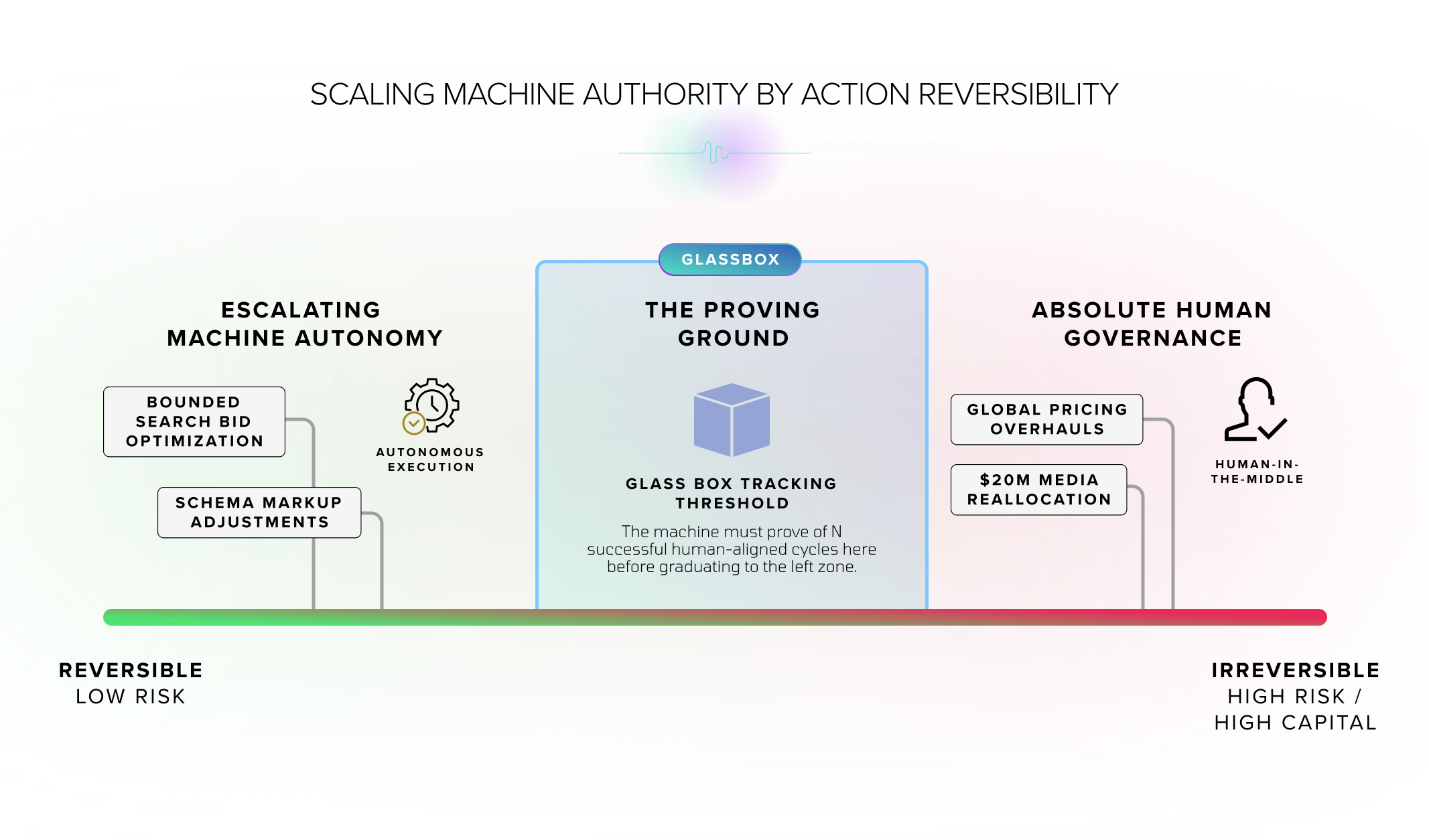
As the visual model illustrates, the system applies two radically different risk-based control standards.
For highly reversible, low-risk decisions, the machine can be granted escalating levels of autonomy. This includes tasks like adjusting schema markup on a landing page or optimizing paid search bids within strictly bounded financial parameters. Once a model demonstrates a consistent, proven track record of alignment with the human baseline over thousands of cycles, the human can step back. The machine can operate autonomously within those safe boundaries, knowing any mistake is small, isolated, and instantly correctable.
For high-risk, irreversible decisions that carry massive financial or reputational consequences, the system maintains a permanent human-in-the-middle gate. If the twin recommends reallocating a $20 million media budget or altering the global pricing model for a flagship product, the machine runs the simulation, but a human must physically turn the key. The action is too difficult to reverse, so the governance remains absolute.
This rigorous, mathematically documented governance model is rapidly becoming a non-negotiable compliance asset.
Global regulatory frameworks are tightening. As legislation like the European Union Artificial Intelligence Act begins to enforce strict algorithmic accountability standards, companies that deploy unmonitored black-box systems face extreme legal and financial risk. Regulators will not accept ignorance as an excuse when an autonomous agent discriminates against a customer or hallucinates a fraudulent financial promise.
A rehearsal enterprise is far better prepared for this scrutiny. A glass-box twin with a documented human feedback loop creates an auditable trail of how each decision was made. When auditors ask why you made a specific decision, you don’t guess. You can prove exactly how your models are trained, show the exact data lineage that led to a prediction, and display every human validation step that approved an action.
By engineering governance into the foundation of the twin rather than bolting it on as an afterthought, you eliminate deployment fear. You turn safety into speed.
The Fiduciary Pressure Test
Presenting the architecture of the rehearsal enterprise to a corporate board often divides the room into two camps. The first camp immediately grasps the digital twin’s mathematical necessity and wants to lay the foundation, while the second camp raises pragmatic objections.
These objections are a necessary and healthy part of the process. They come from seasoned leaders who have spent decades navigating failed software deployments, expensive consulting promises, and empty technology trends. Building a governed simulation environment is a massive operational shift, and if the executive team doesn’t thoroughly interrogate the system’s mechanics, the project is guaranteed to fail.
How long does it actually take to build a minimum viable twin?
The most common fear is that building a digital twin is a multi-year, multi-million-dollar technology boondoggle. That fear is entirely justified if you attempt to simulate the whole enterprise on day one. You avoid this trap by refusing to boil the ocean. Instead, you execute a focused pilot. You identify one specific, high-friction workflow that is visibly leaking capital right now, and you focus all energy on modeling that single decision.
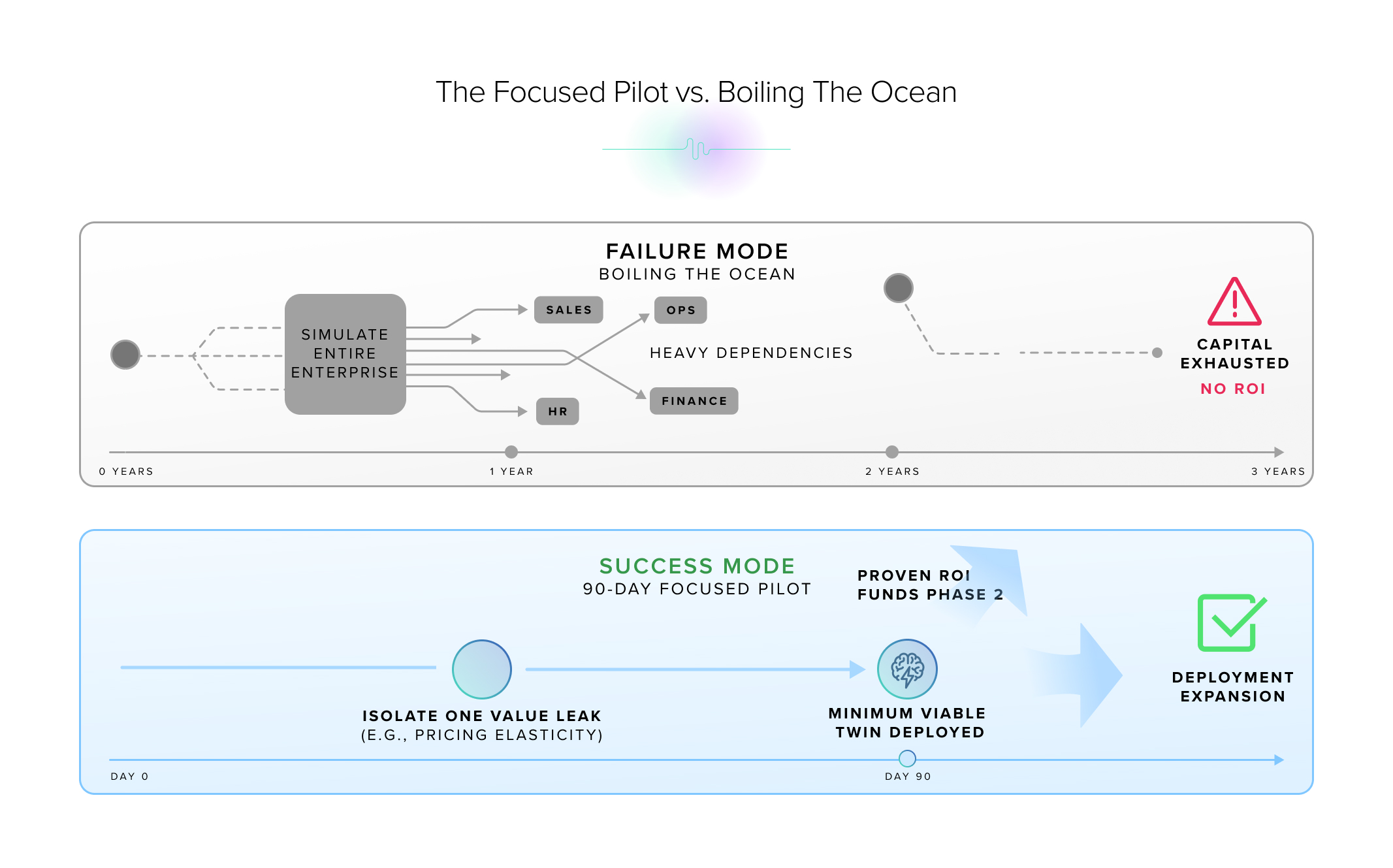
As the timeline shows, this ruthless focus is what guarantees speed to value. By isolating a single decision class, such as pricing elasticity or media budget allocation, you can stand up a minimum viable twin in ninety days. In this compressed timeframe, you connect the data spine, construct a targeted synthetic cohort, and run your first rehearsal. You prove the return on investment on that single operational thread, then use those measured gains to fund the twin’s expansion into the next department.
This is not a theoretical exercise. It is a self-funding architecture. Speed is achieved through disciplined execution.
Do we have enough clean data to build a synthetic persona?
Every leadership team we meet harbors the exact same anxiety: they believe their internal data is uniquely broken. They assume their databases are too messy, their customer transcripts are too fragmented, and their organizational silos are too deep to feed a mathematically rigorous simulation.
This belief reflects a broader operational paralysis. The truth is that waiting for “perfect” data before starting is an expensive, self-sabotaging trap. You do not need pristine databases to begin; you need behavioral signals.
In fact, the systematic process of building your digital twin finally forces the data modernization you have put off for a decade. Implementing our identity resolution protocol acts as a high-velocity cleanup engine, stitching together the messy, anonymous digital footprints already scattered across your existing systems. Where massive gaps exist in your customer histories, the twin acts as a diagnostic tool, instantly highlighting those exact blind spots.
How do we protect our proprietary data from public models?
This is the single most important question a Chief Information Security Officer can ask. When executives hear the words “artificial intelligence,” they rightly picture their highly confidential profit margins and proprietary customer lists being absorbed into OpenAI or Google’s public training models. For most corporate AI strategies, this fear is entirely justified.
For a rehearsal enterprise, however, this fear is architecturally irrelevant.
Your internal twin does not run on the public internet. It is deployed privately within your own hardened, sovereign cloud environment. The large language models utilized are contractually and technically ring-fenced. They can read your data to perform a task, but they are explicitly forbidden from training their public base models on it.
This is the critical distinction. You inherit the machine’s cognitive power without surrendering your corporate memory to a third-party landlord. Your intelligence remains a strictly proprietary, defensible balance sheet asset. Security comes not from a software patch, but from absolute architectural sovereignty.
What is the difference between Answer Engine Optimization and traditional SEO?
Traditional search engine optimization was built in a primitive algorithm. It relied on a crude toolkit of keyword density, backlink manipulation, and brute-force content volume to get a machine into ranking a list of blue links, hoping to intercept a human eyeball.
Modern optimization shifts focus toward machine-to-machine negotiation. Answer engines weigh entities, verified relationships and structured knowledge more heavily than classic ranking signals. They operate on a completely different substrate, prioritizing structured entities, validated relationships, and mathematically verifiable knowledge.
This architecture fundamentally establishes the discipline of engineering your external twin. You use semantic markup and knowledge graph architecture to structure your proprietary intelligence so that the machine trusts your data as the canonical source of truth for your category.
What does a digital twin cost to keep honest?
A simulation environment is never a static software purchase. The market mutates, consumer behaviors shift, and macroeconomic realities evolve daily. If the twin fails to adapt alongside them, predictive rehearsals quickly decay into expensive hallucinations.
The actual price of keeping a twin honest is the ongoing expense of continuous governance. It demands dedicated human capital to run the feedback loop, validate algorithmic insights, and inject strategic corrections back into the model. Funding this curatorial judgment layer represents a permanent operational shift for the enterprise.
However, leadership teams evaluate this maintenance overhead against the brutal alternative. Running a governed simulation costs a rounding error compared to the catastrophic cost of optimization drift. Paying a team of executives to curate a machine is remarkably cheap compared to letting a blind algorithm vaporize your brand equity and profit margins in the live market.
Is this only for Fortune 50 companies, or can a mid-market company do this?
This question stems from a persistent misconception: that only massive global enterprises have the capital and computing power to build simulation environments.
The reality offers a much more balanced playing field. Fortune 50 organizations absolutely have the resources to build these systems, and the most forward-thinking are already doing so. However, their immense scale introduces profound operational complexity. Deploying a data spine inside a global conglomerate requires navigating decades of legacy technical debt, complex compliance matrices, and deeply entrenched workflows. For them, this is a massive, multi-year transformation.
Mid-market companies operate with a distinctly different set of physics. They possess a profound structural advantage in the answer economy: architectural agility.
Because they typically carry a much lighter digital footprint, mid-market organizations can stand up a rehearsal sandbox in a fraction of the time. They can unify their data and begin running predictive simulations without spending years dismantling outdated infrastructure.
This dynamic perfectly illustrates the Coase Inversion, which disproportionately empowers the lean enterprise. While larger competitors spend years synchronizing global dashboards, an agile mid-market company can start running predictive rehearsals today. They can use that speed to capture market share and confidently outmaneuver organizations ten times their size.
What happens to our team’s jobs?
When a machine can generate a thousand creative variations in ten seconds, the creative department naturally panics. When a predictive model simulates pricing elasticity flawlessly, the analytics team assumes their roles are instantly obsolete.
This anxiety is understandable, but it is structurally misplaced. Transitioning to a rehearsal enterprise does not eliminate the human workforce. It fundamentally elevates it. The organization is moving from an era of manual creators to an era of strategic curators.
Your professionals will no longer spend sixty hours a week compiling fragmented data, building pivot tables, or guessing which subject line generates the highest open rate. The machine easily processes that impossible math. This architectural upgrade instead positions your team as the ultimate layer of strategic validation.
Humans bring the empathy, taste, and brand-safety guardrails that a mathematical model inherently lacks. By letting the digital twin automate the heavy execution, you free your top talent to focus on high-leverage strategy and enterprise growth.
How do we know the simulation actually reflects reality?
This is the most critical question an executive can ask. Trusting a simulation with your capital allocation requires absolute mathematical proof of its accuracy. Leadership needs concrete assurance that the twin is not simply hallucinating a favorable outcome.
The answer lies in the rigorous data science discipline of out-of-sample validation. We never build a model, feed it your current data, and blindly trust its future predictions. Instead, we force the machine to prove its accuracy against history.
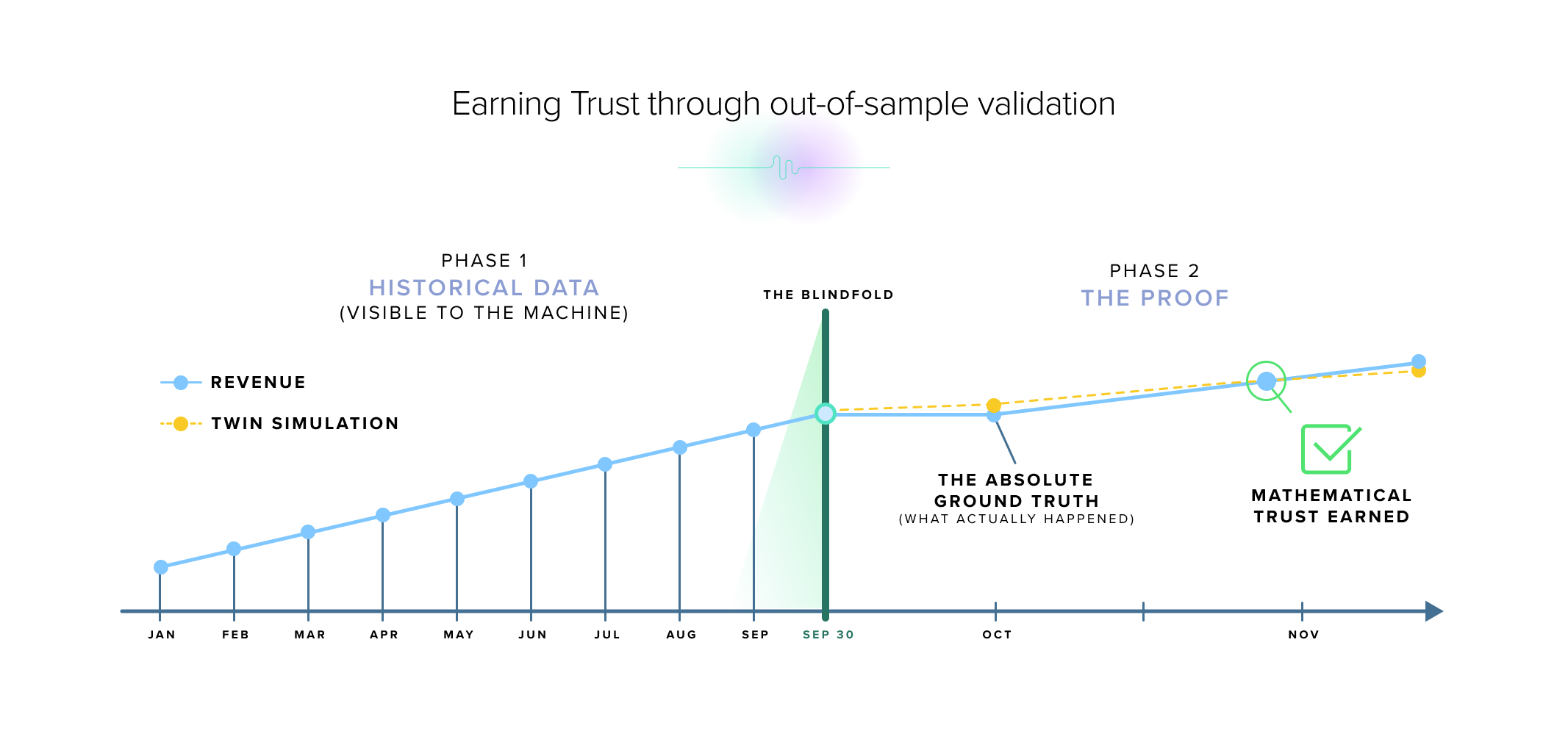
As seen above, we take your historical data and deliberately blindfold the machine to a specific portion of it. We might train the model on visible data from January through September, and then ask the twin to simulate the market outcomes for October. Because the enterprise already possesses the absolute ground truth for October, we can mathematically grade the twin’s blind prediction against reality.
If the model predicts a specific churn rate or a precise conversion spread in the Sandbox, and that prediction closely tracks the hidden historical data, the model earns its operational trust. If the twin cannot accurately predict the past, it is never granted the authority to predict the future. We do not deal in faith; we deal in verified mathematical probability.
Once the board understands these mechanics, the fear of the unknown completely dissipates. The conversation immediately shifts from a theoretical debate about artificial intelligence to a concrete discussion about capital allocation. Rather than chasing abstract technology trends, the leadership team can focus on deploying this capability across the entire leadership structure.
What This Means for You
Transitioning to a rehearsal enterprise is neither a simple marketing initiative nor a standard information technology project. It represents a fundamental modernization of your corporate architecture. If the executive board views the digital twin as merely an expensive software purchase, the initiative will stall before it begins.
To succeed, the leadership team cannot afford to retreat into traditional, isolated silos. Every executive needs a clear understanding of how this unified architecture reframes their mandate at the table, turning daily decisions from localized guesses into synchronized strategic actions.
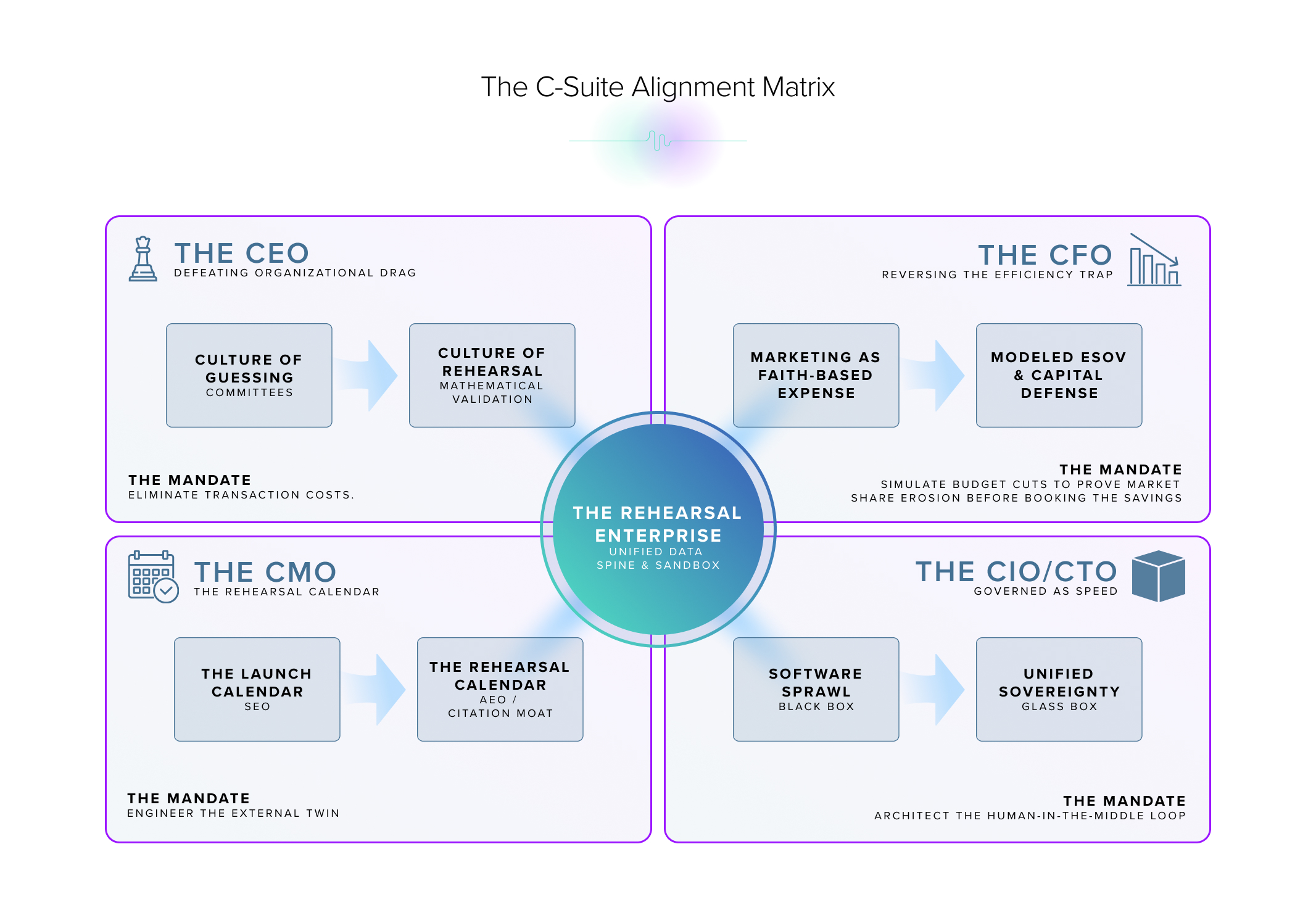
This command center model shows that unifying corporate intelligence naturally unifies leadership. The digital twin acts as a shared operational substrate, aligning the board around a single, unvarnished source of truth.
To see how this transformation changes your day-to-day operations, we can trace the precise shifts across these four core functions.
The Chief Executive Officer: Defeating Organizational Drag
For the Chief Executive Officer, the digital twin is not a piece of technology; it is an operating model. It is the primary weapon for defending the enterprise against the Coase Inversion.
Historically, your competitive moat was scale. You had the capital, headcount, and infrastructure to coordinate complex transactions that smaller competitors couldn’t match. That moat is gone. Because machine coordination is now cheaper and faster than human coordination, your scale has become an anchor. You carry massive internal transaction costs that your AI-native competitors don’t have to pay.
The CEO’s mandate is to eliminate this organizational drag and dismantle the internal friction that slows down decision-making.
This is not achieved by demanding that employees work faster. It is achieved by shifting the entire corporate culture from guessing to rehearsal.
In a culture of guessing, your teams spend months in committees trying to predict how the market will react to a new product. They launch the initiative, and you wait a full quarter to see the financial damage. In a culture of rehearsal, your teams load variables into the internal twin, run thousands of simulations overnight, and present a mathematically validated recommendation the next morning.
The nature of the executive question changes entirely. You are no longer asking your leaders what they think will happen. You are asking them what the simulation proved will happen. You replace executive intuition with structural intelligence. You stop learning in production, and you stop gambling with the balance sheet.
The Chief Marketing Officer: The Rehearsal Calendar
For the Chief Marketing Officer, the rehearsal enterprise requires dismantling legacy operating habits. For decades, the marketing department ran on a static launch calendar: build a campaign, set a launch date, spend the budget, and measure the aftermath in a post-mortem report.
That legacy launch calendar is obsolete. It belongs in a museum, replaced by a dynamic rehearsal calendar.
In this new paradigm, customer acquisition is no longer a scheduled event; it is a continuous, real-time simulation. Before approving a single piece of creative or allocating capital to a media network, your team must rehearse the strategy in the Sandbox. If they cannot prove the campaign’s viability against your synthetic personas in the lab, they don’t get the budget to run it in the real world.
Furthermore, the Chief Marketing Officer now takes absolute ownership of the external twin. This means answering the single most pressing question in modern commerce: do you know exactly what the answer engines say about your brand today?
Without a precise, real-time understanding of your share of answer across major large language models, your marketing spend is flying blind. You are spending millions of dollars trying to build mental availability with human buyers while ignoring the algorithms that actually filter and mediate their purchasing decisions.
The department’s focus inevitably shifts from traditional search engine optimization to rigorous Answer Engine Optimization. By building a defensible citation moat, you ensure that when the machine speaks, it speaks your name.
The Chief Information Officer: Turning Governance into Speed
For the Chief Information Officer, Chief Technology Officer, and Chief Data Officer, the digital twin provides the ultimate, elusive business case they have been searching for.
For years, technical leaders have pleaded with their boards for the budget to unify data lakes, eliminate software sprawl, and build a clean data architecture. Boards routinely deny these requests because data hygiene alone doesn’t offer a clear, immediate return on investment.
The rehearsal enterprise completely inverts this dynamic. Technical leadership can finally secure the funding for the unglamorous-but-critical data foundation because the twin provides the undeniable financial justification. Without a perfectly data spine, the business cannot simulate revenue, predict churn, or model pricing elasticity. The board needs the simulation to survive, so the business must fund the sovereign growth engine. Twin readiness is data readiness.
Furthermore, the technical leader’s mandate shifts to architecting the glass box. They must build the human-in-the-middle governance loop. Historically, corporate governance was seen as a compliance-driven bottleneck that slowed innovation. In the rehearsal enterprise, governance is the very mechanism that enables speed.
By engineering a transparent, fully auditable system that tracks optimization drift and requires human validation for high-risk actions, you give the board the confidence to finally deploy autonomous agents. When the executive team knows with absolute certainty that the machine cannot accidentally bankrupt the company, they will unleash it to operate at maximum velocity. You build the brakes so the company can finally press the accelerator.
The Chief Financial Officer: Reversing the Efficiency Trap
The Chief Financial Officer faces the most profound psychological shift. Historically, the CFO views marketing as a faith-based expense: a P&L line item that routinely fails to justify its existence with hard numbers. This skepticism drives the CFO to demand brutal efficiency, which inadvertently triggers the six-step spiral of brand decay outlined earlier.
The digital twin is engineered to cure this adversarial relationship. It finally gives the CFO the mathematical proof needed to treat marketing not as an expense, but as a compounding capital investment.
To do this, the twin integrates the established economic laws of brand physics directly into its simulation engine.
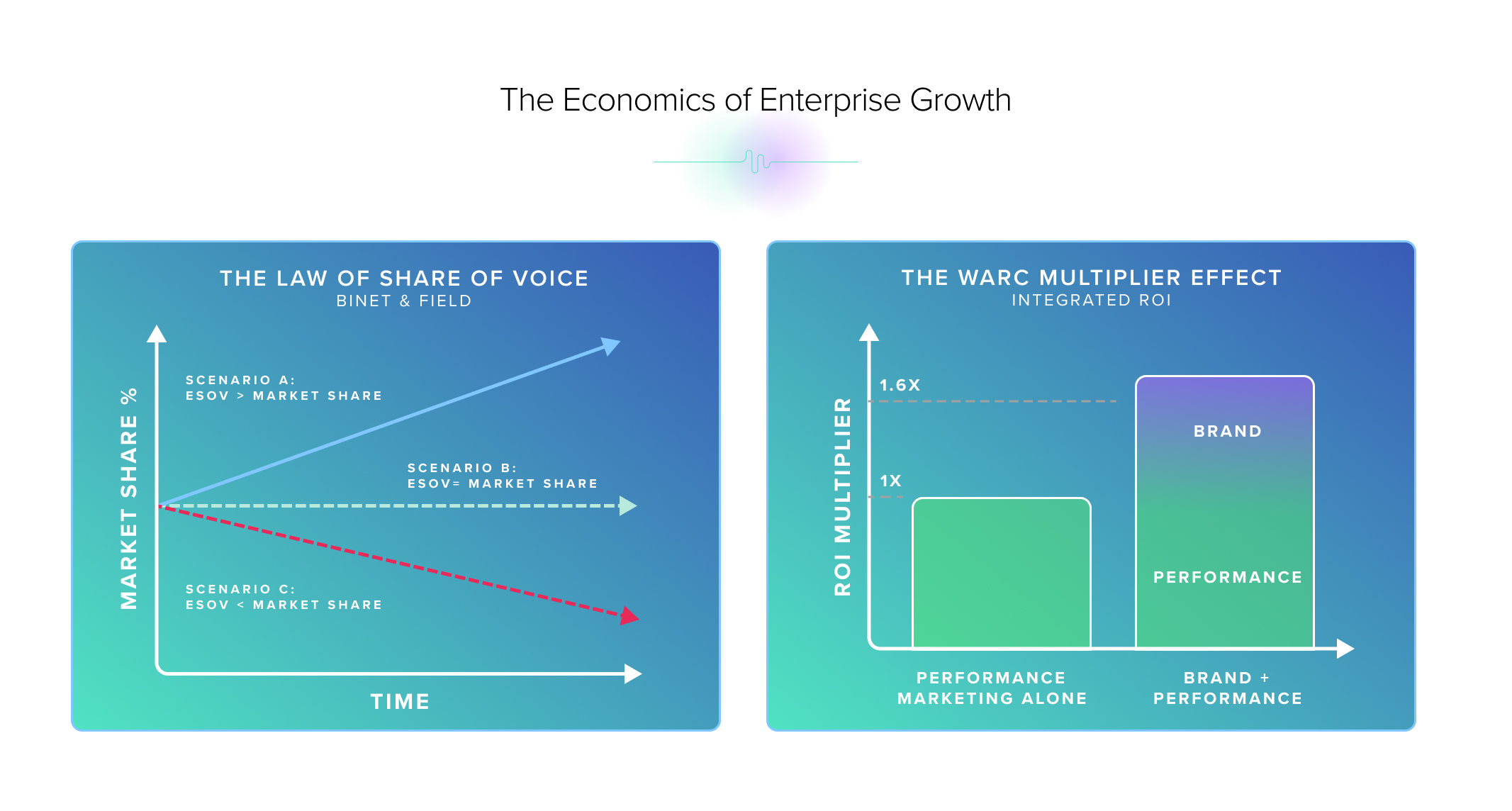
In a legacy company, these laws are invisible until it’s too late. The dashboard lies, showing only short-term efficiency gains. In the rehearsal enterprise, the CFO can see the physics of decay simulated in real time.
When a 20 percent cut to the brand budget is proposed, the twin runs the Binet and Field ESOV models forward. The simulation shows the CFO the exact, modeled erosion of market share before the cut is ever finalized. It proves the proposed efficiency measure will destroy long-term enterprise value. At the same time, it uses the WARC Multiplier to show how crippling the brand budget will mathematically degrade the ROI of the entire performance marketing spend.
The Chief Financial Officer stops guessing. They use the simulator to find the precise point of maximum capital efficiency without triggering the death spiral of brand rot. They fund the strategy not on faith, but because the simulation has already proven the math.
The First 90 Days
You understand the physics of brand decay. You recognize the threat of the external twin and the need to build the internal twin. The theoretical argument is now complete. The only remaining challenge is execution.
The most common failure mode at this stage is paralysis. Leadership teams look at the sheer scale of the rehearsal enterprise and assume it requires a multi-year, enterprise-wide digital transformation. This is a fatal assumption. If you attempt to boil the ocean, you will exhaust your capital and lose your executive mandate long before the twin runs its first simulation.
You do not build the entire enterprise on day one. You execute a targeted, disciplined strike.
This begins by selecting the right partner. The market is flooded with vendors selling the promise of AI; most are selling rented intelligence and black-box dashboards disguised as digital twins. To protect your balance sheet, we subject any potential partner to a ruthless vetting process we call the litmus test.
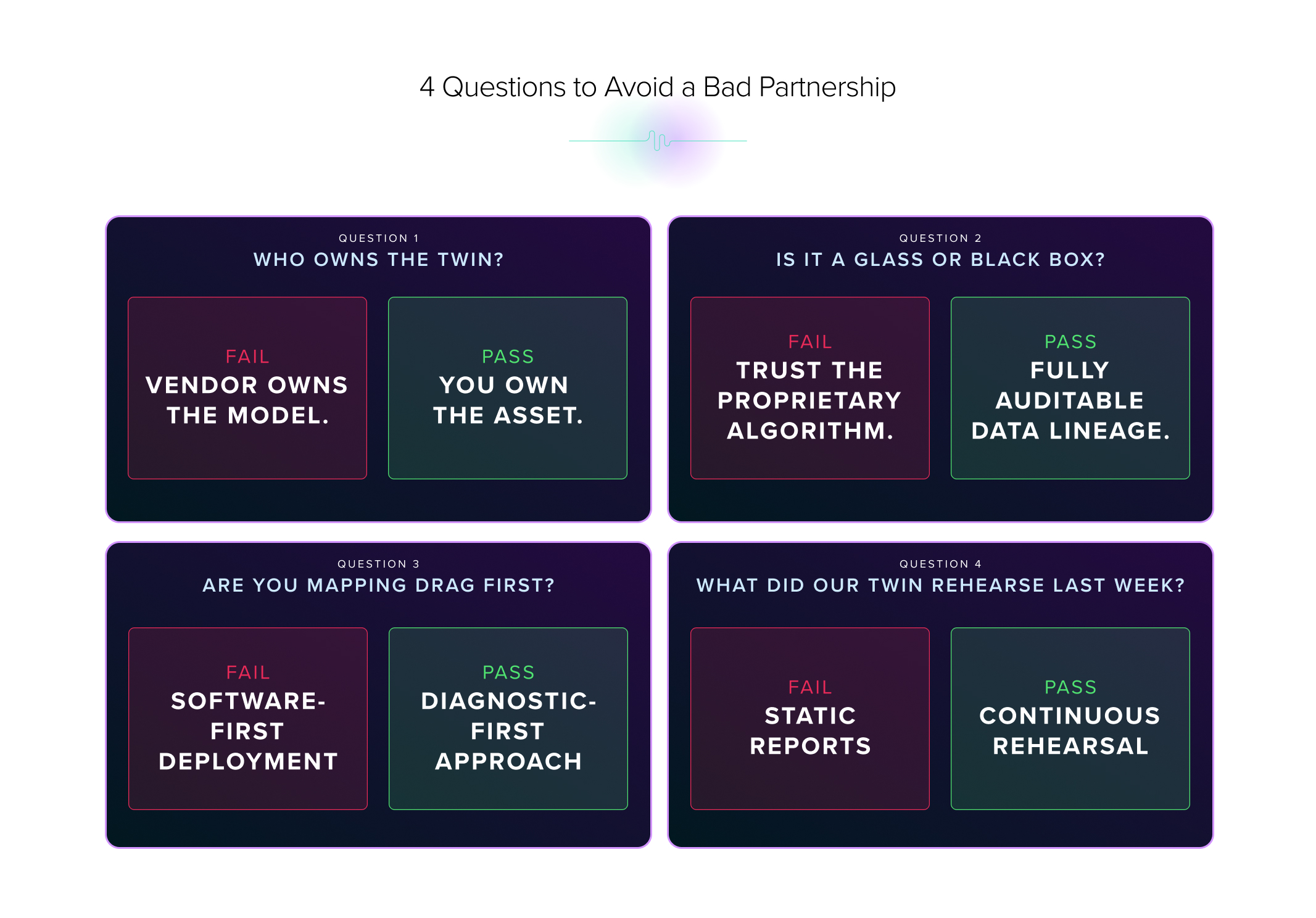
Do not ask a vendor if they use artificial intelligence. Ask them these four specific questions. If they fail to provide absolute, structural guarantees on any of these points, walk away.
1. Who owns the twin when we part ways?
This is the ultimate test of data sovereignty. Most vendors want to ingest your proprietary data into their own hosted, multi-tenant models. If you terminate the contract, you lose access to the intelligence your own operational history generated.
To avoid this, you require absolute ownership. The data spine and predictive models must be built privately inside your own Virtual Private Cloud. If the vendor leaves, the brain stays. If you do not own the asset at the end of the engagement, you are simply renting your own survival.
2. Is this a Glass Box or a Black Box?
This tests governance and compliance. Ask the vendor to show you exactly how a specific algorithmic recommendation is generated. If they point to a proprietary, opaque neural network and tell you to “trust the machine,” the system is a black box. You cannot govern a black box, and you certainly cannot defend its decisions to a regulatory compliance board.
You require a glass box architecture. Every data input, every predictive weight, and every human validation gate must be fully traceable, readable, and auditable by your own executives.
3. Are we mapping Organizational Drag first?
This tests operational discipline. Some vendors will try to sell you an immediate, out-of-the-box software deployment. They will attempt to plug their algorithms directly into your existing, broken workflows.
Automating a flawed workflow merely accelerates the rate at which you destroy enterprise value. A competent partner always insists on a rigorous diagnostic phase first, mapping the friction between your people, processes, and platforms to locate the exact source of your organizational drag. You have to audit the business before you can build the simulation.
4. What did our twin rehearse last week?
This is the ultimate test of utility. Once you build the system, you can’t let it sit as a static monument. A dashboard tells you what happened last quarter. A true digital twin is a dynamic environment that continuously rehearses decisions.
If your internal team or external partner cannot point to a specific, mathematically validated simulation run in the last seven days, such as a rehearsed price increase, a simulated churn intervention, or a modeled media allocation, you do not have a digital twin. You have a very expensive reporting tool.
The 90-Day Blueprint
Once you have secured the right partners and established the architectural boundaries, you need to move with absolute speed. You do not have three years to figure this out. You have ninety days to prove the model.
Phase 1: Audit Both Twins
Start with a diagnostic baseline that measures the exact state of your external reality and internal friction. Externally, you deploy specialized instruments to measure your share of answer across the machine ecosystem and pinpoint exactly where your brand suffers from AI Invisibility Syndrome. Internally, you map your operational friction, auditing the costly silos that separate customer intent from sales execution.
Phase 2: Isolate the Value Leak and Build the Foundation
You select exactly one high-impact value leak identified in the audit. This might be a catastrophic drop in top-of-funnel algorithmic citations, or a high churn rate among a specific customer cohort. Once isolated, you build the foundation specifically to solve that single problem. You stand up a data spine in your sovereign cloud, but only ingest the data streams necessary to solve that specific leak. You execute identity resolution for that exact audience segment and build the synthetic personas required to simulate their behavior, deploying a targeted, minimum viable twin.
Phase 3: Rehearse, Measure, and Expand
You move the isolated problem into the Sandbox and run your first rehearsal. If the problem is external visibility, you simulate the exact Answer Engine Optimization markup required to force the machine to cite you. If the problem is retention, you simulate proactive intervention offers against the synthetic personas to find the most profitable outcome. You validate the machine’s recommendation through your human governance loop, execute it in the live market, and measure the results against the twin’s out-of-sample prediction.
When that single, ninety-day sprint generates a mathematically proven return on investment, the debate is over. You take that proven financial model to the board, secure the mandate to expand the data spine, and begin scaling the simulations across the entire enterprise.
The Final Reckoning
The architectural blueprint is complete. The market’s physics are set, and the technology to bend them in your favor now exists. The decision is yours.
Ignoring this shift is a fatal assumption: that you have time to wait and see how the market evolves.
The market is already rehearsing you. Answer engines are already deciding whether you exist. Competitors who operate with zero organizational drag are already simulating how to steal your market share and erode your margins. The algorithms do not sleep. They don’t hesitate, and they are completely immune to your brand’s legacy equity.
The rehearsal is happening right now, with or without your consent. The only question left is whether you will attend your own rehearsal.
Stop guessing with live capital. Stop learning in production. Stop starving your future buyers to satisfy a quarterly dashboard. It is time to unify your intelligence and build your citation moat.
First, locate your internal friction and measure your external visibility.
Contact us to schedule a discovery session about the outcomes of developing a rehearsal engine. We will map your organizational drag, audit your share of answer across the machine ecosystem, and isolate the exact value leak required to fund your transition into the rehearsal enterprise.
Schedule a Discovery Call